
Experiment Videos and Materials
Experiment Videos
When using these videos or other materials in public settings, please click on “Application for Use of Video Materials” at the bottom of each experiment introduction page. After agreeing to the “Terms of Use” described on the application page, submit your application for use.
-
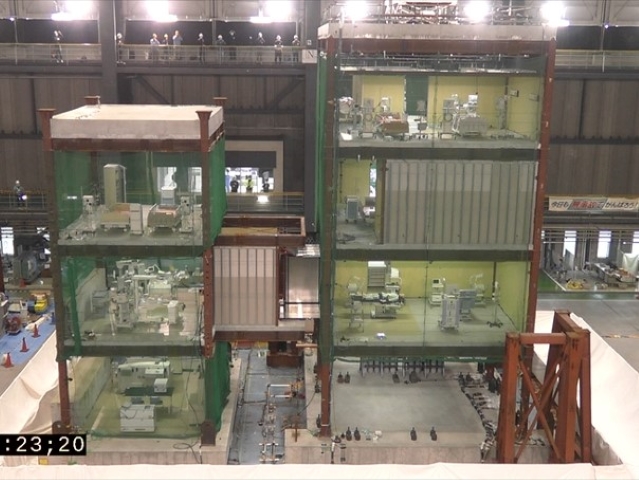
2003 Holistic Seismic Assessment of Critical Buildings with Due Consideration of Non-Structural Component and Equipment
(Dec. 2020) ( Test Number: E202003 )Steel Frame Isolation/Damping Non-structural Equipment Furniture - Input Ground Motion
-
Dec. 8 - JMA Kobe motion (the 1995 Southern Hyogo Prefecture Earthquake), 50% in X- and Y-dir., and 100% in Z-dir.
Overall view: E202003_201208_1.wmv
Operating room at the 3rd floor of earthquake-resistant building: E202003_201208_2.wmv
Dialysis room at the 3rd floor of seismic isolation building: E202003_201208_3.wmv
-
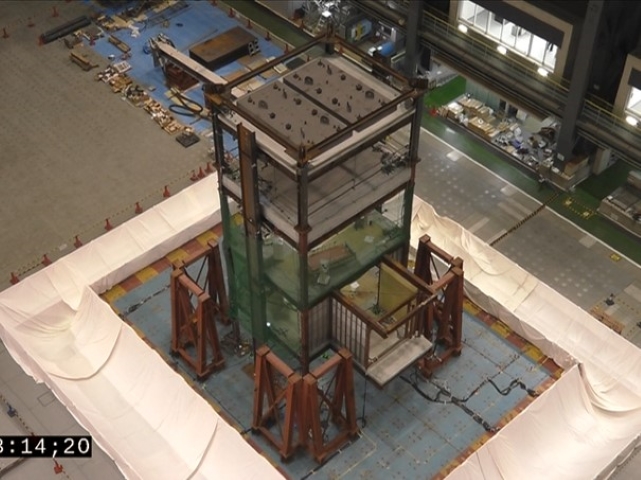
2004 Frame-Spine System with Force-Limiting Connections for Low-Damage Seismic-Resilient Buildings
(Dec. 2020) ( Test Number: E202004 )Steel Frame - Input Ground Motion
-
Dec. 17 - JMA Kobe motion (the 1995 Southern Hyogo Prefecture Earthquake) in Y-dir. 100%
Overall view: E202004_201217_1.mp4
T-shaped tongue damper, a joint at the second floor: E202004_201217_2.mp4
U-shaped dampers, a joint at the fourth floor: E202004_201217_3.mp4
-
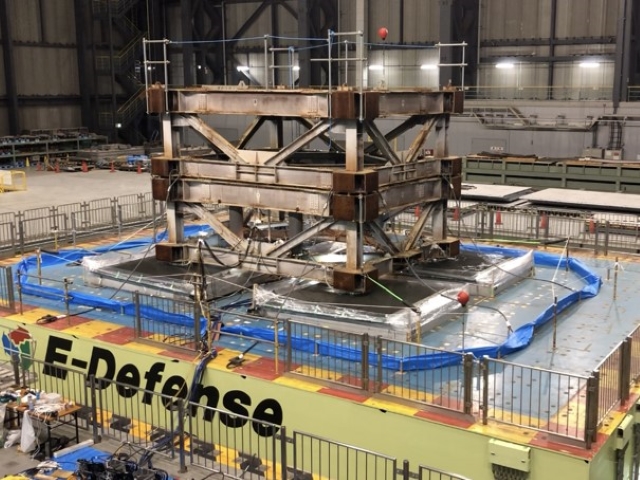
2006 Shake Table Test of Floating Base-isolation Device using 60-ton Test Bed
(Feb. 2021) ( Test Number: E202006 )Isolation/Damping - Input Ground Motion
-
Feb. 24 - JR Takatori motion (the 1995 Southern Hyogo Prefecture Earthquake) 130%: E202006_200224.wmv
-
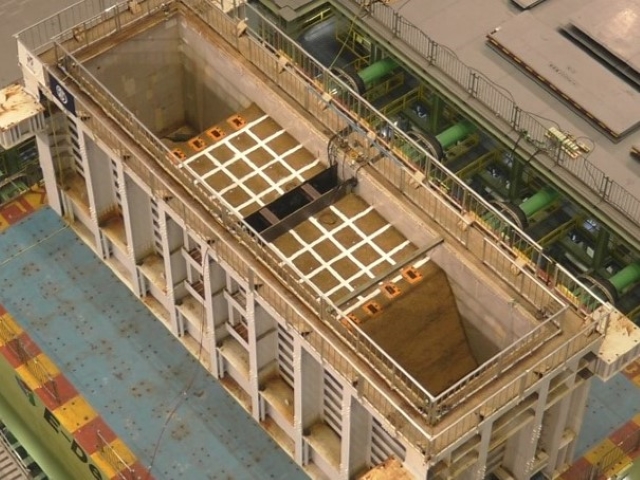
2102 Full-scale Shaking Table Test of Seismic Reinforced Joints for Water Pipelines
(Oct. 2021) ( Test Number: E202102 )Geotech Equipment - Input Ground Motion
-
Oct. 26 - 1 Hz Sinusoidal motion 750 Gal, 20s of duration
Bird view: E202102_211026_1.wmv
Inside of seismic reinforcement pipe using “seismic reinforcement fitting”: E202102_211026_2.wmv
Inside of unreinforced piping: E202102_211026_3.wmv
-
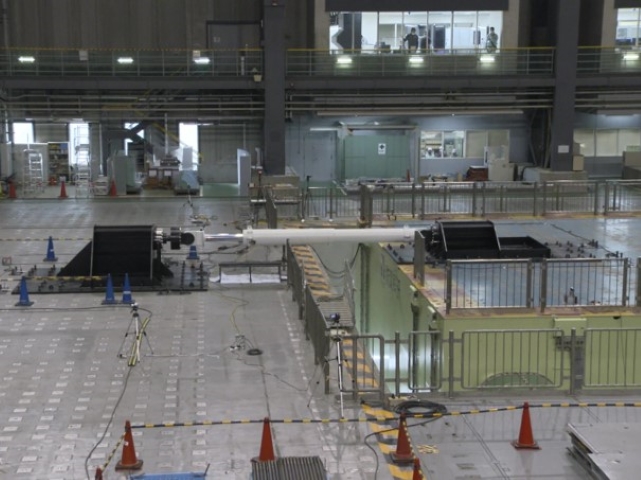
2103 Seismic Damper Performance Test
(Nov. 2021) ( Test Number: E202103 )Isolation/Damping - Input Ground Motion
-
Nov. 17 - Sinusoidal motion, 3 cycles, max. displacement 780 mm: E202103_211117.wmv
-
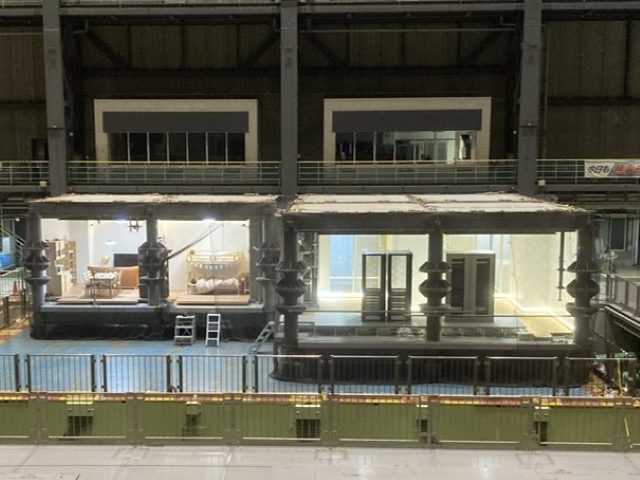
2104 E-Defense Experiment for Earthquake Damage Mitigation and Damage Assessment for Indoor Spaces and Functions
(Dec. 2021 & Jan. 2022) ( Test Number: E202104 )Non-structural Equipment Furniture - Input Ground Motion
-
Jan. 19 - JMA Kobe motion (the 1995 Southern Hyogo Prefecture Earthquake) 75%:
E202104_220119.wmv
-
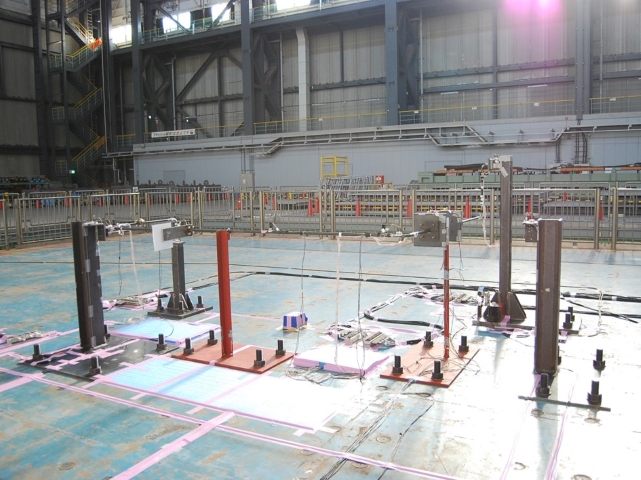
2105 Shake Table Test of Piping System with Damage Sequence Control
(Feb. 2022) ( Test Number: E202105 )Equipment - Input Ground Motion
-
Feb. 25 - K-NET Hobetsu motion (the 2018 Hokkaido Eastern Iburi Earthquake)
Overall view: E202105_220225_1.wmv
Detailed view of a piping support: E202105_220225_2.wmv
-
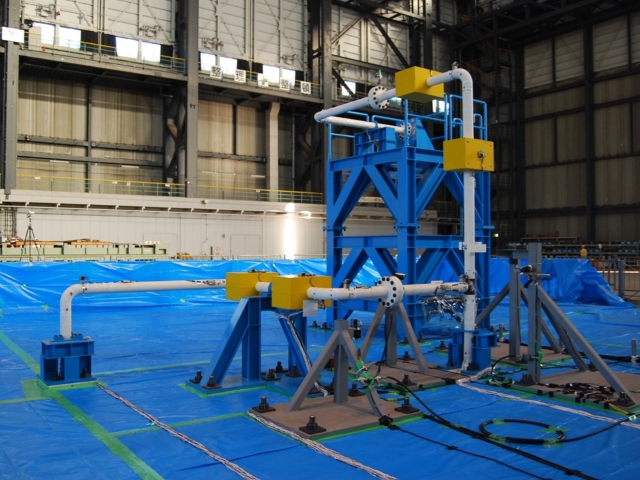
2201 Shaking Table Test of Piping System for Developing High-precision Simulation Model
(Aug. & Sep. 2022) ( Test Number: E202201 )Equipment - Input Ground Motion
-
Sep. 1 - Simulated earthquake motion 500%
Overall view: E202201_220901_1.wmv
Detailed view of a T-joint: E202201_220901_2.wmv
-
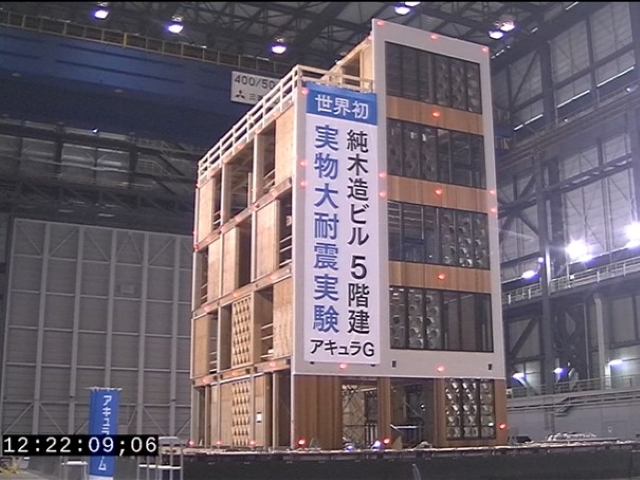
2202 AQ Group: Shaking Table Experiment of Mid- to High-Rise Pure Wood Structures
(Sep. 2022) ( Test Number: E202202 )Timber - Input Ground Motion
-
Sep. 22 - JMA Kobe motion (the 1995 Southern Hyogo Prefecture Earthquake) 100%
Overall view from North-west: E202202_220922_1.mp4
Overall view from South-east: E202202_220922_2.mp4
-
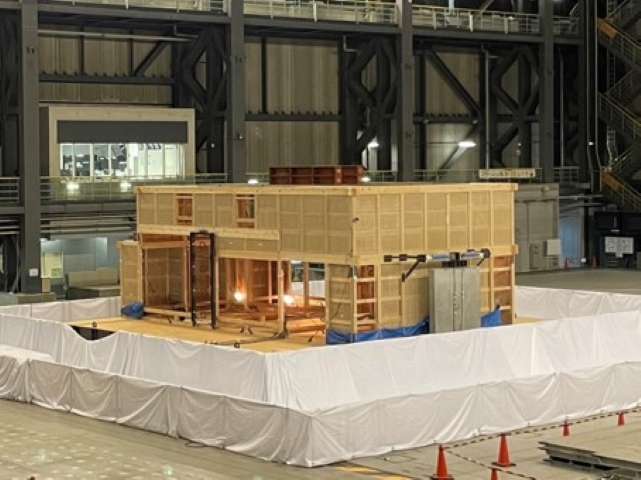
2203 Seismic Performance Evaluation of Traditional Japanese Wooden Houses with Outer-Frame Reinforcement
(Dec. 2022) ( Test Number: E202203 )Timber Isolation/Damping - Input Ground Motion
-
Dec. 14 - Level 2 simulated motion determined by the Building Center of Japan 100%
Bird view from South-west: E202203_221214_1.wmv
Around oil dampers: E202203_221214_2.wmv
-
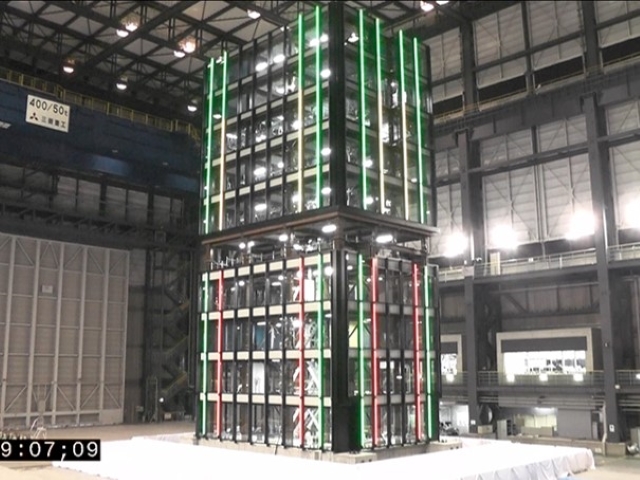
2204 Shake-table Test for Assessing Dynamic Characteristics of Building Structures using a 10-story Steel Office Building
(Feb. 2023) ( Test Number: E202204 )Steel Frame Non-structural Equipment Furniture - Input Ground Motion
-
Feb. 17 - JMA Kobe motion (the 1995 Southern Hyogo Prefecture Earthquake) 100%: E202204_230217.wmv
-
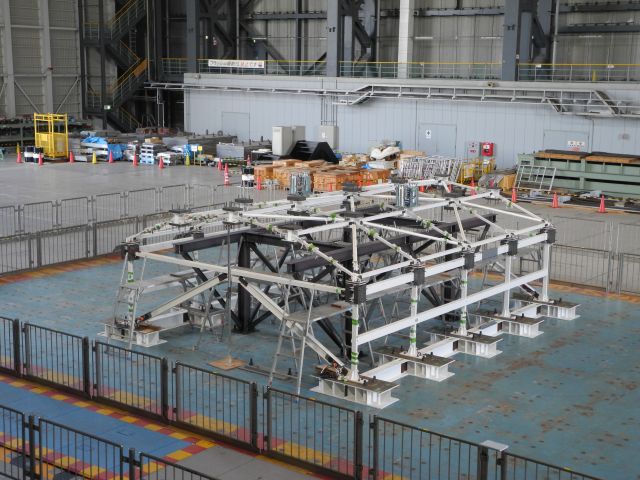
2301 An Experiment on Seismic Response Control of Gymnasium Structures
(July - August. 2022) ( Test Number: E202301 )Steel Frame - Input Ground Motion
-
Aug. 3 - 4.4 Hz Sinusoidal motion, in Y-axis, 1000 Gal: E202301_230803.mp4
-
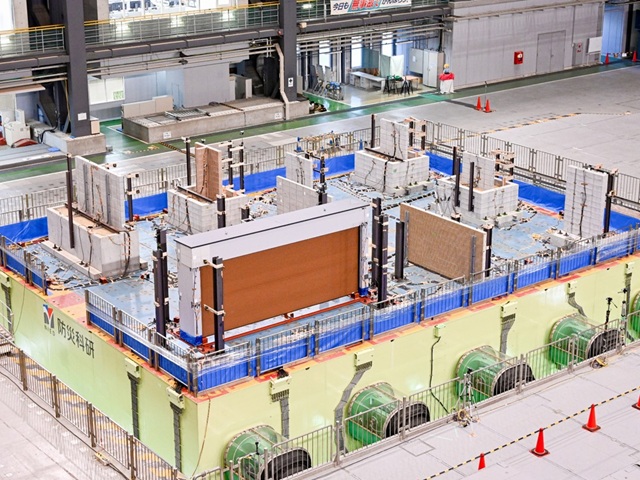
2302 Verification of Seismic Performance of Concrete Block Walls
(Oct. 2023) ( Test Number: E202302 )Others - Input Ground Motion
-
Oct. 16 - Notification wave (El Centro NS-component phase) in Y-axis, E202302_231016.mp4
-
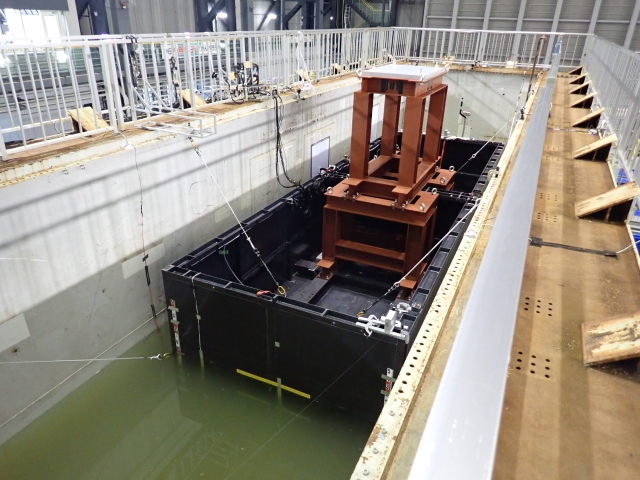
2303 Study on Vibration Stability of a Floating Seismic Isolation Structure for Nuclear Power Plants
(Feb. 2024) ( Test Number: E202303 )Isolation/Damping Equipment - Input Ground Motion
- Feb. 9 - Nakaminato Motion (the 2011 off the Pacific coast of Tohoku Earthquake), large-level: E202303_240209.wmv
2003
Holistic Seismic Assessment of Critical Buildings with Due Consideration of Non-Structural Component and Equipment
(Dec. 2020) (
Test Number: E202003 )
In the “Tokyo Metropolitan Resilience Project ” - a project subsidized by the Ministry of Education, Culture, Sports, Science and Technology - E-Defense is being used to collect and maintain data on the maintenance of building functions, including interior and exterior materials, furniture, fixtures, and piping, and on the seismic margin of buildings until they collapse, with the aim of quickly restoring urban functions in the event of a major earthquake, identifying damage, and carrying out repairs.
In this research project, with the aim of developing a system to support safe and efficient decision-making by hospital administrators in the aftermath of a disaster, a large-scale shaking table experiment was conducted on hospital buildings equipped with high-performance facilities. The experiment was designed to propose a method for quantitatively assessing the degree of functional loss immediately after an earthquake in regional core hospitals and other facilities expected to maintain continuous operations during disasters, thereby avoiding unnecessary confusion. Two test structures, a four-story earthquake-resistant building and a three-story earthquake-isolated building, are connected by a bridge corridor. Medical equipment was installed inside the test structures to reproduce the conditions of an actual medical facility. Based on the results of the experiment, this study proposes a quantitative evaluation method for determining the building collapse margin, identifying factors that cause a decline in hospital functions, evaluating the performance of individual high-performance facilities, and assessing the loss of facility functions.
Detailed information and acquired data and images from this experiment are available in E-Defense Data Archive, ASEBI.
DOI: https://doi.org/10.17598/NIED.0020-E202003
Application for Use of Video Materials
×
2004
Frame-Spine System with Force-Limiting Connections for Low-Damage Seismic-Resilient Buildings
(Dec. 2020) (
Test Number: E202004 )
Conventional ductile steel frame systems have significant potential for lateral story drift concentration and single-story mechanisms, with associated damage to drift-sensitive non-structural systems, and potential for collapse. A stiff / strong spine combined with a conventional ductile frame helps eliminate story drift concentration, but spine-like systems develop large seismic forces and accelerations from higher mode response. Recent work shows that significantly reduced seismic forces and floor accelerations can be achieved using deformable force-limiting connections (FLCs) to isolate the floors of a building from a stiff lateral-force-resisting system. To verify this, as part of a collaborative research project with the Disaster Prevention Research Institute at Kyoto University and the University of Illinois at Urbana-Champaign, E-Defense shake table tests were conducted on a full-scale 4-story steel frame building connected to a spine with U-shaped and T-shaped tongue dampers. The lower three stories of the 4-story steel frame building were reused from the seismic isolation building used in the previous tests (E202003). Shake table tests show that elastic spines added to a deficient MRF can enforce a more uniform drift profile, and that increased floor accelerations arising from addition of the elastic spines can be reduced by employing FLC.
Detailed information and acquired data and images from this experiment are available in E-Defense Data Archive, ASEBI.
DOI: https://doi.org/10.17598/NIED.0020-E202004
Application for Use of Video Materials
×
2006
Shake Table Test of Floating Base-isolation Device using 60-ton Test Bed
(Feb. 2021) (
Test Number: E202006 )
In response to the national innovation mission, NIED is exploring the development of high-performance seismic isolation devices to realize "earthquake-free spaces." In this experimental study, based on the prototype developed in the 2020 research project (E201902), a test bed owned by NIED (steel frame structure prototype: 7.0 × 5.5 × H 4.7 m, 60 tons) was horizontally isolated using a water-levitation method, simulating a small two-story building. However, the hydraulic parallel-link vertical seismic isolation device, which was intended to be used in combination with the system, was removed from the experiment due to damage caused by operator error during a trial run. Shaking tests were conducted using seismic waveforms such as the 1995 Southern Hyogo Prefecture Earthquake (JR Takatori record). As a result, the system successfully reduced horizontal accelerations to less than one-tenth of their original values during strong ground motions, achieving the target performance. Please look at the impressive images from the experiment. The measurement data and images obtained from this experiment are available.
Detailed information and acquired data and images from this experiment are available in E-Defense Data Archive, ASEBI.
DOI: https://doi.org/10.17598/NIED.0020-E202006
Application for Use of Video Materials
×
2102
Full-scale Shaking Table Test of Seismic Reinforced Joints for Water Pipelines
(Oct. 2021) (
Test Number: E202102 )
In recent earthquakes, water supply disruptions have occurred every time due to the damage to water supply pipes, which are essential for life. One of the main reasons for these disruptions is the detachment of pipe joints. While seismic reinforcement of existing pipelines is being advanced to mitigate damage, many ductile cast-iron pipes with insufficient seismic resistance remain. Therefore, in collaboration with Kanazawa University and Taisei Kiko Co., Ltd., a large-scale shaking table experiment was conducted. A test specimen was constructed by embedding “seismically reinforced piping” and “unreinforced piping” into a large steel soil container with internal dimensions of 4 m in depth, 16 m in width, and 4.5 m in height. The seismically reinforced piping incorporated seismic reinforcement products such as fittings to prevent joint disengagement, while the unreinforced piping was left as-is. By applying excitation using E-Defense to collapse the ground, the behavior of the pipes and joints under conditions of significant ground deformations was investigated. A sinusoidal input motion with a maximum of 750 Gal, 1 Hz, and a duration of approximately 20 seconds was used. The experiment concluded that when the ground collapsed and significant ground displacement acted on the embedded pipes, the unreinforced joints completely pulled out, while the seismic reinforcement joints maintained their functionality.
Detailed information and acquired data and images from this experiment are available in E-Defense Data Archive, ASEBI.
DOI: https://doi.org/10.17598/NIED.0020-E202102
Application for Use of Video Materials
×
2103
Seismic Damper Performance Test
(Nov. 2021) (
Test Number: E202103 )
In recent years, as structures that are the subject of seismic reinforcement become larger, seismic control devices are also required to be able to follow larger responses. Seismic reinforcement work is currently being carried out on the Tatara Bridge, located on the Setouchi Shimanami Kaido, and seismic control dampers, the largest ever used in Japan, are planned to be installed as seismic control devices. Until now, performance confirmation of similar large dampers has been carried out using reduced-scale test specimens and simplified model tests, but there are limitations to accurately estimating full-scale performance.
Therefore, this experiment aims to verify the actual behavior of seismic control dampers during earthquakes by using E-Defense, Japan's largest shaking table. Measurement data and images obtained from this experiment are available to the public.
Detailed information and acquired data and images from this experiment are available in E-Defense Data Archive, ASEBI.
DOI: https://doi.org/10.17598/NIED.0020-E202103
Application for Use of Video Materials
×
2104
E-Defense Experiment for Earthquake Damage Mitigation and Damage Assessment for Indoor Spaces and Functions
(Dec. 2021 & Jan. 2022) (
Test Number: E202104 )
This research aims to collect data on seismic damage to nonstructural members, indoor facilities, furniture, fixtures, etc., and to propose guidelines for damage verification methods, damage prevention methods, and seismic damage sensing methods. Specifically, a large shaking table test specimen that can reproduce damage caused by earthquake motion to various nonstructural members, indoor facilities, furniture, fixtures, etc. (a test unit that can be used repeatedly by replacing nonstructural members, indoor facilities, furniture, fixtures, etc. installed inside it for each test while the main structural members remain undamaged) was prepared and tested for various types of earthquake motion. The data on damage to each nonstructural member under various earthquake ground motions would be collected. Furthermore, these data sets have been developed and examined with the aim of constructing a damage monitoring method.
In order to achieve the objectives of this research, large-scale shaking table experiments were conducted to evaluate damage to indoor spaces under various seismic motions and to obtain data related to post-earthquake business continuity and so on.
Detailed information and acquired data and images from this experiment are available in E-Defense Data Archive, ASEBI.
DOI: https://doi.org/10.17598/NIED.0020-E202104
Application for Use of Video Materials
×
2105
Shake Table Test of Piping System with Damage Sequence Control
(Feb. 2022) (
Test Number: E202105 )
As part of the Ministry of Education, Culture, Sports, Science and Technology (MEXT) public offering “Development of Technology to Mitigate Damage Expansion and Improve Nuclear Reactor Structural Resilience,” specifically the “Technology to Control Damage Sequences under Severe Earthquakes,” an E-Defense experiment was conducted to clarify the elastic-plastic response behavior of a piping system test specimen composed of small-diameter piping and supporting structures under seismic loads, and to investigate damage sequence control technology. The test specimen consists of a 15A pipe, two pipe support structures supporting the pipe, and two pipe fixed brackets. The input seismic motions were sinusoidal motion and observed seismic motions with a dominant frequency near the first natural frequency of the test specimen, the 2018 Hokkaido Eastern Iburi Earthquake, and excerpts from the 15- to 55-second records of the K-NET Hobetsu NS-component. Through shaking tests, the support structures were plastically deformed, and detailed data were obtained up to crack initiation through subsequent shaking.
Detailed information and acquired data and images from this experiment are available in E-Defense Data Archive, ASEBI.
DOI: https://doi.org/10.17598/NIED.0020-E202105
Application for Use of Video Materials
×
2201
Shaking Table Test of Piping System for Developing High-precision Simulation Model
(Aug. & Sep. 2022) (
Test Number: E202201 )
In the seismic design of nuclear power plants, following the accident at the Fukushima Daiichi Nuclear Power Plant during the 2011 Off-the-Coast of Tohoku Earthquake, considerations for conditions exceeding design assumptions have become necessary. Therefore, in the seismic design and seismic performance evaluation of next-generation nuclear power systems, modeling capable of appropriately evaluating non-elastic behavior, including ultimate behavior, is indispensable. Based on the above, a verification experiment using E-Defense was conducted to acquire data essential for verifying a high-precision simulation model capable of reproducing non-elastic behavior, including ultimate strength evaluation, targeting piping systems, which are one of the critical structures in nuclear facilities. A test specimen with a slightly complex three-dimensional shape, including five elbows, one T-joint, and a riser section, was fabricated. To amplify the response during shaking tests and adjust the test specimen's natural frequency, 400 kg weights were installed at each location. As input motions, simulated earthquake motions (narrow-band random waves with a frequency range of 1.5 Hz to 5.5 Hz, designed to excite the first and second modes of the test specimen while maintaining the phase of actual earthquake motions) and sine motions (single-axis in the Y direction) were used. By inputting simulated earthquake motions ranging from 25% to 500%, data was acquired from the elastic range to the ultimate behavior of the piping system. As a result, detailed data such as damage data of the T-joint and ratchet deformation in the straight pipe directly above the T-joint were obtained.
Detailed information and acquired data and images from this experiment are available in E-Defense Data Archive, ASEBI.
DOI: https://doi.org/10.17598/NIED.0020-E202201
Application for Use of Video Materials
×
2202
AQ Group: Shaking Table Experiment of Mid- to High-Rise Pure Wood Structures
(Sep. 2022) (
Test Number: E202202 )
【Facility Rental Experiment Conducted by AQ Group Co., Ltd.】
A three-dimensional shaking table test was conducted on a five-story timber-frame building designed and constructed by AQ Group Co., Ltd. to verify the seismic performance and safety of a five-story timber-frame building as a standard model, with the aim of accelerating the adoption of mid-to-high-rise timber-frame construction. The test specimen is a 5-story timber-frame building constructed using timber-frame construction methods. It serves as a prototype aimed at establishing a medium-sized timber-frame building that can be designed and constructed using commonly available timber and metal materials, pre-cut technology, existing certified construction methods, and allowable stress calculations. The test specimen has a total floor area of 439.5 m2, with a plan layout of 8.19 m × 12.285 m from the first to fourth floors, and 5.005 m × 12.285 m on the fifth floor. with a height of 16.404 m. The building is intended for commercial use on the first floor, office space on the second floor, rental housing on the third floor, and owner-occupied housing on the fourth and fifth floors. Detailed response data of the test specimen has been obtained by inputting seismic waves observed in the 1995 Southern Hyogo Prefecture Earthquake and the Niigata-Chuetsu earthquake.
Detailed information and acquired data and images from this experiment are available in E-Defense Data Archive, ASEBI.
DOI: https://doi.org/10.17598/NIED.0020-E202202
Application for Use of Video Materials
×
2203
Seismic Performance Evaluation of Traditional Japanese Wooden Houses with Outer-Frame Reinforcement
(Dec. 2022) (
Test Number: E202203 )
This research project was carried out as a joint research project between the National Research Institute for Earth Science and Disaster Resilience (NIED) and Hyogo Prefecture, and as a cooperative joint research project between Hyogo Prefecture and Kobe University. In this experiment, a three-dimensional shaking table test was conducted using a full-scale wooden frame specimen, considering a two-story old wooden house. The data obtained from the experiment will be used to verify the effectiveness of the seismic reinforcement method applied to the seismic retrofit of old houses, as well as to verify the behavior of the actual outer-frame method during a large earthquake. The measurement data and images obtained in this experiment are available.
Detailed information and acquired data and images from this experiment are available in E-Defense Data Archive, ASEBI.
DOI: https://doi.org/10.17598/NIED.0020-E202203
Application for Use of Video Materials
×
2204
Shake-table Test for Assessing Dynamic Characteristics of Building Structures using a 10-story Steel Office Building
(Feb. 2023) (
Test Number: E202204 )
To save lives and keep society and the economy going in the event of a big earthquake like the one expected in the Nankai Trough in the near future, it is essential to get ready now and have a plan for after the earthquake so decisions can be made quickly. The National Research Institute for Earth Science and Disaster Resilience is developing a “dynamic characteristic evaluation method” that assesses the dynamic characteristics of buildings, such as their shaking period and ease of settling, based on their shaking patterns. To this end, a joint research project with a private company is underway to develop exterior materials (LED light alert system) that incorporate sensors to measure building shaking and LED lights that instantly display the measurement and evaluation results. Here, shake table tests were conducted to verify and validate the dynamic characteristic evaluation method and LED light alert system. The test specimen was a full-scale 10-story office building with a floor area of 12.0 m × 8.0 m, 10 stories, a height of 26.9 m, and a weight of approximately 700 tons. In the experiments, the test specimen was subjected to repeated small earthquakes with seismic intensities of 2 to 4 and large earthquakes with seismic intensities exceeding 5 to capture changes in dynamic characteristics. An LED light alert system was also installed on the test specimen to demonstrate the immediate light emission display of deformations. The results of the experiments demonstrated that the developed dynamic characteristic evaluation method could capture changes in dynamic characteristics, and that the LED light alert system could accurately measure building deformation and display it in real time using LED lights. Additionally, through a framework for joint research and the provision of surplus space, various interior materials, furniture, fixtures, and equipment were installed inside the building, enabling the acquisition of valuable data on the shaking, movement, and damage caused by earthquakes.
Detailed information and acquired data and images from this experiment are available in E-Defense Data Archive, ASEBI.
DOI: https://doi.org/10.17598/NIED.0020-E202204
Application for Use of Video Materials
×
2301
An Experiment on Seismic Response Control of Gymnasium Structures
(July - August. 2022) (
Test Number: E202301 )
In Japan, gymnasia are often used as evacuation shelters, when disasters occur. In this research, a shake table test of a scaled gymnasium was conducted to study elastic and elastoplastic seismic responses and ensure the effectiveness of seismic countermeasures such as dampers.
The test specimen is 1/4 scaled gymnasium with arched roof. The span width, length and height are 6m, 8m and 3.2m, respectively. With considering a similarity rule, the structural members were designed and the roof weight was adjusted. Friction dampers and tuned mass dampers were installed in the span directional framing and on the roof, respectively.
Three days of testing has been conducted. In the first day, the elastic seismic responses, the dominant vibration mode and roof response accelerations were studied. In the second day, the friction and tuned mass dampers were activated and it was demonstrated how much these dampers can reduce the roof seismic responses. In the third day, the collapse test was conducted and the collapse mechanism and ultimate behavior were investigated.
Detailed information and acquired data and images from this experiment are available in E-Defense Data Archive, ASEBI.
DOI: https://doi.org/10.17598/NIED.0020-E202301
Application for Use of Video Materials
×
2302
Verification of Seismic Performance of Concrete Block Walls
(Oct. 2023) (
Test Number: E202302 )
The Japanese Building Standards Law and the Architectural Institute of Japan (AIJ) currently specify standards for the height and structure of concrete block walls. However, the construction of certain concrete block walls was undertaken without adherence to these established standards, while others have experienced deterioration over time. Garage gates composed of concrete blocks are susceptible to overturning and necessitate enhancements in seismic performance. Concrete block walls have been the subject of numerous studies, which have verified their structural performance through static and dynamic loading tests. However, there is still a lack of knowledge regarding seismic reinforcement methods and the influence of foundation embedment on dynamic response. In consideration of these factors, the E-Defense experiment sought to elucidate the dynamic response characteristics and seismic performance of concrete block walls and steel garage gates equipped with shutters. The objective of the experiment was twofold: first, to substantiate the validity of prevailing design standards, and second, to acquire knowledge that could contribute to the establishment of new standards for concrete block walls and the development of seismic reinforcement methods for walls with inadequate seismic performance.
The test specimens utilized in the E-Defense experiment are listed below:
(1) Seismic reinforcement steel frames for concrete block walls embedded in the ground;
(2) A new construction method for concrete block walls;
(3) Concrete block walls with a retaining wall embedded in the ground designed according to AIJ guidelines;
(4) A noncompliant reinforced concrete block wall;
(5) A steel garage gate with a shutter;
(6) Large void reinforced masonry walls with an L-shaped foundation;
(7) A concrete block wall with an L-shaped foundation;
(8) A concrete block wall with an I-shaped foundation embedded in the ground;
(9) A concrete block wall with an L-shaped foundation embedded in the ground.
The objectives were achieved by verifying the seismic performance and other characteristics of the specimens through vibration testing.
Detailed information and acquired data and images from this experiment are available in E-Defense Data Archive, ASEBI.
DOI: https://doi.org/10.17598/NIED.0020-E202302
Application for Use of Video Materials
×
2303
Study on Vibration Stability of a Floating Seismic Isolation Structure for Nuclear Power Plants
(Feb. 2024) (
Test Number: E202303 )
This study is a joint research between the Japan Atomic Energy Agency (JAEA) and the National Research Institute for Earth Science and Disaster Resilience (NIED).
The purpose of this research is to conduct a series of vibrational shaking tests to evaluate the seismic isolation performance of a floating seismically isolated structure using a floating body equipped with a floating seismic isolation mechanism in a pool.
The results of the tests demonstrated the seismic isolation effect of the floating seismic isolation structure with air cavity and orifice.
Detailed information and acquired data and images from this experiment are available in E-Defense Data Archive, ASEBI.
DOI: https://doi.org/10.17598/NIED.0020-E202303
Application for Use of Video Materials
×