
Experiment Videos and Materials
Experiment Videos
When using these videos or other materials in public settings, please click on “Application for Use of Video Materials” at the bottom of each experiment introduction page. After agreeing to the “Terms of Use” described on the application page, submit your application for use.
-
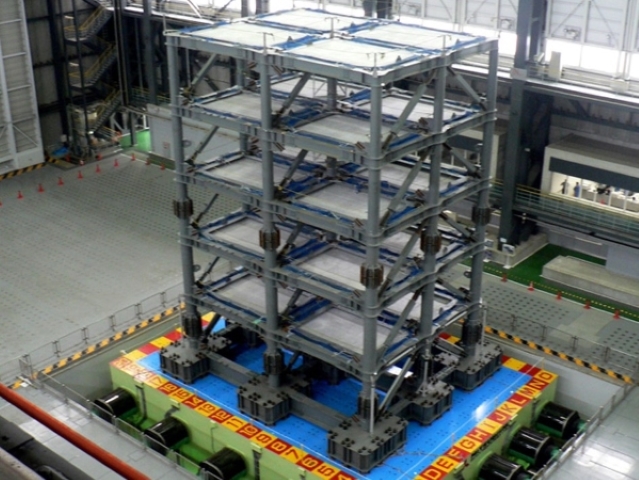
0501 Response Verification Test of E-Defense Shaking Table using Test Bed Structure
(Jul. 2005) ( Test Number: E200501 )Steel Frame - Input Ground Motion
-
Jul. 8 - JMA Kobe Motion (the 1995 Southern Hyogo Prefecture Earthquake) 90% : E200501_050708_1.mpeg
Jul. 8 - JR Takatori Motion (the 1995 Southern Hyogo Prefecture Earthquake) 90% : E200501_050708_2.mpeg
-
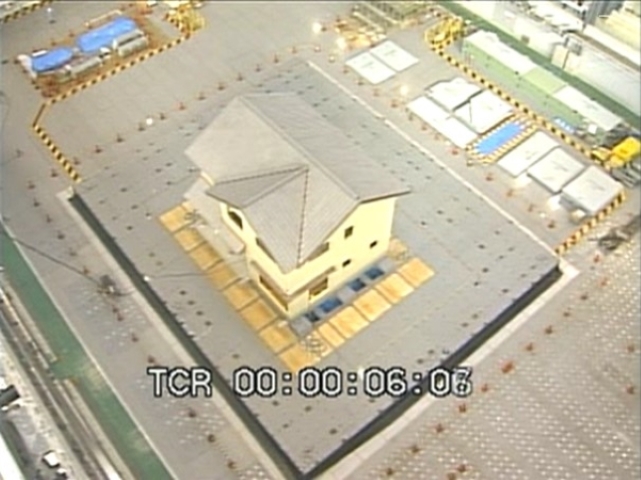
0503 E-Defense Experiment on Wooden House, Restore from Earthquake Disaster and Seismic Isolation
(Oct. 2025) ( Test Number: E200503 )Timber Isolation/Damping - Input Ground Motion
-
Test date: October 20 and 21, 2005.
Oct. 20 - JR Takatori motion (the 1995 Southern Hyogo Prefecture Earthquake) YZ-2 directional input 100% : E200503_051020.mpg
Oct. 20 – The 3rd input of JR Takatori motion 3-directional input 100% : E200503_051021.mpg
-
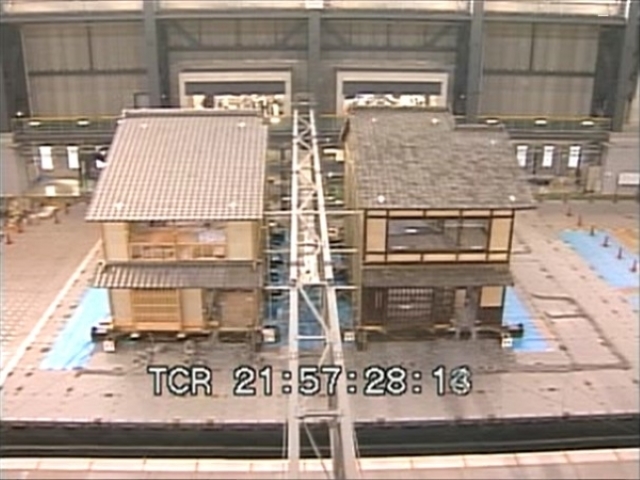
0504 E-Defense Experiment on Reconstruction and New Construction of Traditional Wooden House, Machiya in Kyoto
(Nov. 2005) ( Test Number: E200504 )Timber - Input Ground Motion
-
Nov. 10 - Building Center of Japan Level 2 Seismic Wave (BCJ-L2), unilateral excitation with peak acceleration of 400 gal: E200504_051110_1.wmv
Nov. 11 - JMA Kobe motion (the 1995 Southern Hyogo Prefecture Earthquake) 100%: E200504_051110_2.wmv
-
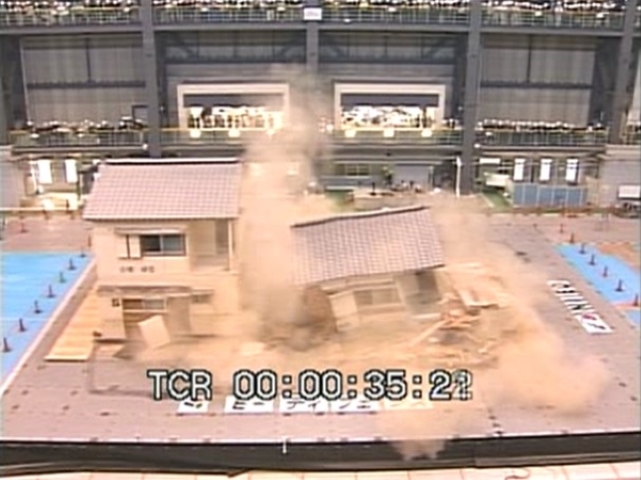
0505 E-Defense Experiments on Existing Non-compliant Wooden Houses with and without Reinforcement
(Nov. 2005) ( Test Number: E200505 )Timber - Input Ground Motion
-
Nov. 21 - JR Takatori motion (the 1995 Southern Hyogo Prefecture Earthquake) 100%
E200505_051121.wmv
Nov. 24 - JR Takatori motion 100%:
E200505_051124.wmv
Remind: The seismic performance scores by the precise seismic diagnosis in the experiment outline are modified after the experiment.:E200505_2.pdf
- Summary
- E200505_(説明あり)在来木造住宅震動台実験.mp4
-
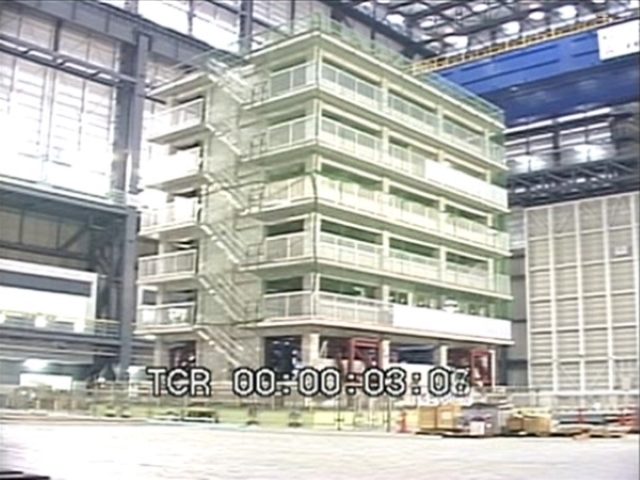
0506 Three-dimensional Seismic Structural Failure Experiment of Full-scale Reinforced Concrete Buildings
(Jan. 2006) ( Test Number: E200506 )Reinforced Concrete - Input Ground Motion
-
Jan. 13 - JMA Kobe motion (the 1995 Southern Hyogo Prefecture Earthquake) 100%
E200506_060113.wmv
Jan. 16 - JMA Kobe motion 60%
E200506_060116.wmv
-
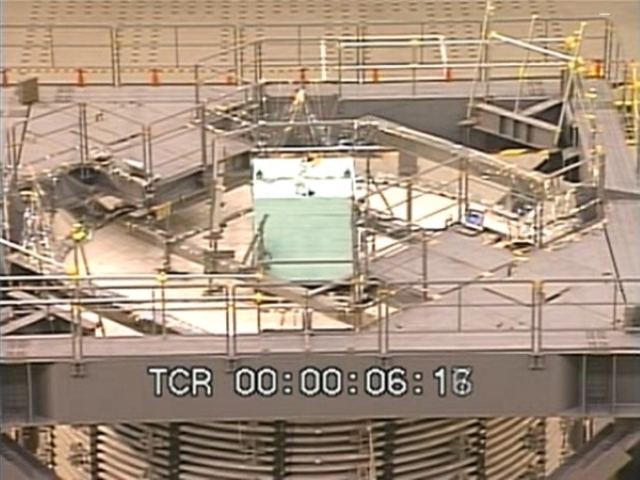
0507 Experiment of Pile Foundation in Non-liquefied Horizontal Ground
(Feb. 2006) ( Test Number: E200507 )Geotech - Input Ground Motion
-
Feb. 24 - JR Takatori motion (the 1995 Southern Hyogo Prefecture Earthquake) 80%
E200507_060224.wmv
-
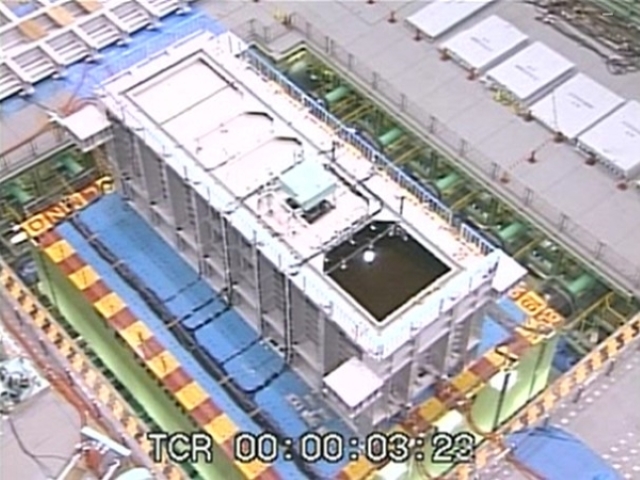
0508 Experiment of Sheet Pile Seawall and Pile Foundation behind the Wall in Liquefaction-induced Lateral Spreading
(Mar. 2006) ( Test Number: E200508 )Geotech - Input Ground Motion
-
Mar. 23 - JR Takatori motion (the 1995 Southern Hyogo Prefecture Earthquake), horizontal 1 direction and vertical direction 80%
E200508_060323.wmv -
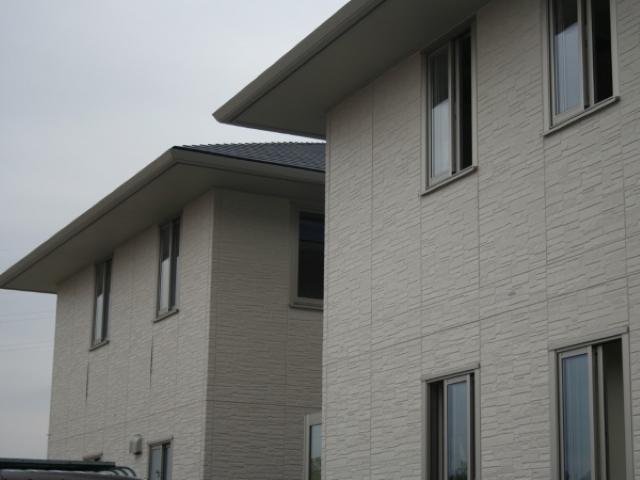
0601 Verification Experiment of Seismic Performance and Damping Effect of 2-story Steel Frame House
(Jun. 2006) ( Test Number: E200601 )Steel Frame Isolation/Damping Furniture - Input Ground Motion
-
Jun. 29 - K-NET Ojiya motion (the Mid Niigata prefecture Earthquake in 2004) 70%
Overall view: E200601_060629_1.mpeg
Living room at the 1st floor of seismic control housing: E200601_060629_2.mpeg
Kids room at the 2nd floor of earthquake-resistant housing: E200601_060629_3.mpeg
-
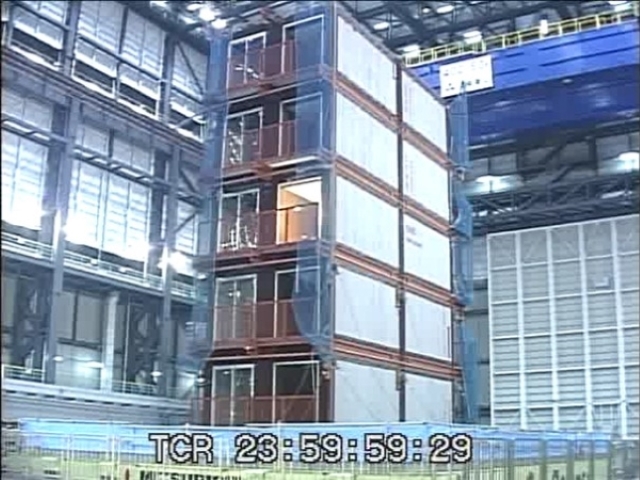
0602 Soleil Project: Seismic Experiment for Unit Houses
(Jul. 2006) ( Test Number: E200602 )Others - Input Ground Motion
-
Jul. 20 - JR Takatori motion (the 1995 Southern Hyogo Prefecture Earthquake) 75 kine
E200602_060720.mpeg
-
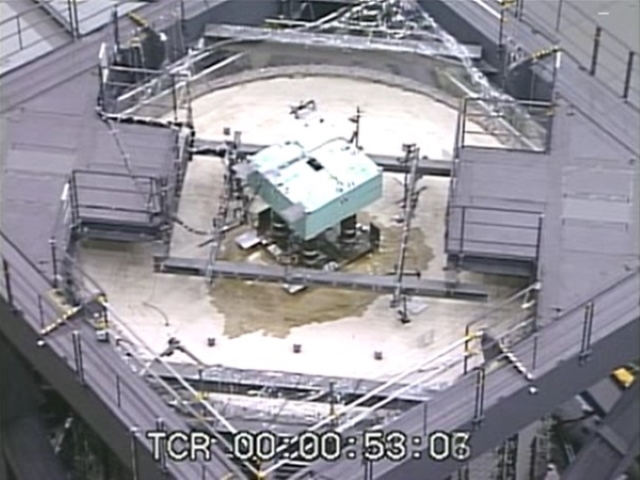
0603 Experiment of Pile Foundation on Liquefied Horizontal Ground
(Aug. 2006) ( Test Number: E200603 )Geotech - Input Ground Motion
-
Aug. 25 - JR Takatori motion (the 1995 Southern Hyogo Prefecture Earthquake), horizontal 2 directions 50%
E200603_060825.wmv
-
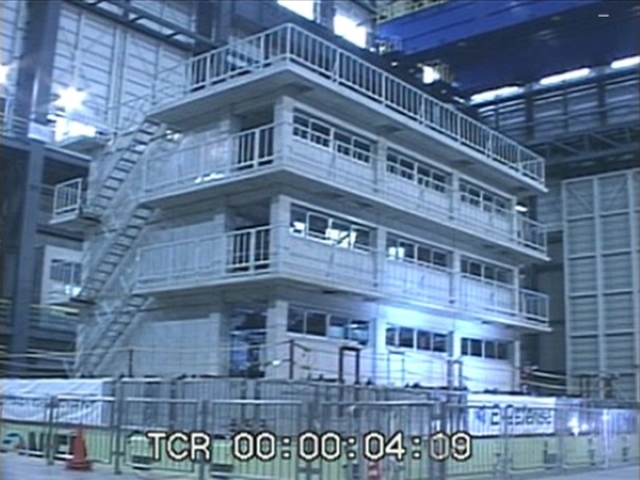
0604 Experiment of 3-stories RC Building imitating School Structure
(Sep. - Oct. 2006) ( Test Number: E200604 )Reinforced Concrete Furniture - Input Ground Motion
-
Oct. 2, Unreinforced specimen - JMA Kobe motion (the 1995 Southern Hyogo Prefecture Earthquake) 100%
E200604_061002.wmv
Nov. 1, Retrofit specimen - JMA Kobe motion 130%
E200604_061101.wmv
-
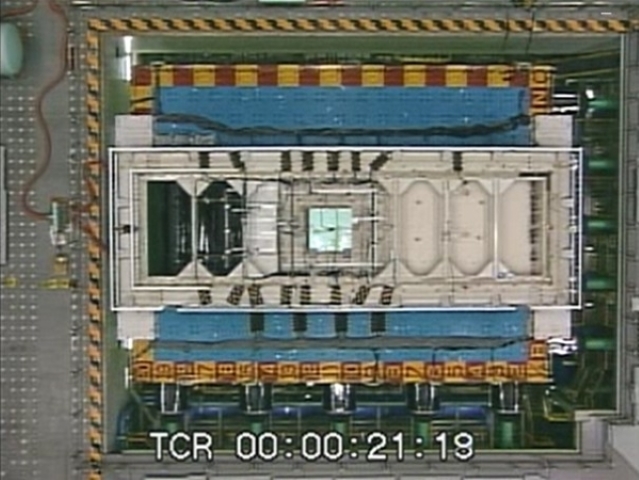
0605 Experiment of Caisson Seawall and Pile Foundation behind the Wall in Liquefaction-induced Lateral Spreading
(Dec. 2006) ( Test Number: E200605 )Geotech - Input Ground Motion
-
Dec. 15 - JR Takatori motion (the 1995 Southern Hyogo Prefecture Earthquake), horizontal 1 direction and vertical direction 80%
E200605_061215.wmv
-
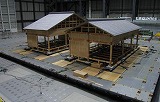
0606 Experiment of Traditional Wooden Framework House
(Feb. 2007) ( Test Number: E200606 )Timber - Input Ground Motion
-
Feb. 2 - JMA Kobe motion (the 1995 Southern Hyogo Prefecture Earthquake) 100%
E200606_070202.wmv
-
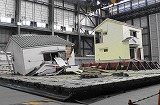
0607 Shaking Table Test of Full-Scale Conventional Wooden Frame House
(Feb. 2007) ( Test Number: E200607 )Timber - Input Ground Motion
-
Feb. 28 - 1st JR Takatori motion (the 1995 Southern Hyogo Prefecture Earthquake) 100%
E200607_070228_1.wmv
Feb. 28 - 2nd JR Takatori motion 100%:
E200607_070228_2.wmv
Mar. 5 - 4th JR Takatori motion 100%:
E200607_070305.wmv
-
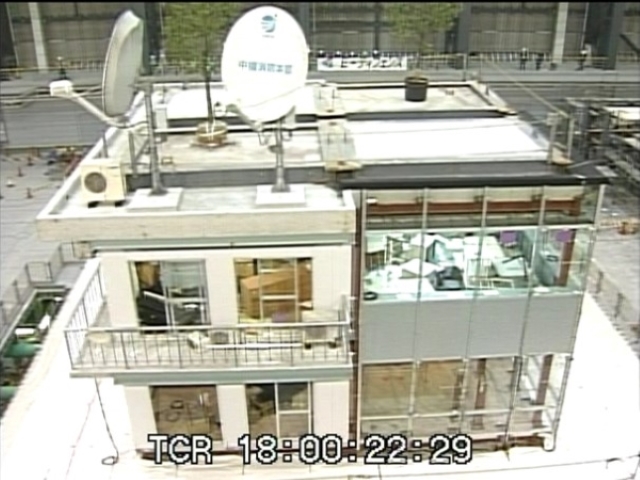
0608 Examination of Destruction of Non-structural Members and Fall of Utensils by Long-period Earthquake Ground Motion in High-rise Building
(Mar. 2007) ( Test Number: E200608 )Non-structural Furniture - Input Ground Motion
-
Mar. 29 - Expected ground motion from a scenario Nankai earthquake (continued period: 180 seconds)
E200608_070329.wmv
-
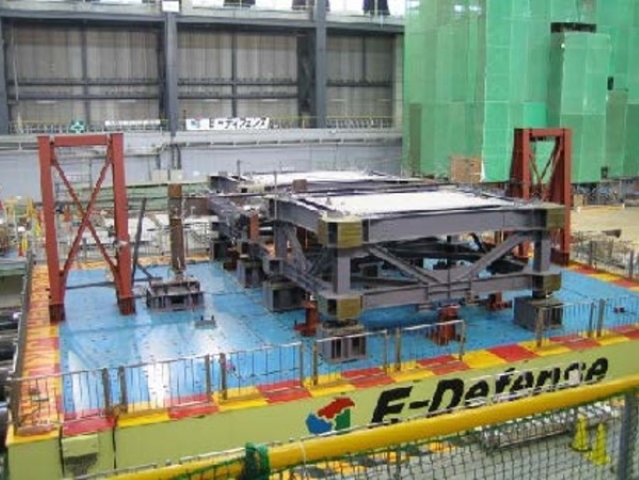
0701 Preliminary Experiment for Plane Frame Specimen with Testbed Loading Device
(Jul. 2007) ( Test Number: E200701 )Steel Frame - Input Ground Motion
-
Jul. 30 - JMA Kobe motion (the 1995 Southern Hyogo Prefecture Earthquake) Y-axis 100%
Overall view: E200701_070730_1.mpeg
Beam-column joint of plane frame specimen: E200701_070730_2.mpeg
-
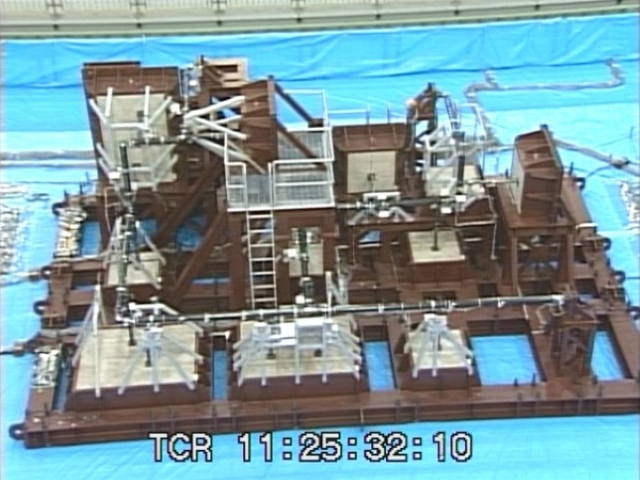
0702 Shaking Table Test of Small-diameter Piping-support System
(Aug. 2007) ( Test Number: E200702 )Equipment - Input Ground Motion
-
Aug. 24 - Artificial motion in X-direction, the maximum acceleration of 800 Gal
Overall view from East: E200702_070824_1.mpeg )
Overall view from North: E200702_070824_2.mpeg )
Details of T-joint: E200702_070824_3.mpeg )
-
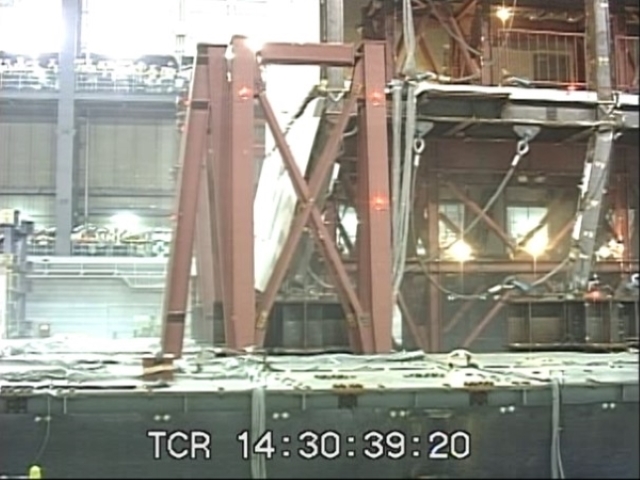
0703 Experimental Study on Complete Collapse of Steel Frame Building
(Sep. 2007) ( Test Number: E200703 )Steel Frame Non-structural - Input Ground Motion
-
Sep. 25 - JR Takatori motion (the 1995 Southern Hyogo Prefecture Earthquake) 40%
E200703_070925.wmv
Sep. 27 - JR Takatori motion 100%
E200703_070927.wmv
-

0704 7-story XLam Wood Panel Building (Japan-Italy Collaborative Research)
(Oct. 2007) ( Test Number: E200704 )Timber Furniture - Input Ground Motion
-
Oct. 23 - JMA Kobe motion (1995 Southern Hyogo Prefecture Earthquake) 100%
Panoramic view (skew): E200704_071023_1.wmv
7F (inside of the room): E200704_071023_2.wmv
-
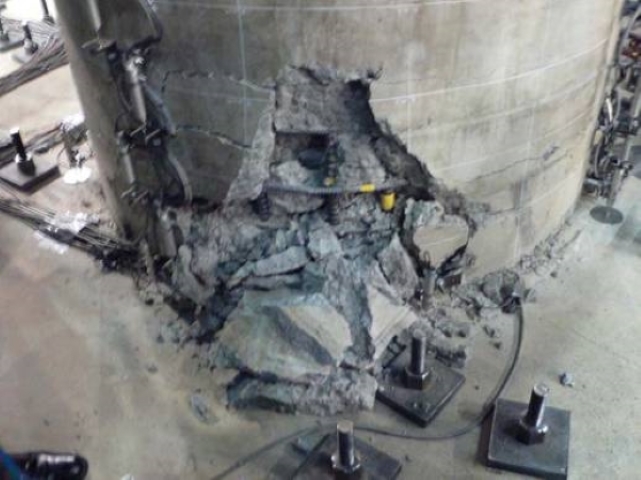
0705 Experimental Study of Seismic Performance of Bridge Component (C1-1)
(Dec. 2007) ( Test Number: E200705 )Reinforced Concrete - Input Ground Motion
-
Dec. 13 - JR Takatori motion (1995 Southern Hyogo Prefecture Earthquake) 100%
E200705_071213.wmv -
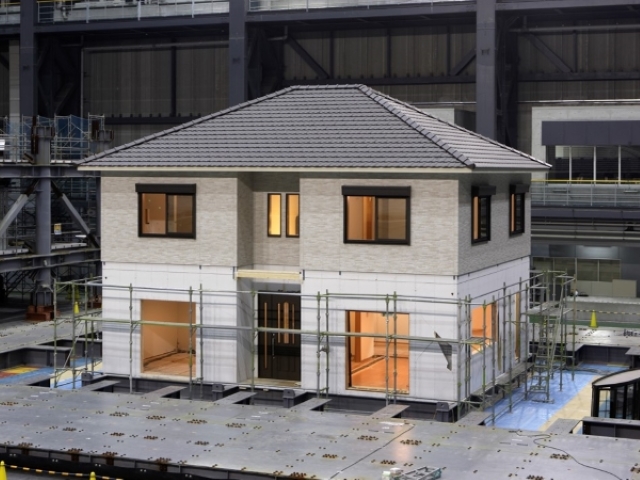
0706 Experiments on Seismic Performance of 2-story Wooden Houses
(Jan. 2008) ( Test Number: E200706 )Timber Furniture - Input Ground Motion
-
Jan. 10, Wooden house with seismic grade 2 - JMA Kobe motion (the 1995 Southern Hyogo Prefecture Earthquake) 100%
Bird view: E200706_080110_1.mpg
Column base at the 1st floor: E200706_080110_2.mpg
Living room: E200706_080110_3.mpg )
-
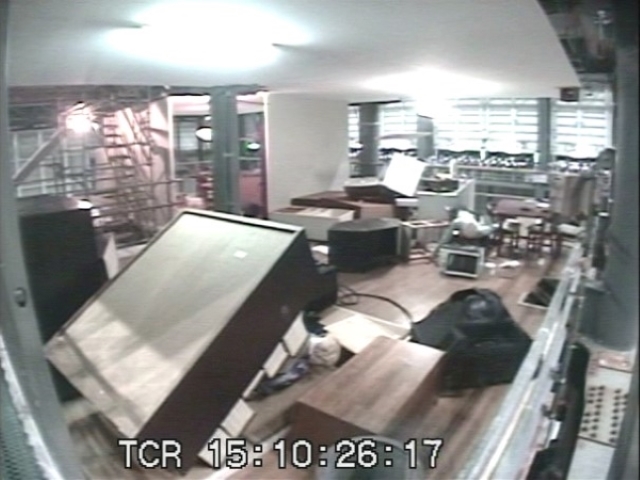
0707 Experimental Study on the Safety and Functionality of Indoor Spaces in High-rise Buildings during Large-amplitude Motion
(Jan. 2008) ( Test Number: E200707 )Furniture - Input Ground Motion
-
Jan. 24 - Expected ground motion from a scenario Nankai earthquake
E200707_080124.wmv
Conclusion paper: E200707_2.pdf
-
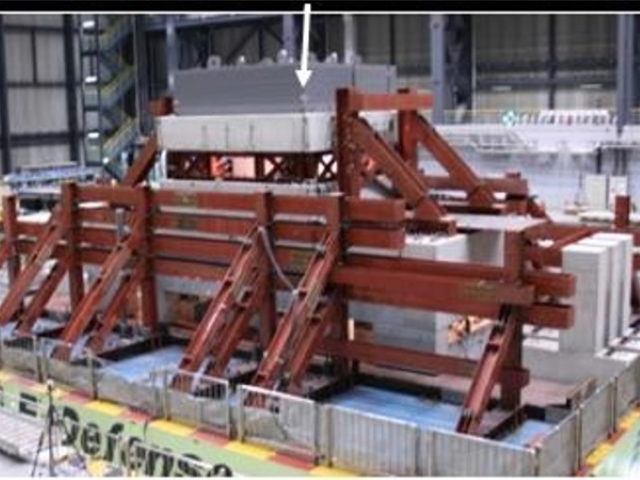
0708 Study on the Response Characteristics of Horizontal Seismically Isolated Plants to Inputs Exceeding Design Motions
(Feb. 2008) ( Test Number: E200708 )Isolation/Damping Equipment - Input Ground Motion
- ・・・
-
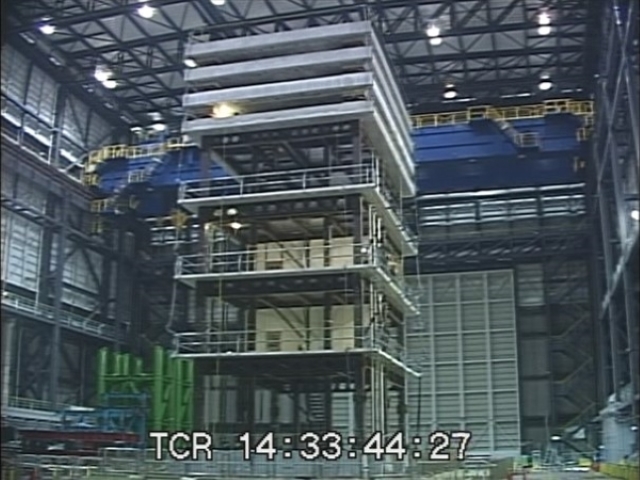
0709 Understanding the Damage Process and Marginal Seismic Performance of High-rise Buildings subjected to Long-period Ground Motions
(Mar. 2008) ( Test Number: E200709 )Steel Frame - Input Ground Motion
-
Mar. 21- Expected ground motion for Nagoya from a scenario Tokai-Tonankai earthquake
Panoramic view (front): E200709_080321_1.wmv
Panoramic view (skew): E200709_080321_2.wmv
Beam, beam-column joint, member: E200709_080321_3.wmv
-
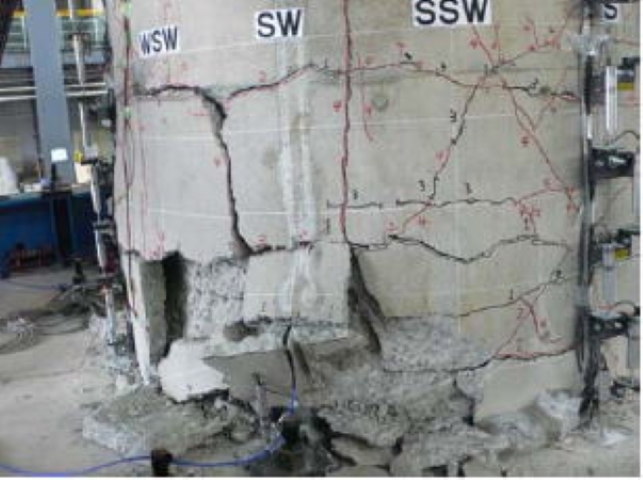
0802 Experimental Study of Seismic Performance of Bridge Component (C1-5)
(Aug. - Sep. 2008) ( Test Number: E200802 )Reinforced Concrete - Input Ground Motion
-
Aug. 26 – The 2nd input of 100% JR Takatori motion (the 1995 Southern Hyogo Prefecture Earthquake)
E200802_080826.wmv
Sep. 2 - The third time input of 125% JR Takatori motion
E200802_080902.wmv
-
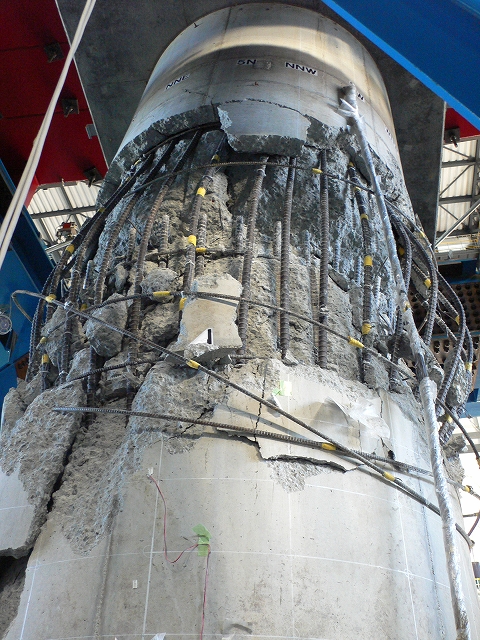
0802.1 Experimental Study of Seismic Performance of Bridge Component (C1-2)
(Oct. 2008) ( Test Number: E200802 )Reinforced Concrete - Input Ground Motion
-
Oct. 2 - JR Takatori motion (the 1995 Southern Hyogo Prefecture Earthquake) 100%
E200802_081002.wmv -
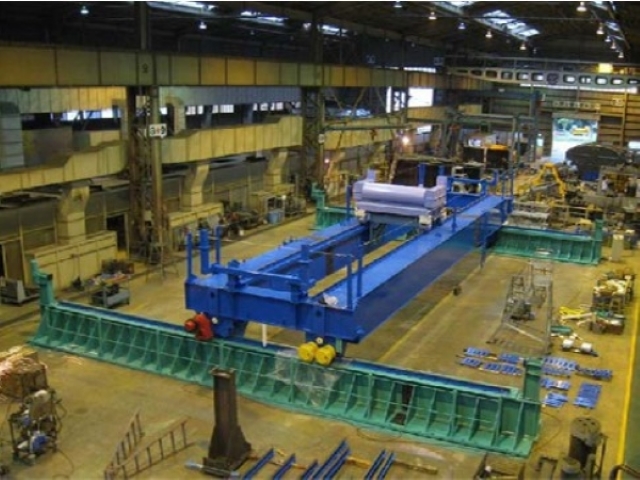
0803 Shaking Table Test for Verification of Seismic Performance of Cranes in Nuclear Facilities
(Oct. & Nov. 2008) ( Test Number: E200803 )Equipment - Input Ground Motion
-
Nov. 10 - Artificial motion 150%
Bird view: E200803_081110_1.mpg
Detailed view of a crane wheel: E200803_081110_2.mpg
-
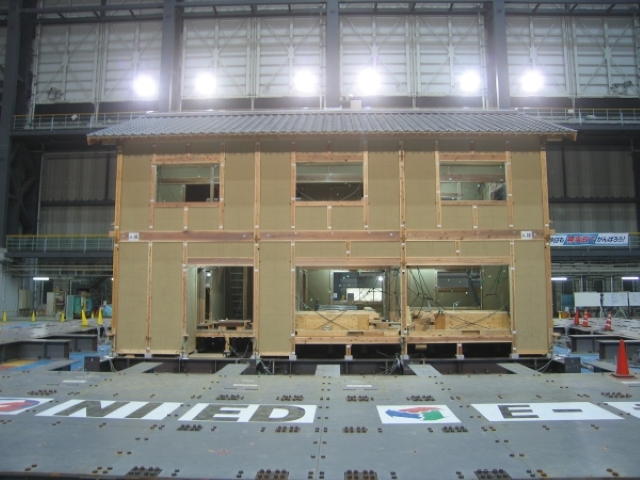
0804 Verification Experiment on Seismic Performance of Wooden Building built by Traditional Frame Construction Method, Part 1
(Nov. & Dec. 2008) ( Test Number: E200804 )Timber - Input Ground Motion
-
Nov. 28, House B - JMA Kobe motion (the 1995 Southern Hyogo Prefecture Earthquake) 100%
E200804_081128.wmv
Dec. 4, House A - JMA Kobe motion 100%
E200804_081204.wmv
-
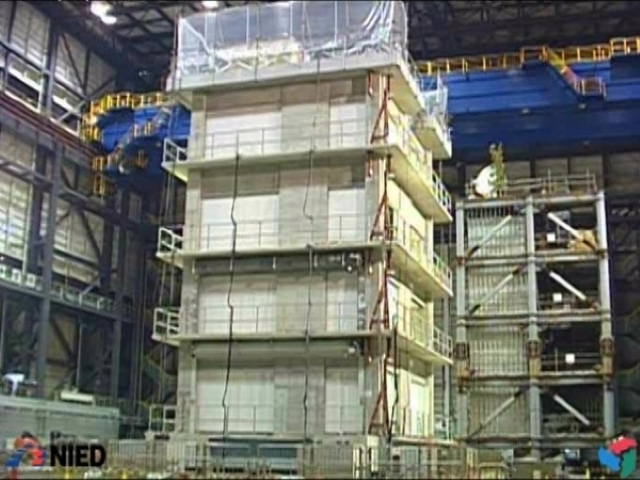
0805 Experiment to Evaluate Maintenance of Functions of Important Facility, Medical Facility
(Dec. 2008 & Jan. 2009) ( Test Number: E200805 )Reinforced Concrete Isolation/Damping Equipment Furniture - Input Ground Motion
-
JMA Kobe motion (the 1995 Southern Hyogo Prefecture Earthquake) 80%,
near fault earthquake & Expected ground motion for Sannomaru area,
Nagoya from a scenario Tokai-Tonankai earthquake
Comparison of the fixed- and isolated-base structures
E200805_090122.wmv
-
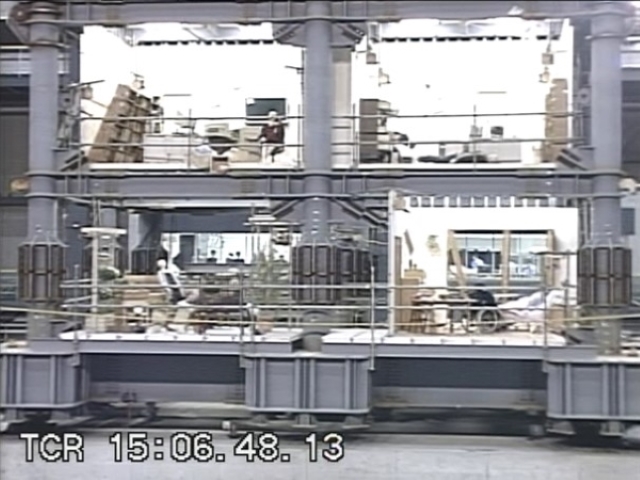
0806 Experimental study on Securing Indoor Safety in High-rise Buildings during Large Earthquakes
(Feb. 2009) ( Test Number: E200806 )Furniture - Input Ground Motion
-
Feb. 4 - Higashi Yuenchi motion 100%
Overall view: E200806_090204_1.mpeg
Amplifiers: E200806_090204_2.mpeg
Nursing room: E200806_090204_3.mpeg
Copy machine: E200806_090204_4.mpeg
- Summary
- E200806_2月6日公開実験.mpeg
0501
Response Verification Test of E-Defense Shaking Table using Test Bed Structure
(Jul. 2005) (
Test Number: E200501 )
Prior to the fully operational use of E-Defense, verification tests were conducted to confirm the response and performance of the shaking table and the measurement system when the full-scale test specimen was mounted on it. A five-story steel frame building 12 m wide, 9 m deep, and 20 m high was constructed as the test specimen, and seismic motions observed during the 1995 Southern Hyogo Prefecture Earthquake were input. As a result, it was found that the response of the shake table is affected by the resonance of the specimen, but this effect can be reduced by adjusting the input seismic motion.
Detailed information and acquired data and images from this experiment are available in E-Defense Data Archive, ASEBI.
DOI: https://doi.org/10.17598/NIED.0020-E200501
Application for Use of Video Materials
×
0503
E-Defense Experiment on Wooden House, Restore from Earthquake Disaster and Seismic Isolation
(Oct. 2025) (
Test Number: E200503 )
As a part of “Special Project for Earthquake Disaster Mitigation in Urban Areas” supported by Ministry of Education, Culture, Sports, Science and Technology (MEXT), E-Defense tests were conducted on a wooden seismic isolation housing system, and data was obtained on the limit behavior of seismic isolation and seismic capacity of wooden seismic isolation housing systems, which are composed of seismic isolation rubber, sliding bearings, dampers, etc.
As a test specimen, a two-story wooden house was built using the conventional wooden frame construction method (building area: 72.87 m2, 1st floor area: 67.49 m2, 2nd floor area: 62.93 m2, total floor area: 130,42 m2), and the observed seismic motion of the 1995 Southern Hyogo Prefecture Earthquake, such as the JR Takatori wave, was input. Shaking table tests were also conducted for cases where the maximum response exceeded the design limit of the seismic isolation system, and the results obtained are being used to develop seismic isolation housing that is safe even in the event of unexpected seismic activity, and to estimate the seismic behavior of seismic isolation housing.
Detailed information and acquired data and images from this experiment are available in E-Defense Data Archive, ASEBI.
DOI: https://doi.org/10.17598/NIED.0020-E200503
Application for Use of Video Materials
×
0504
E-Defense Experiment on Reconstruction and New Construction of Traditional Wooden House, Machiya in Kyoto
(Nov. 2005) (
Test Number: E200504 )
As a part of “Special Project for Earthquake Disaster Mitigation in Urban Areas” supported by Ministry of Education, Culture, Sports, Science and Technology (MEXT), shaking experiment on full-scale wooden houses built before WWII was conducted. For their oldness, severe damage is concerned at a large earthquake. The two test structures, one for an actual built house relocated from Kyoto city and the other for a house newly designed and built in the similar timber frame method as one relocated from Kyoto based on new design method were shaken at the same time to clarify their earthquake-resisting capacity.
Detailed information and acquired data and images from this experiment are available in E-Defense Data Archive, ASEBI.
DOI: https://doi.org/10.17598/NIED.0020-E200504
Outline of the experiment: E200504.pdf
Application for Use of Video Materials
×
0505
E-Defense Experiments on Existing Non-compliant Wooden Houses with and without Reinforcement
(Nov. 2005) (
Test Number: E200505 )
As a part of “Special Project for Earthquake Disaster Mitigation in Urban Areas” supported by the Ministry of Education, Culture, Sports, Science and Technology (MEXT), shaking experiment of full-scale wooden houses built before 1981, when the Building Standard Law was revised drastically, was conducted. The test structures were two similar houses chosen by public offering, relocated from Nishiakashi city to E-Defense. Then one was left as it was (House B) and the other was reinforced against earthquake (House A). Both of test structures were shaken at the same time and investigated the differences of their behavior under a large earthquake.
Detailed information and acquired data and images from this experiment are available in E-Defense Data Archive, ASEBI.
DOI: https://doi.org/10.17598/NIED.0020-E200505
Outline of the experiment: E200505_1.pdf
Application for Use of Video Materials
×
0506
Three-dimensional Seismic Structural Failure Experiment of Full-scale Reinforced Concrete Buildings
(Jan. 2006) (
Test Number: E200506 )
As a part of “Special Project for Earthquake Disaster Mitigation in Urban Areas,” supported by the Ministry of Education, Culture, Sports, Science and Technology (MEXT), a shaking table experiment of full-scale 6-story reinforced concrete (RC) building had been conducted. The test specimen was 12 m long, 17 m wide, 16 m tall, 6-story building and its weight was around 1,000 tonf which was the heaviest test structure ever since E-Defense started running. The structure was designed based on the code of design and practice in 1970’s. The test specimen was subjected to the record of the 1995 Southern Hyogo Prefecture Earthquake and the behavior was studied to obtain necessary data for upgrading earthquake-resistance improvement technology of RC building.
Detailed information and acquired data and images from this experiment are available in E-Defense Data Archive, ASEBI.
DOI: https://doi.org/10.17598/NIED.0020-E200506
Experiment Overview:E200506.pdf
Application for Use of Video Materials
×
0507
Experiment of Pile Foundation in Non-liquefied Horizontal Ground
(Feb. 2006) (
Test Number: E200507 )
As a part of “Special Project for Earthquake Disaster Mitigation in Urban Areas” supported by the Ministry of Education, Culture, Sports, Science and Technology (MEXT), a series of shaking experiments on soil-pile foundation interaction was conducted.
Detailed information and acquired data and images from this experiment are available in E-Defense Data Archive, ASEBI.
DOI: https://doi.org/10.17598/NIED.0020-E200507
Application for Use of Video Materials
×
0508
Experiment of Sheet Pile Seawall and Pile Foundation behind the Wall in Liquefaction-induced Lateral Spreading
(Mar. 2006) (
Test Number: E200508 )
As a part of “Special Project for Earthquake Disaster Mitigation in Urban Areas” supported by the Ministry of Education, Culture, Sports, Science and Technology (MEXT), a series of shaking experiments was conducted to comprehend lateral spreading phenomena of the ground induced by liquefaction of coastal areas using a large-scale specimen with sheet pile type quay wall and pile group foundation structure. About 900 channel sensors were set in order to clarify ground behavior of lateral spreading and failure process of pile foundation structure under earthquakes. As a result, large displacement of the ground and the structures, and significant change in earth pressure and pore water pressure were observed through the sensors.
Detailed information and acquired data and images from this experiment are available in E-Defense Data Archive, ASEBI.
DOI: https://doi.org/10.17598/NIED.0020-E200508
Experiment Overview:E200508.pdf
Application for Use of Video Materials
×
0601
Verification Experiment of Seismic Performance and Damping Effect of 2-story Steel Frame House
(Jun. 2006) (
Test Number: E200601 )
【Facility Rental Experiment Conducted by Daiwa House Industry Co., Ltd.】
In recent years, housing has been required to have seismic performance capable of withstanding earthquakes of the same intensity as the 1995 Southern Hyogo Prefecture Earthquake without collapsing. While this performance far exceeds design standards, if non-structural components can contribute to seismic performance, the load on the building structure can be reduced, making it possible to achieve the above performance. On the other hand, if the rigidity of the building increases significantly due to non-structural components, localized large stresses may act on the structure, potentially leading to a decrease in the building's seismic performance. To verify the above, experiments were conducted on each component, and based on the results, modeling and response analysis were performed. However, it is currently challenging to appropriately evaluate the combined effects of components and scale effects. Therefore, to understand the stiffness and damping of residential buildings and to develop numerical models, shake table tests were conducted on actual buildings using E-Defense.
Detailed information and acquired data and images from this experiment are available in E-Defense Data Archive, ASEBI.
DOI: https://doi.org/10.17598/NIED.0020-E200601
Application for Use of Video Materials
×
0602
Soleil Project: Seismic Experiment for Unit Houses
(Jul. 2006) (
Test Number: E200602 )
【Facility Rental Experiment Conducted by Soleil Project Co., Ltd.】
Using a construction method that stack 40-foot containers (2.5 m × 12 m × 2.9 m) as residential units, a five-story building test specimen was constructed (two units per floor × five floors = 10 units). with the aim of confirming its seismic performance. Using the JR Takatori motion of the 1995 Southern Hyogo Prefecture Earthquake as the excitation input, the test specimen survived without collapse at the motion with 50 kine of the maximum velocity, and the results were in good agreement with the pre-analysis up to 50 kine. At 75 kine, responses exceeding the pre-analysis values were observed.
Detailed information and acquired data and images from this experiment are available in E-Defense Data Archive, ASEBI.
DOI: https://doi.org/10.17598/NIED.0020-E200602
Application for Use of Video Materials
×
0603
Experiment of Pile Foundation on Liquefied Horizontal Ground
(Aug. 2006) (
Test Number: E200603 )
As a part of “Special Project for Earthquake Disaster Mitigation in Urban Areas” supported by the Ministry of Education, Culture, Sports, Science and Technology (MEXT), a series of shaking experiments on pile foundation placed in level liquefiable ground had been conducted by using a cylindrical laminar container to examine behavior of liquefied ground and structural interaction in consequence of shaking.
Detailed information and acquired data and images from this experiment are available in E-Defense Data Archive, ASEBI.
DOI: https://doi.org/10.17598/NIED.0020-E200603
Application for Use of Video Materials
×
0604
Experiment of 3-stories RC Building imitating School Structure
(Sep. - Oct. 2006) (
Test Number: E200604 )
As a part of “Special Project for Earthquake Disaster Mitigation in Urban Areas,” supported by the Ministry of Education, Culture, Sports, Science and Technology (MEXT), shaking table experiments of 3-story reinforced concrete (RC) school buildings was conducted under the leadership of Prof. Toshimi Kabeyasawa of Earthquake Research Institute, the University of Tokyo. The main objectives were to validate input dissipation and seismic retrofit effect. The test specimens were two 3-story RC building structures. One was a bare RC specimen, simulating an old and non-ductile school building. The other was a retrofit specimen, which was constructed in the exactly same design as the bare RC specimen but strengthened with attached steel braces. Those test structures were constructed on a pool-shaped container each which were simulating the flexible boundary condition of the spread foundation and neighborhood soils.
Detailed information and acquired data and images from this experiment are available in E-Defense Data Archive, ASEBI.
DOI: https://doi.org/10.17598/NIED.0020-E200604
Experiment Overview: E200604.pdf
Application for Use of Video Materials
×
0605
Experiment of Caisson Seawall and Pile Foundation behind the Wall in Liquefaction-induced Lateral Spreading
(Dec. 2006) (
Test Number: E200605 )
As a part of “Special Project for Earthquake Disaster Mitigation in Urban Areas” supported by the Ministry of Education, Culture, Sports, Science and Technology (MEXT), a shaking experiment was conducted with a large-scale model composed of caisson type quay walls and pile group in order to perceive lateral spreading phenomenon of the ground induced by liquefaction in coastal areas. About 900 channel sensors were set to clarify ground behavior and failure process of the pile foundation when lateral spreading occurred. Large displacements of the ground and the structures, and significant change of earth pressure and pore water pressure were captured by the sensors.
Detailed information and acquired data and images from this experiment are available in E-Defense Data Archive, ASEBI.
DOI: https://doi.org/10.17598/NIED.0020-E200605
Application for Use of Video Materials
×
0606
Experiment of Traditional Wooden Framework House
(Feb. 2007) (
Test Number: E200606 )
As a part of “Special Project for Earthquake Disaster Mitigation in Urban Areas” supported by the Ministry of Education, Culture, Sports, Science and Technology (MEXT), an experiment of full-scale wooden houses built by traditional timber framework method was conducted. The method of the test structures were used to be common before 1950, in which the Japanese Building Standard Law was enacted, and those structures have aseismic elements whose behavior of performance at seismic events were not yet clarified. We focused attention on difference of foundation style, floor stiffness and roof style, and conducted experiments on eccentricity ratio, floor stiffness, roof style and column base style as parameters to validate their impact to aseismic capacity of houses.
Detailed information and acquired data and images from this experiment are available in E-Defense Data Archive, ASEBI.
DOI: https://doi.org/10.17598/NIED.0020-E200606
Experiment Overview: E200606.pdf
Application for Use of Video Materials
×
0607
Shaking Table Test of Full-Scale Conventional Wooden Frame House
(Feb. 2007) (
Test Number: E200607 )
As a part of “Special Project for Earthquake Disaster Mitigation in Urban Areas” supported by the Ministry of Education, Culture, Sports, Science and Technology (MEXT), a collapse experiment of full-scale wooden houses was conducted. 2 test structures, house C and D whose framework were the same of house A and B tested in November 2005, were built newly. The test structures were constructed based on the previous building standards which were used until 1981 and whose seismic performance was insufficient.
The purpose of the experiment on House C was to investigate the effect of aging on the seismic capacity of wooden house. The purpose of the experiment on House D was to verify the effect of partial seismic reinforcement compared with House B which was considered to be fully reinforced, specifically the lack of the reinforcement at joints.
Detailed information and acquired data and images from this experiment are available in E-Defense Data Archive, ASEBI.
DOI: https://doi.org/10.17598/NIED.0020-E200607
Experiment Overview: E200607.pdf
Application for Use of Video Materials
×
0608
Examination of Destruction of Non-structural Members and Fall of Utensils by Long-period Earthquake Ground Motion in High-rise Building
(Mar. 2007) (
Test Number: E200608 )
A full-scale test structure which was partially extracted from a high-rise building was shaken to reproduce the floor response and story drift. The experiment was conducted in order to clarify those phenomena which may occur in and outside of high-rise buildings under a long-period ground motion. Damage of nonstructural components including exterior wall and ceiling as well as dangerous behavior including overturning and scattering of fixtures and fittings were observed in the test structure. Adopted earthquakes were Nankai earthquake expected in near future and the 1995 Southern Hyogo Prefecture Earthquake.
Detailed information and acquired data and images from this experiment are available in E-Defense Data Archive, ASEBI.
DOI: https://doi.org/10.17598/NIED.0020-E200608
Experiment Overview: E200608.pdf
Application for Use of Video Materials
×
0701
Preliminary Experiment for Plane Frame Specimen with Testbed Loading Device
(Jul. 2007) (
Test Number: E200701 )
By using E-Defense shaking table, it is possible to excite full-scale large test specimens. However, experiments using such large test specimens cost considerably expensive, so depending on the purpose of the experiment, it may be more economical to test a key portion of a structure, such as a building's plan frame, to obtain the necessary data. Therefore, preliminary experiments were conducted to verify a method of loading a plane frame using a so-called “test bed” equipped with a multi-purpose inertial mass system. The test bed consists of a steel truss box with dimensions of 6m × 4.5m and a height of 2.7m, incorporating a concrete slab with dimensions of 3000mm × 4000mm and a mass of 30 tons. The plan frame of the test specimen was sandwiched between two test beds, and by connecting the test frame to the test beds, the horizontal inertial forces of the test bed during an earthquake were transmitted to the test frame. The detailed data and video obtained from this experiment are available.
Detailed information and acquired data and images from this experiment are available in E-Defense Data Archive, ASEBI.
DOI: https://doi.org/10.17598/NIED.0020-E200701
Application for Use of Video Materials
×
0702
Shaking Table Test of Small-diameter Piping-support System
(Aug. 2007) (
Test Number: E200702 )
【Facility Rental Experiment Conducted by Mitsubishi Heavy Industries, Ltd.】
Nuclear power plants in Japan are designed to satisfy seismic design requirements based on the “Regulatory Guide for Reviewing Seismic Design of Nuclear. Power Reactor Facilities.” Following the revision of the guideline in September 2006, the government requested operating companies to conduct seismic backchecks on existing plants. While seismic margin has been confirmed for important facilities at nuclear power plants through various seismic tests, seismic margin tests simulating simultaneous elastic-plastic behavior of piping and supports have not been extensively conducted to date. Based on the above, experiments were conducted using E-Defense to confirm the seismic safety of the entire piping-support system. Using 4-inch and 2-inch diameter pipes and pipe supports commonly found in nuclear power plants as test specimens, simulated earthquake motions equivalent to a major earthquake were input, enabling confirmation of the seismic safety of the small-diameter piping system, including pipe supports.
Detailed information and acquired data and images from this experiment are available in E-Defense Data Archive, ASEBI.
DOI: https://doi.org/10.17598/NIED.0020-E200702
Application for Use of Video Materials
×
0703
Experimental Study on Complete Collapse of Steel Frame Building
(Sep. 2007) (
Test Number: E200703 )
A full-scale 4-story steel building was repeatedly subjected to ground shaking until it collapsed. The building satisfied the minimum requirements prescribed in the current Building Standard Law of Japan. Composite concrete slabs were provided to complete a very realistic structure. The building was furnished with a complete set of nonstructural elements including ALC (AAC) exterior walls, aluminum sash, glass windows, partition walls, and ceiling. The experiment was conducted by increasing the intensity of excitation gradually from small to the strongest motion that the E-Defense can produce.
Detailed information and acquired data and images from this experiment are available in E-Defense Data Archive, ASEBI.
DOI: https://doi.org/10.17598/NIED.0020-E200703
Experiment Overview: E200703.pdf
Application for Use of Video Materials
×
0704
7-story XLam Wood Panel Building (Japan-Italy Collaborative Research)
(Oct. 2007) (
Test Number: E200704 )
As a part of international collaborative research of NIED and CNR-IVALSA “Istituto per la Valorizzazione del Legno e delle Specie Arboree-Trees and Timber Institute - Firenze ITALY”, a shaking experiment of full-scale 7-story wood structure was conducted. This was a part of SOFIE project, PI : Professor Ario Ceccotti, which was CNR-IVALSA leading project to develop the construction method by cross laminate panel, XLam: 7 cm to 20 cm thick laminated panel made of 2 cm thick piece of wood bonded alternately and thickly without any interspace.
A test structure was timber box-frame construction which was 23.5 m height, 7.5 m width, 15 m depth and total weight 285 tonf. The test structure was shaken by the JMA Kobe record (1995 Southern Hyogo Prefecture Earthquake), and the response of the structure under the severe motion was investigated.
Application for Use of Video Materials
×
0705
Experimental Study of Seismic Performance of Bridge Component (C1-1)
(Dec. 2007) (
Test Number: E200705 )
To investigate the failure mechanisms of reinforced concrete (RC) bridge piers that sustained extensive damage during the 1995 Southern Hyogo Prefecture Earthquake, shaking table tests were conducted on full-scale RC bridge pier specimens designed according to 1960s design standards. The input ground motion applied to the shaking table was equivalent to that observed at JR Takatori Station during the 1995 Southern Hyogo Prefecture Earthquake.
Detailed information and acquired data and images from this experiment are available in E-Defense Data Archive, ASEBI.
DOI: https://doi.org/10.17598/NIED.0020-E200705
Experiment Overview: E200705.pdf
Application for Use of Video Materials
×
0706
Experiments on Seismic Performance of 2-story Wooden Houses
(Jan. 2008) (
Test Number: E200706 )
【Facility Rental Experiment Conducted by Tama Home Co., Ltd】
In recent years, seismic performance has come to be one of the key considerations when purchasing a home. To minimize casualties and property damage caused by earthquakes, it is essential for home builders to continue constructing and supplying homes with high seismic performance. With this in mind, the E-Defense experiment was conducted to demonstrate that homes can withstand major earthquakes anticipated in the future without collapsing. As a test specimen, a two-story wooden frame house was constructed using a standard detached house with a floor plan of 8 m × 10 m, a first-floor area of 80 m2, and a second-floor area of 72 m2.
Initially, the structure with seismic grade 3 or higher was subjected to seismic shaking, followed by the removal of some diagonal bracing to simulate seismic grade 2 conditions, after which shaking tests were conducted. The results of the experiments indicated that non-structural components may significantly influence the overall structural performance of the house, among other findings.
Detailed information and acquired data and images from this experiment are available in E-Defense Data Archive, ASEBI.
DOI: https://doi.org/10.17598/NIED.0020-E200706
Application for Use of Video Materials
×
0707
Experimental Study on the Safety and Functionality of Indoor Spaces in High-rise Buildings during Large-amplitude Motion
(Jan. 2008) (
Test Number: E200707 )
A large-amplitude floor response of a high-rise building was reproduced by using 5-story steel frame test structure with two amplifying layers comprised of rubber bearings and concrete slab.
Realistic conditions of residential room as well as office room were reproduced and a tuned synthetic ground motion was input to the shaking table. The large-amplitude floor response corresponding to the maximum displacement of 1.5 m was reproduced in the test structure of 5-story frame. The response of the test structure was tuned to represent the floor response of the 30th floor of a 30-story high-rise building which was subjected to synthetic ground motion for Nagoya from a scenario Tokai-Tonankai earthquake. Dangerous phenomena in the office room, residential room, kitchen and living room were clarified and the resistant measure prepared in the same type of rooms showed significant improvement in terms of safety.
Detailed information and acquired data and images from this experiment are available in E-Defense Data Archive, ASEBI.
DOI: https://doi.org/10.17598/NIED.0020-E200707
Experiment Overview: E200707_1.pdf
Application for Use of Video Materials
×
0708
Study on the Response Characteristics of Horizontal Seismically Isolated Plants to Inputs Exceeding Design Motions
(Feb. 2008) (
Test Number: E200708 )
【Facility Rental Experiment Conducted by Central Research Institute of Electric Power Industry】
To understand the seismic behavior of the isolation system in ground motions exceeding the design seismic motion level and design motions, shake table tests of a horizontally isolated system were conducted using E-Defense at a scale closer to that of the actual structure. A test specimen consisting of an upper building model composed of an upper foundation plate and wall structure, and an isolation layer containing Lead Rubber Bearings (LRB), was constructed. Temporary design seismic motions and observed seismic motions from past earthquakes were input into the test specimen. The experimental results showed that, under design seismic motion levels, the horizontal acceleration response was reduced, while the vertical response exhibited amplification, among other phenomena.
Detailed information and acquired data and images from this experiment are available in E-Defense Data Archive, ASEBI.
DOI: https://doi.org/10.17598/NIED.0020-E200708
Application for Use of Video Materials
×
0709
Understanding the Damage Process and Marginal Seismic Performance of High-rise Buildings subjected to Long-period Ground Motions
(Mar. 2008) (
Test Number: E200709 )
A test structure to investigate the seismic performance of high-rise steel buildings represented a 21-story and 80-m-tall building corresponding to average high-rise buildings. The test structure was comprised of the lower part of full-scale 4-story steel frame structure and the higher part of substitute layers. The substitute layers were prepared in order to represent the seismic responses generated in 5th to 21st floors of the model building. The steel frame was designed and constructed in reference to the past design materials. Imposed ground motions were a synthetic ground motion for simulating the metropolitan area from a scenario Tokai earthquake and a synthetic ground motion for Nagoya from a scenario Tokai-Tonankai earthquake
Detailed information and acquired data and images from this experiment are available in E-Defense Data Archive, ASEBI.
DOI: https://doi.org/10.17598/NIED.0020-E200709
Experiment Overview: E200709.pdf
Application for Use of Video Materials
×
0802
Experimental Study of Seismic Performance of Bridge Component (C1-5)
(Aug. - Sep. 2008) (
Test Number: E200802 )
In order to reproduce the severe damage caused to RC bridge piers by the Southern Hyogo Prefecture Earthquake, shaking table tests were conducted on a test specimen of an RC bridge pier with step-down main reinforcement bars, which was constructed in the 1970s. The column of the test specimen had a circular cross-section with a diameter of 1.8m, a height of 7.5m, and the foundation was 7.0m long, 7.0m wide and 1.8m high, with a total weight of approximately 300t. When the actual observation record of the Southern Hyogo Prefecture Earthquake was input, it was possible to reproduce the actual damage situation, and data was obtained that captured the destruction process, which had never been seen before.
Detailed information and acquired data and images from this experiment are available in E-Defense Data Archive, ASEBI.
DOI: https://doi.org/10.17598/NIED.0020-E200802
Experiment Overview: E200802_1.pdf
,
E200802_2.pdf
Application for Use of Video Materials
×
0802.1
Experimental Study of Seismic Performance of Bridge Component (C1-2)
(Oct. 2008) (
Test Number: E200802 )
To confirm whether RC bridge piers designed and constructed using current design methods have sufficient strength to withstand earthquakes of the magnitude of the Southern Hyogo Prefecture Earthquake, a shaking table test was conducted using a test specimen of an RC pier based on current design standards. The test specimen had a circular cross-section with a diameter of 2.0m, a column height of 7.5m, a foundation with dimensions of 7.0m x 7.0m x 1.8m, and a total weight of approximately 310t. The observed seismic motion of the Southern Hyogo Prefecture Earthquake was input into the specimen. This experiment proved that bridge piers designed and constructed using current design methods have sufficient strength.
Detailed information and acquired data and images from this experiment are available in E-Defense Data Archive, ASEBI.
DOI: https://doi.org/10.17598/NIED.0020-E200802
Experiment Overview: E200802_3.pdf
Application for Use of Video Materials
×
0803
Shaking Table Test for Verification of Seismic Performance of Cranes in Nuclear Facilities
(Oct. & Nov. 2008) (
Test Number: E200803 )
【Facility Rental Experiment Conducted by Hitachi-GE Nuclear Energy, Ltd.】
In the event of an earthquake causing damaged or fallen cranes at nuclear facilities, there is a possibility that safety-critical equipment such as spent fuel storage facilities may be damaged. In such cases, cranes must be equipped with fall prevention functions. Cranes are located at the upper part of buildings and are prone to response amplification. Based on the above, E-Defense experiments were conducted with the aim of understanding earthquake-induced nonlinear responses, especially in vertical motion, including load-bearing capacity, sliding/floating/collision, and verifying the performance of fall prevention functions. Based on a detailed investigation of the crane's structural overview and dynamic characteristics, the ceiling crane of a BWR reactor building was selected as the test specimen. The detailed specifications of the test specimen were determined by incorporating the shake table specifications of E-Defense. Due to constraints on the size of the shake table, the test specimen scale was set to 1/2.5. Simulated earthquake motions and observed motions from the 2007 Niigata Chuetsu-Oki Earthquake were input into the test specimen, and important data was successfully collected.
Detailed information and acquired data and images from this experiment are available in E-Defense Data Archive, ASEBI.
DOI: https://doi.org/10.17598/NIED.0020-E200803
Application for Use of Video Materials
×
0804
Verification Experiment on Seismic Performance of Wooden Building built by Traditional Frame Construction Method, Part 1
(Nov. & Dec. 2008) (
Test Number: E200804 )
NIED and Japan Housing and Wood Technology Center had conducted shaking table experiments on creation of design method and performance validation project of Traditional Wooden Houses under the support of Ministry of Land, Infrastructure, Transport and Tourism. There were two test specimens (House A and B) in this experiment. They were two 2-story wood-framed houses built in a traditional manner. The modules and floor area and height of each story were not the same for both specimens but the floor plans were almost the same. In the experiment, by inputting a ground motion such as observed ground motion of the 1995 Southern Hyogo Prefecture Earthquake, damage and behavior of the specimens under strong earthquake were confirmed.
Detailed information and acquired data and images from this experiment are available in E-Defense Data Archive, ASEBI.
DOI: https://doi.org/10.17598/NIED.0020-E200804
Experiment Overview: E200804.pdf
Application for Use of Video Materials
×
0805
Experiment to Evaluate Maintenance of Functions of Important Facility, Medical Facility
(Dec. 2008 & Jan. 2009) (
Test Number: E200805 )
Shaking table experiments had been conducted to evaluate ability of functional maintenance of medical facilities under earthquake disaster. A full-scale 4-story reinforced concrete building specimen simulating a hospital which contained a stuff station, a dialysis room, an operating room and a patient’s room each furnished with real medical equipment and furniture was set up to reproduce function of the medical facility more faithfully. Two hospitals of different kind of structure each, one for a base-fixed structure and the other for a seismic isolated structure, were compared and evaluated their functional maintenance by shaking table experiments. Comparative video of the experiments shows risk of the aseismic hospital and ability of functional maintenance of the seismic isolated hospital under a near fault earthquake ground motion. But even a seismic isolated structure which widely reduces damages against earthquake in general can be exposed to risk by long-period, long-duration earthquake ground motion such as synthetic ground motion for Sannomaru area, Nagoya from a scenario Tokai-Tonankai earthquake if one fails to take earthquake countermeasures.
Detailed information and acquired data and images from this experiment are available in E-Defense Data Archive, ASEBI.
DOI: https://doi.org/10.17598/NIED.0020-E200805
Experiment Overview: E200805.pdf
Application for Use of Video Materials
×
0806
Experimental study on Securing Indoor Safety in High-rise Buildings during Large Earthquakes
(Feb. 2009) (
Test Number: E200806 )
Since the 1995 Southern Hyogo Prefecture Earthquake, significant casualties have been caused by the overturning of furniture and fixtures during major earthquakes. Therefore, it is extremely important to ensure not only the seismic performance of buildings but also the safety of the rooms inside. In particular, in the upper floors of super-high-rise buildings, the shaking that propagates and amplifies through the building can continue for an extended period, potentially increasing the risk of damage inside the rooms. Based on the above, in collaboration with Hyogo Prefecture, E-Defense experiments were conducted to evaluate indoor safety in high-rise buildings. Furniture and office equipment were installed inside a test specimen with extremely high rigidity, designed for verifying the performance of the E-Defense shake table, to replicate residence spaces and offices. Additionally, to reproduce the large, slow-moving motions of high-rise buildings, amplifiers consisting of two layers of seismic isolation devices were installed beneath the test specimen. By inputting seismic motions observed during the 1995 Southern Hyogo Prefecture Earthquake and those assumed for the Nankai Trough Earthquake into a numerical analysis model of a super-high-rise building, the response motion of the upper floors was calculated and input into the test specimen. Useful image data on the damage conditions inside the building, as well as the effectiveness of overturning prevention measures, has been obtained.
Detailed information and acquired data and images from this experiment are available in E-Defense Data Archive, ASEBI.
DOI: https://doi.org/10.17598/NIED.0020-E200806
Application for Use of Video Materials
×