
This Month's Featured Shaking Test Video
On around the 15th of each month, one past E-Defense shaking table experiment video is selected from the archives and featured with detailed commentary.
-
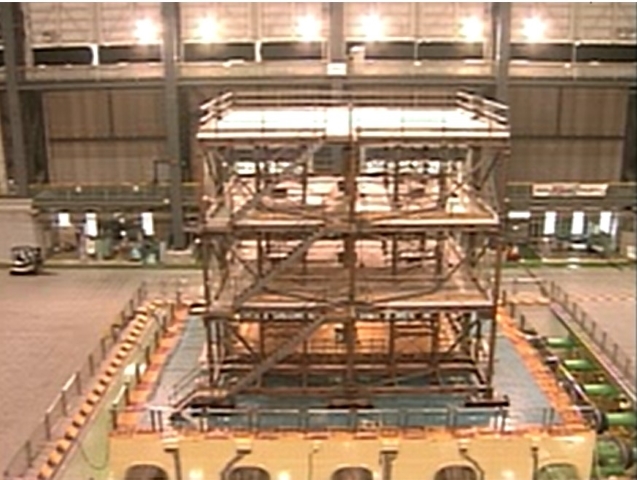
E201303 : Experimental Study on Seismic Measures for Steel Frame Buildings damaged by Past Earthquakes
Explanation
During the 1995 Southern Hyogo Prefecture Earthquake, instances of beam failure at beam-column joints in steel-framed buildings were observed for the first time in Japan. Buildings suffering such damage often exhibit minimal post-earthquake tilting and little visible damage to exterior cladding, making it difficult to detect joint damage or failure during post-earthquake visual inspections. However, the beam-column joints are structurally critical components, and their damage significantly impacts the overall safety of the building. Therefore, technology is needed to detect this type of damage, which is difficult to identify visually after an earthquake, and to assess the building's integrity. This research conducted full-scale shake table tests on steel buildings to understand the damage that would occur if a steel-framed building with damaged beam-column joints were subjected to another major earthquake, and to develop technology for estimating the integrity of buildings damaged in a major earthquake.
For the experimental planning, steel-framed buildings damaged in the Southern Hyogo Prefecture Earthquake were investigated, and three-story steel-framed buildings were selected as the research subjects. The test buildings were designed in accordance with the 1981 seismic regulations, simulating office buildings constructed within Kobe City.
An experimental procedure was planned for buildings that experienced beam-column joint failure during the Southern Hyogo Prefecture Earthquake, simulating a scenario where they encounter a major earthquake. In the experiment, undamaged steel-framed buildings were first subjected to the assumed major earthquake ground motion for comparison. Subsequently, the ground motion observed during the Southern Hyogo Prefecture Earthquake was applied to the beam-column joints, gradually increasing in intensity until failure occurred. Following the failure at the beam-column joint, the simulated major earthquake motion was reapplied. The seismic motion from the Southern Hyogo Prefecture Earthquake used the JR Takatori record. The simulated major earthquake motion was created based on the anticipated shaking in Kobe City during a Nankai Trough earthquake. The measured seismic intensity for the JR Takatori recording and the simulated major earthquake motion was 6.3 and 5.4, respectively.
In the experiment, the acceleration amplitude of the JR Takatori motion was reduced to 40%, 60%, and 80% for input. As the experiment progressed and deformation repeated, the beam-column joint failed in the experiment using 100% of the JR Takatori input (whole building shaking: E201303_131010_08_31.wmv , joint failure: E201303_131010_08_17.wmv ). Subsequently, the assumed major seismic motion was input at intensities of 50%, 100%, and 150% (building sway at 150% input: E201303_131015_10_31.wmv ).
The building inclination measured after each seismic input remained minor, confirming that such damage is difficult to detect through visual inspection of the exterior. Although inputting large seismic motions after the beam-column joint failure did not lead to major events like building collapse in this experiment, the magnitude of seismic deformation approximately doubled before and after failure. This indicates a potential risk of hazardous damage, such as falling exterior cladding. Furthermore, technologies for detecting damage to beam-column joints were investigated. It was confirmed that the building's natural period changes distinctly due to joint failure. Additionally, it was possible to measure the building's natural period from both the micro-tremor inherent to the structure and from vibrations applied to the building using small-scale machinery.
This research was conducted as a joint research project between Hyogo Prefecture and the National Research Institute for Earth Science and Disaster Resilience, and as a collaborative research project between Hyogo Prefecture and Kobe University. Sincere thanks to all involved in this effort.
Detailed experimental data is available in ASEBI.
DOI: https://doi.org/10.17598/NIED.0020-E201303
A detailed report on this experiment is also available on the Hyogo Prefecture website.
https://web.pref.hyogo.lg.jp/kk41/e-defenseh25.html
Last Updated:2026/03/15
-
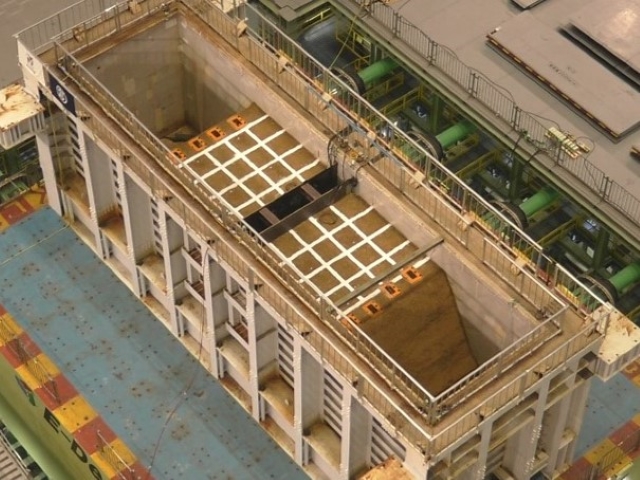
E202102 : Full-scale Shaking Table Test of Seismic Reinforced Joints for Water Pipelines
Explanation
The 2024 Noto Peninsula Earthquake caused widespread failure of water supply and sewerage systems, severely impacting daily life in the affected areas and leading to long-term recovery and reconstruction efforts. Furthermore, on the 28th of the same month, an extensive road collapse occurred in Yashio City, Saitama Prefecture, caused by damage to buried sewer pipes. As of February 2026, one year later, restoration work is still ongoing. In January 2026, it was reported that the Ministry of Land, Infrastructure, Transport and Tourism plans to revise seismic standards, focusing primarily on water pipelines connected to disaster bases such as medical facilities and evacuation centers, with the aim of enhancing seismic reinforcement and addressing aging infrastructure.
The proportion of earthquake-resistant pipelines within the primary water supply network stood at a low 42.3% as of the end of fiscal year 2022. Promptly advancing seismic reinforcement of underground pipelines is an urgent priority to ensure stable water supply during future disasters and establish a system capable of rapid restoration. Examining damage to buried pipelines in past earthquakes reveals that, for example, in the 2011 Tohoku Region Pacific Ocean offshore Earthquake, approximately 70% of the damage to ductile iron pipes, a representative water supply pipe material, was caused by pipes disconnecting at their joints. Therefore, it is apparent that reinforcing pipe joints to prevent disconnection is a highly effective reinforcement method. Based on the above, as part of a joint research project with Taisei Kiko Co., Ltd. and Kanazawa University, a large-scale E-Defense shaking table experiment was conducted on a water supply pipeline using full-scale ductile iron pipes buried in the ground.
In the experiment, water pipeline specimens with unreinforced joints and earthquake-resistant reinforced joints were installed within sloping ground. As the seismic reinforcement methods for the joints, techniques capable of continuously supplying water to the surrounding area without installing bypass pipelines were selected. By applying seismic forces to these test specimens using the E-Defense Shaking Table, the slope was intentionally collapsed, inducing significant ground displacement around the joint areas (E202102_211026_1.wmv). As a result, the unreinforced joint completely disconnected, allowing surrounding soil to flow into the pipe and completely losing its function as a lifeline (E202102_211026_3.wmv). In contrast, the earthquake-resistant joint remained securely attached without detachment, and no soil inflow into the pipe was observed (e.g., pipe interior footage using earthquake-resistant reinforcement fittings, E202102_211026_2.wmv). After the experiment, when water pressure was applied to the pipe, no pressure drop or leakage due to joint damage was detected, confirming the pipe maintained its functionality as a water supply line.
This experimental research aims to contribute to the promotion of earthquake-resistant reinforcement for water supply pipelines. Furthermore, special thanks are expressed to the Osaka City Waterworks Bureau, Okayama City Waterworks Bureau, Kobe City Waterworks Bureau, and other related organizations that participated in and cooperated with the experiments.
Detailed experimental data is available in ASEBI.
DOI: https://doi.org/10.17598/NIED.0020-E202102
Last Updated:2026/02/16
-
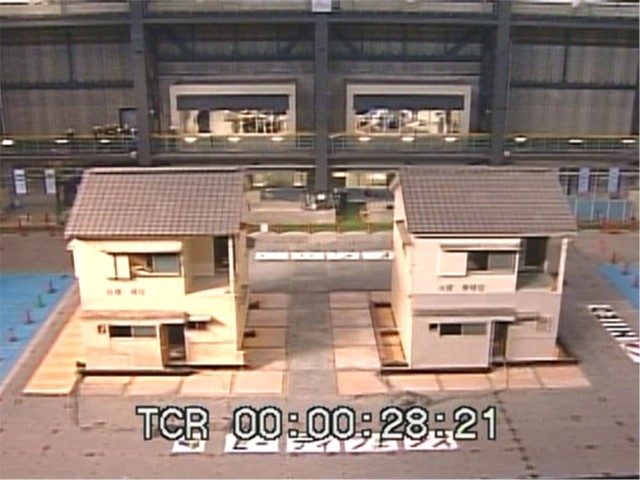
E200505 : E-Defense Experiments on Existing Non-compliant Wooden Houses with and without Reinforcement
Explanation
The two test specimens used in this experiment were actual 32-year-old wooden houses (wooden post-and-beam construction) built with identical structural specifications and floor plans.
These two houses were carefully disassembled, their components transported, and then reassembled on the E-Defense shake table, effectively “relocating” them (the depth direction in the photo is the X-axis, the width direction is the Y-axis). One building served as the “unreinforced test specimen” (right in photo), while the other was the “seismic-reinforced test specimen” (left in photo), reinforced by adding metal brackets at beam-column joints, structural plywood, and diagonal bracing. The evaluation scores (*1) for the “unreinforced test specimen” were 1.17 (X-direction) and 0.50 (Y-direction) for the first floor, and 1.23 (X-direction) and 0.85 (Y-direction) for the second floor. In contrast, the seismic performance scores for the “seismic-reinforced test specimen” were 1.97 (X-direction) and 1.84 (Y-direction) for the first floor, and 1.94 (X-direction) and 2.01 (Y-direction) for the second floor, indicating a significant improvement in seismic performance.
The "unreinforced test specimen" completely collapsed when subjected to seismic motion equivalent to seismic intensity 7 observed at JR Takatori Station during the 1995 Southern Hyogo Prefecture Earthquake (E200505_051121.wmv).
This phenomenon of first-floor collapse in houses occurred frequently during the 1995 Southern Hyogo Prefecture Earthquake and has also been observed in the 2024 Noto Peninsula Earthquake, occurring approximately 30 years later. The “seismic-reinforced test specimen” avoided collapse, but damage was observed, including lift-off and detachment of structural plywood, separation of bracing, and loosening of metal fittings. After evaluating the damage and recalculating the score, the first floor achieved a score of 0.93 (Y-direction).
After removing the collapsed “unreinforced specimen,” when the damaged “seismic-reinforced test specimen” was again subjected to seismic excitation using the ground motion observed at JR Takatori Station, it completely collapsed, just like the “unreinforced specimen” (E200505_051124.wmv).
In recent major earthquakes, multiple strong seismic motions have been observed. Damage to buildings can be accumulated through these multiple motions, so it is important to accurately assess the seismic performance of your home and simulate responses appropriate for potential scenarios.
Detailed experimental data is available in ASEBI.
DOI: https://doi.org/10.17598/NIED.0020-E200505
※1: The score is calculated as the ratio of actual seismic resistance to required seismic resistance. A score of 1.0 indicates the minimum seismic performance required to meet the new seismic standards, while a score of 1.5 or higher is evaluated as “will not collapse.” Conversely, a score below 1.0 indicates a high possibility of collapse.
Last Updated:2026/01/15