
Experiment Videos and Materials
Experiment Videos
When using these videos or other materials in public settings, please click on “Application for Use of Video Materials” at the bottom of each experiment introduction page. After agreeing to the “Terms of Use” described on the application page, submit your application for use.
Timber
-
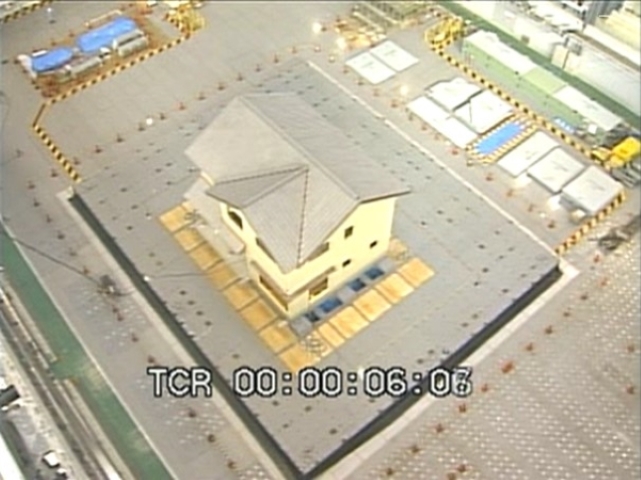
0503 E-Defense Experiment on Wooden House, Restore from Earthquake Disaster and Seismic Isolation
(Oct. 2025) ( Test Number: E200503 )Timber Isolation/Damping - Input Ground Motion
-
Test date: October 20 and 21, 2005.
Oct. 20 - JR Takatori motion (the 1995 Southern Hyogo Prefecture Earthquake) YZ-2 directional input 100% : E200503_051020.mpg
Oct. 20 – The 3rd input of JR Takatori motion 3-directional input 100% : E200503_051021.mpg
-
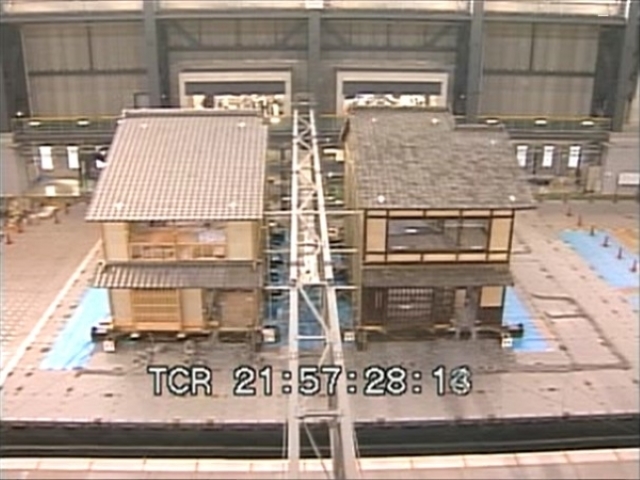
0504 E-Defense Experiment on Reconstruction and New Construction of Traditional Wooden House, Machiya in Kyoto
(Nov. 2005) ( Test Number: E200504 )Timber - Input Ground Motion
-
Nov. 10 - Building Center of Japan Level 2 Seismic Wave (BCJ-L2), unilateral excitation with peak acceleration of 400 gal: E200504_051110_1.wmv
Nov. 11 - JMA Kobe motion (the 1995 Southern Hyogo Prefecture Earthquake) 100%: E200504_051110_2.wmv
-
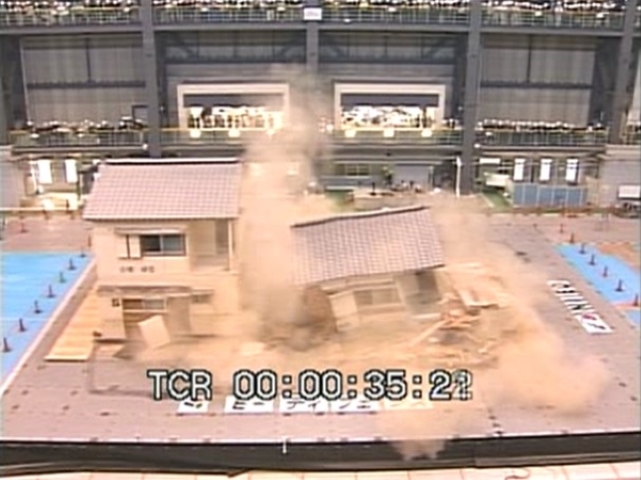
0505 E-Defense Experiments on Existing Non-compliant Wooden Houses with and without Reinforcement
(Nov. 2005) ( Test Number: E200505 )Timber - Input Ground Motion
-
Nov. 21 - JR Takatori motion (the 1995 Southern Hyogo Prefecture Earthquake) 100%
E200505_051121.wmv
Nov. 24 - JR Takatori motion 100%:
E200505_051124.wmv
Remind: The seismic performance scores by the precise seismic diagnosis in the experiment outline are modified after the experiment.:E200505_2.pdf
- Summary
- E200505_(説明あり)在来木造住宅震動台実験.mp4
-
0606 Experiment of Traditional Wooden Framework House
(Feb. 2007) ( Test Number: E200606 )Timber - Input Ground Motion
-
Feb. 2 - JMA Kobe motion (the 1995 Southern Hyogo Prefecture Earthquake) 100%
E200606_070202.wmv
-
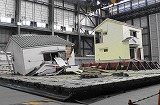
0607 Shaking Table Test of Full-Scale Conventional Wooden Frame House
(Feb. 2007) ( Test Number: E200607 )Timber - Input Ground Motion
-
Feb. 28 - 1st JR Takatori motion (the 1995 Southern Hyogo Prefecture Earthquake) 100%
E200607_070228_1.wmv
Feb. 28 - 2nd JR Takatori motion 100%:
E200607_070228_2.wmv
Mar. 5 - 4th JR Takatori motion 100%:
E200607_070305.wmv
-

0704 7-story XLam Wood Panel Building (Japan-Italy Collaborative Research)
(Oct. 2007) ( Test Number: E200704 )Timber Furniture - Input Ground Motion
-
Oct. 23 - JMA Kobe motion (1995 Southern Hyogo Prefecture Earthquake) 100%
Panoramic view (skew): E200704_071023_1.wmv
7F (inside of the room): E200704_071023_2.wmv
-
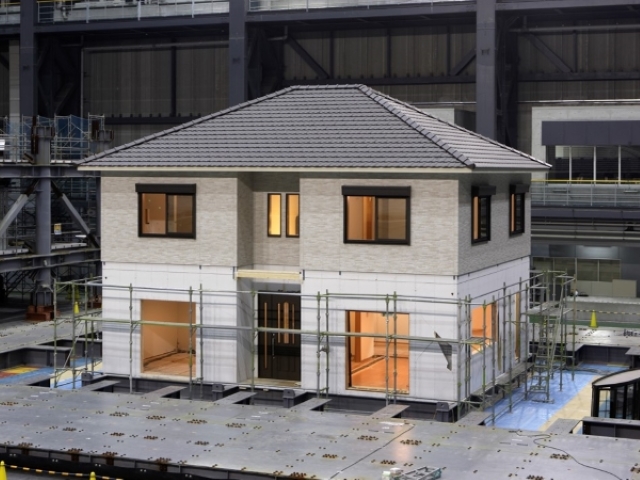
0706 Experiments on Seismic Performance of 2-story Wooden Houses
(Jan. 2008) ( Test Number: E200706 )Timber Furniture - Input Ground Motion
-
Jan. 10, Wooden house with seismic grade 2 - JMA Kobe motion (the 1995 Southern Hyogo Prefecture Earthquake) 100%
Bird view: E200706_080110_1.mpg
Column base at the 1st floor: E200706_080110_2.mpg
Living room: E200706_080110_3.mpg )
-
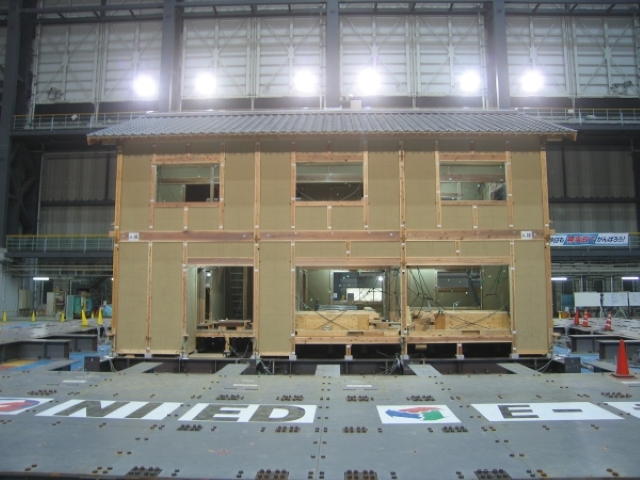
0804 Verification Experiment on Seismic Performance of Wooden Building built by Traditional Frame Construction Method, Part 1
(Nov. & Dec. 2008) ( Test Number: E200804 )Timber - Input Ground Motion
-
Nov. 28, House B - JMA Kobe motion (the 1995 Southern Hyogo Prefecture Earthquake) 100%
E200804_081128.wmv
Dec. 4, House A - JMA Kobe motion 100%
E200804_081204.wmv
-
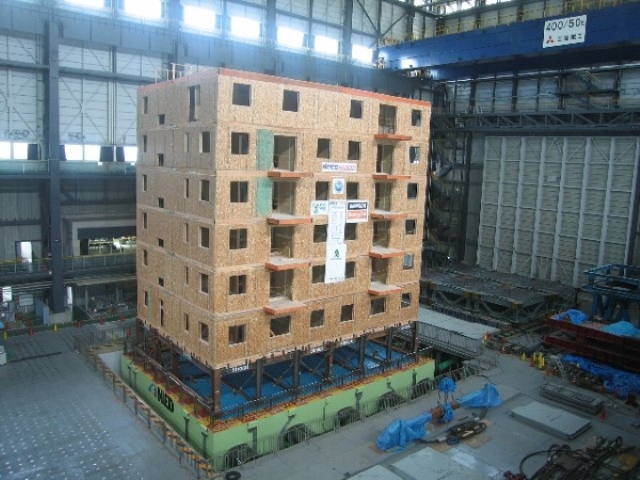
0903 NEES Wood Project “7-story Building using Wooden Panel Construction Method” Experiment of Full-scale Building
(Jul. 2009) ( Test Number: E200903 )Timber - Input Ground Motion
-
July 14 - Canoga Park motion (1994 Northridge Earthquake) 180%
Panoramic view: E200903_090714_1.wmv
Inside of a room on the 7th floor: E200903_090714_2.wmv
-
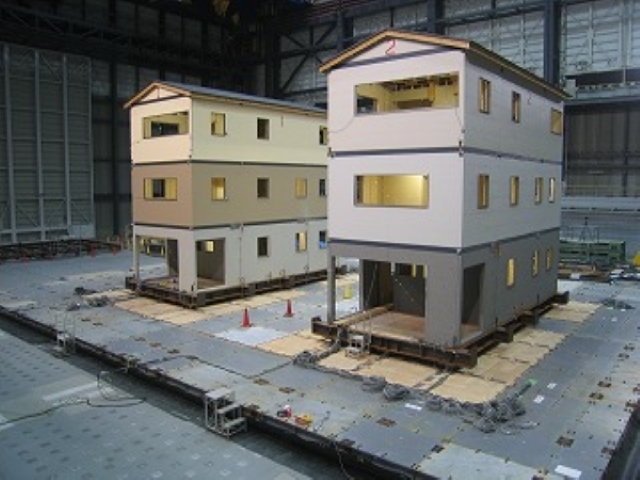
0906 Verification Experiment on the Design Method for Three-story Traditional Wooden Frame Structure
(Oct. 2009) ( Test Number: E200906 )Timber - Input Ground Motion
-
Test date: October 27, 2009
Imposed ground motions: Artificial ground motion 160%
E200906_091027.wmv
-
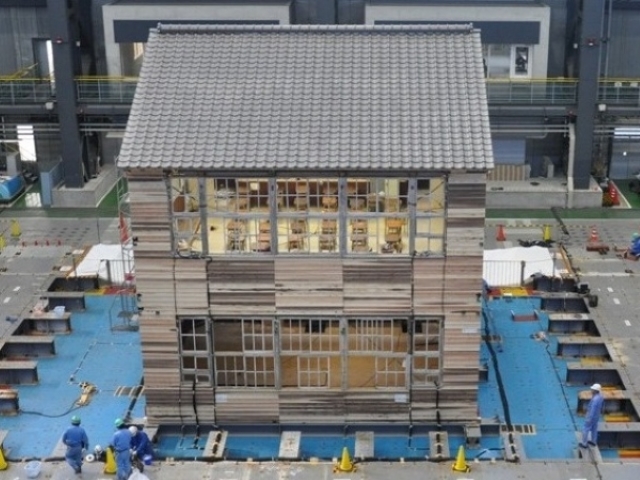
1003 Experimental Study on Development of Seismic Retrofitting Method for Existing Wooden School
(Nov. 2010) ( Test Number: E201003 )Timber - Input Ground Motion
-
Nov. 4, Existing structure - Notice motion in Y-direction, 600 Gal
Overall view: E201003_101104_1.mpeg
Around a column base at the 1st floor: E201003_101104_2.mpeg
Nov. 10, Reinforced structure - Notice motion in Y-direction, 600 Gal
Overall view: E201003_101110_1.mpeg )
Staff station at the 2nd floor: E201003_101110_2.mpeg
- Summary
- E201003_木造校舎 実大震動実験.mpeg
-
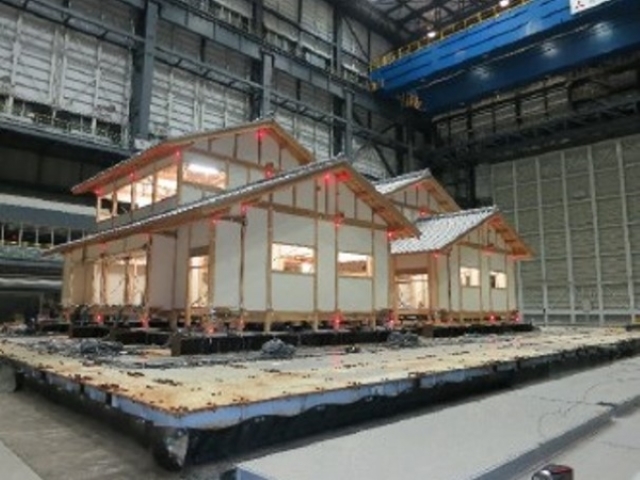
1005 Verification Experiment on Seismic Performance of Wooden Building built by Traditional Frame Construction Method, Part 2
(Jan. 2011) ( Test Number: E201005 )Timber - Input Ground Motion
-
Jan. 21 - JMA Kobe motion (the 1995 Southern Hyogo Prefecture Earthquake)
Overall view: E201005_110121_1.mpg
Detailed view of a column base on a base stone: E201005_110121_2.mpg
-
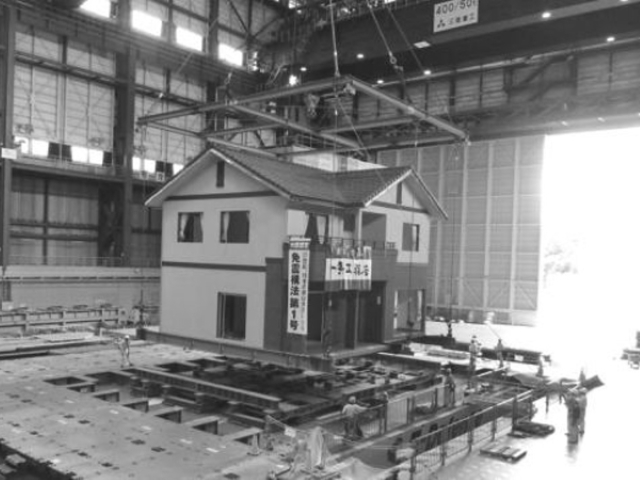
1101 Characteristics of Dynamic Behavior of Small-Scale Base-Isolated Structures under Long-Period Earthquake Motion, Part 1
(Jul. 2011) ( Test Number: E201101 )Timber Isolation/Damping Furniture - Input Ground Motion
-
Jul. 25, Isolated house with no displacement restraint device - Kashiwazaki motion (the Niigataken Chuetsu-oki Earthquake in 2007) 100%
Top view: E201101_110725_1.mpg
Around a base isolation device: E201101_110725_2.mpg
Indoor: E201101_110725_3.mpg
-
1105 Characteristics of Dynamic Behavior of Small-Scale Base-Isolated Structures under Long-Period Earthquake Motion, Part 2
(Dec. 2011) ( Test Number: E201105 )Timber Isolation/Damping - Input Ground Motion
-
Dec. 26 - Kashiwazaki motion (the Niigataken Chuetsu-oki Earthquake in 2007) in 45-degree input 100%
Bird view: E201105_111226_1.mpg
Around a velocity-sensing performance-variable damper: E201105_111226_2.mpg
Around a base isolation device: E201105_111226_3.mpg )
-
1201 Characteristics of Dynamic Behavior of Small-Scale Base-Isolated Structures under Long-Period Earthquake Motion, Part 4
(Jul. 2012) ( Test Number: E201201 )Timber Isolation/Damping - Input Ground Motion
-
Jul. 19 - Kashiwazaki motion (the Niigataken Chuetsu-oki Earthquake in 2007) 100%
Bird view: E201201_120719_1.mpg
Around a velocity-sensing performance-variable damper: E201201_120719_2.mpg
Around a base isolation device: E201201_120719_3.mpg
-
1204 Verification Experiment on Seismic Performance of Wooden Building built by Traditional Construction Method
(Sep. 2012) ( Test Number: E201204 )Timber - Input Ground Motion
-
Sep. 19 - JMA Kobe motion (the 1995 Southern Hyogo Prefecture Earthquake) 100%
Overall view from South: E201204_120919_1.mpeg
In-room: E201204_120919_2.mpeg
Around a base stone: E201204_120919_3.mpeg
-
1402 Shaking Table Testing to verify the Seismic Performance of CLT Buildings
(Feb. 2015) ( Test Number: E201402 )Timber - Input Ground Motion
-
Feb. 10, 2015 5-story CLT building - JMA Kobe motion (the 1995 Southern Hyogo Prefecture Earthquake) 100%
Overall view: E201402_150210_1.wmv
Around the opening: E201402_150210_2.wmv
-
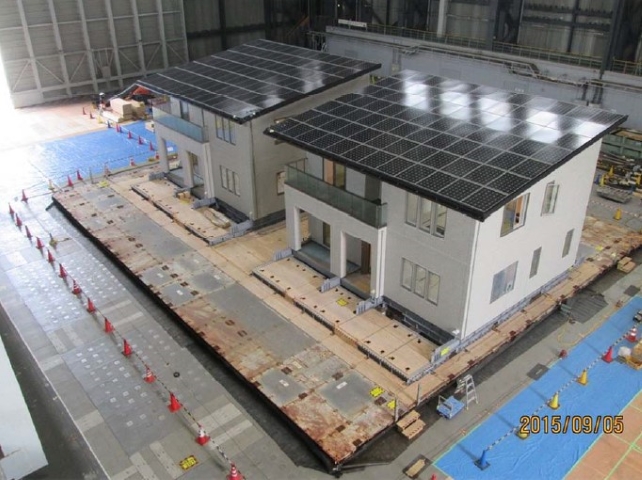
1504 Verification of Seismic Behavior and Structural Integrity of Single-Family Houses subjected to Large Earthquakes
(Aug. & Sep. 2015) ( Test Number: E201504 )Timber Isolation/Damping - Input Ground Motion
-
Sep. 1, Seismic control house specimens - JR Takatori motion (the 1995 Southern Hyogo Prefecture Earthquake) 100%
Overall view E201504_150901_1.wmv
In-room 1: E201504_150901_2.wmv
In-room 2: E201504_150901_3.wmv
-
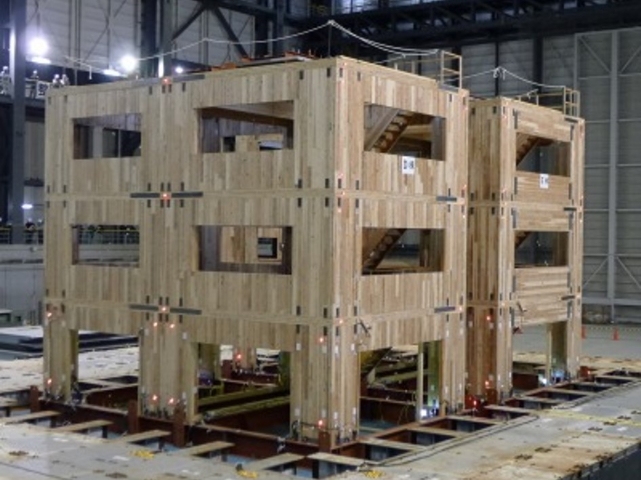
1508 Verification Experiments on Seismic Performance of CLT Buildings
(Jan. 2016) ( Test Number: E201508 )Timber - Input Ground Motion
-
Jan. 26 - JMA Kobe motion (the 1995 Southern Hyogo Prefecture Earthquake) 120%
Overall view: E201508_160126_01.wmv
Around the opening: E201508_160126_02.wmv
-
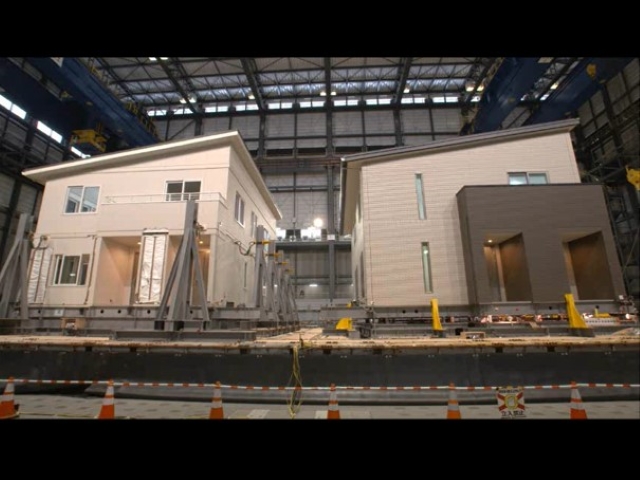
1601 Seismic Performance Evaluation Tests of Wooden Houses and Carports in Recent Large Earthquakes
(Jan. 2017) ( Test Number: E201601 )Timber Isolation/Damping Equipment - Input Ground Motion
-
Jan. 23, seismically reinforced house and isolated house - JMA Mashiki (aftershock in the 2016 Kumamoto Earthquake) 100 %
Bird view from North-east: E201601_170123_1.mp4
Overall and isolation layer: E201601_170123_2.mp4
Indoor at the 1st floor in the reinforced house: E201601_170123_3.mp4
Indoor at the 1st floor in the isolated house: E201601_170123_4.mp4
-
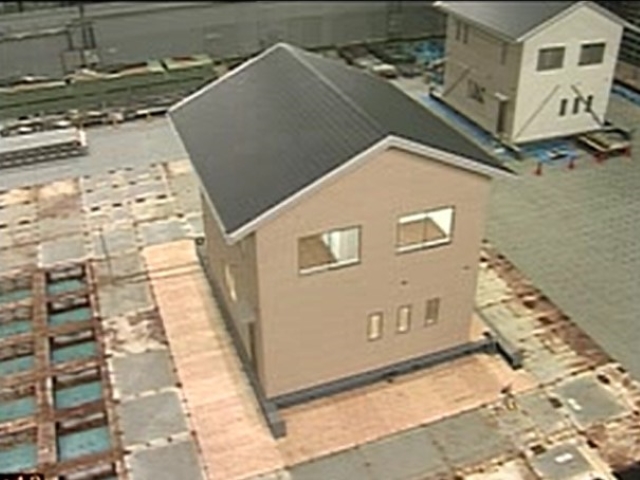
1703 Experiments on Verification of Seismic Performance of Wooden Houses with Different Seismic Grades
(Oct. 2017) ( Test Number: E201703 )Timber - Input Ground Motion
-
Oct. 31, The house with seismic grade 5 - KiK-net Mashiki motion (mainshock in the Kumamoto Earthquake) 100 %
Bird view from South-east: E201703_171031_1.wmv
Bird view from West: E201703_171031_2.wmv
-
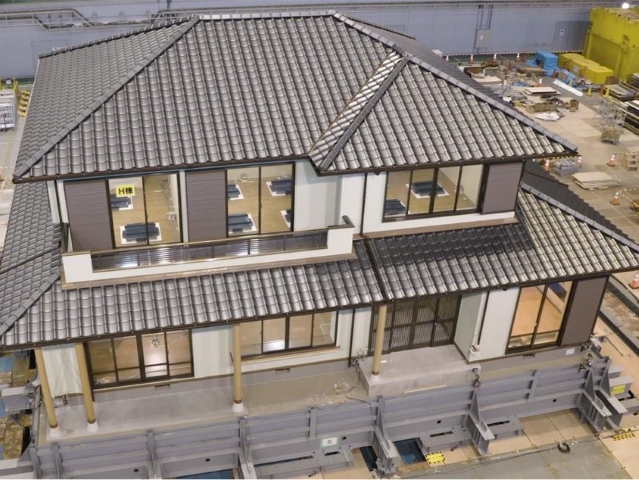
1704 Evaluation of Seismic Performance of Wooden Houses in Recent Large Earthquakes
(Nov. 2017) ( Test Number: E201704 )Timber - Input Ground Motion
-
Nov. 9, the houses with seismic grade 3 and seismic grade 5 - Simulated motion in Nankai Trough Earthquake in Nagoya 100 %
Overall view from South: E201704_171109_1.mpeg
Indoor at the 1st floor in the house with seismic grade 3: E201704_171109_2.mpeg
Indoor at the 1st floor in the house with seismic grade 5: E201704_171109_3.mpeg
-
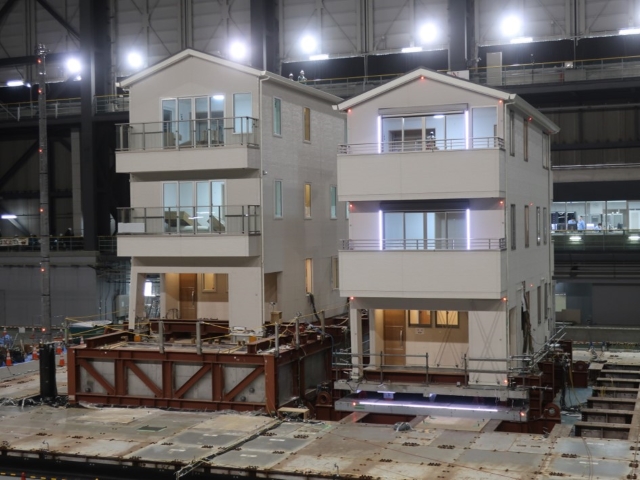
1806 E-Defense Experiment to verify the Function of 3-story Wooden Building including Underground Piping Equipment
(Jan. & Feb. 2019) ( Test Number: E201806 )Timber Geotech Isolation/Damping Non-structural Equipment Furniture - Input Ground Motion
-
Jan. 31 - JMA Kobe motion (the 1995 Southern Hyogo Prefecture Earthquake) 100%
Overall view from North E201806_190131_1.mp4
Overall view from South: E201806_190131_2.mp4
Dining room at the first floor of the isolated house: E201806_190131_3.mp4
Bedroom at the second floor of the seismic-resistant house: E201806_190131_4.mp4
-
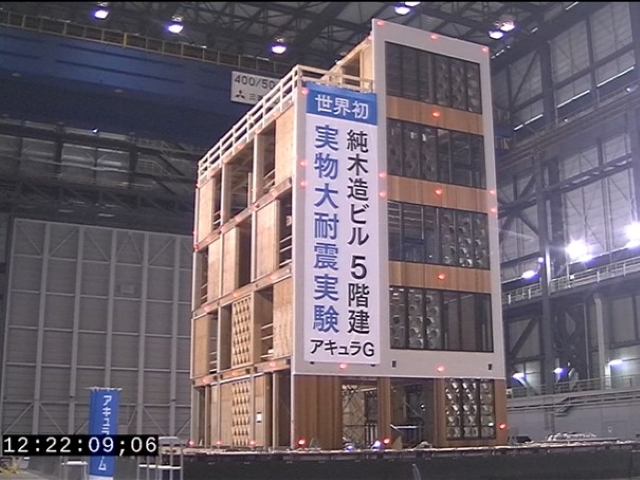
2202 AQ Group: Shaking Table Experiment of Mid- to High-Rise Pure Wood Structures
(Sep. 2022) ( Test Number: E202202 )Timber - Input Ground Motion
-
Sep. 22 - JMA Kobe motion (the 1995 Southern Hyogo Prefecture Earthquake) 100%
Overall view from North-west: E202202_220922_1.mp4
Overall view from South-east: E202202_220922_2.mp4
-
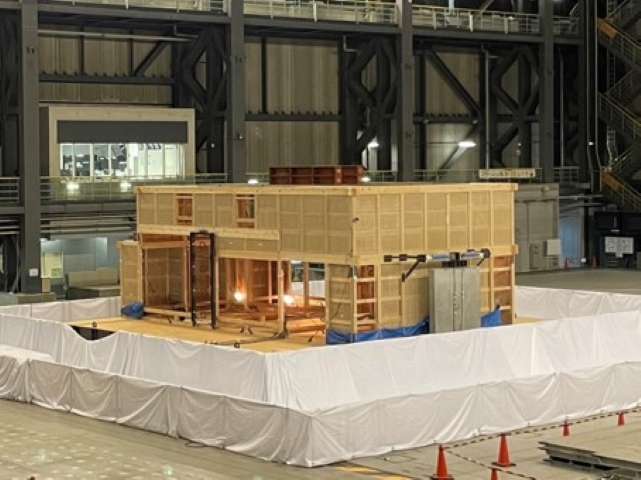
2203 Seismic Performance Evaluation of Traditional Japanese Wooden Houses with Outer-Frame Reinforcement
(Dec. 2022) ( Test Number: E202203 )Timber Isolation/Damping - Input Ground Motion
-
Dec. 14 - Level 2 simulated motion determined by the Building Center of Japan 100%
Bird view from South-west: E202203_221214_1.wmv
Around oil dampers: E202203_221214_2.wmv
0503
E-Defense Experiment on Wooden House, Restore from Earthquake Disaster and Seismic Isolation
(Oct. 2025) (
Test Number: E200503 )
As a part of “Special Project for Earthquake Disaster Mitigation in Urban Areas” supported by Ministry of Education, Culture, Sports, Science and Technology (MEXT), E-Defense tests were conducted on a wooden seismic isolation housing system, and data was obtained on the limit behavior of seismic isolation and seismic capacity of wooden seismic isolation housing systems, which are composed of seismic isolation rubber, sliding bearings, dampers, etc.
As a test specimen, a two-story wooden house was built using the conventional wooden frame construction method (building area: 72.87 m2, 1st floor area: 67.49 m2, 2nd floor area: 62.93 m2, total floor area: 130,42 m2), and the observed seismic motion of the 1995 Southern Hyogo Prefecture Earthquake, such as the JR Takatori wave, was input. Shaking table tests were also conducted for cases where the maximum response exceeded the design limit of the seismic isolation system, and the results obtained are being used to develop seismic isolation housing that is safe even in the event of unexpected seismic activity, and to estimate the seismic behavior of seismic isolation housing.
Detailed information and acquired data and images from this experiment are available in E-Defense Data Archive, ASEBI.
DOI: https://doi.org/10.17598/NIED.0020-E200503
Application for Use of Video Materials
×
0504
E-Defense Experiment on Reconstruction and New Construction of Traditional Wooden House, Machiya in Kyoto
(Nov. 2005) (
Test Number: E200504 )
As a part of “Special Project for Earthquake Disaster Mitigation in Urban Areas” supported by Ministry of Education, Culture, Sports, Science and Technology (MEXT), shaking experiment on full-scale wooden houses built before WWII was conducted. For their oldness, severe damage is concerned at a large earthquake. The two test structures, one for an actual built house relocated from Kyoto city and the other for a house newly designed and built in the similar timber frame method as one relocated from Kyoto based on new design method were shaken at the same time to clarify their earthquake-resisting capacity.
Detailed information and acquired data and images from this experiment are available in E-Defense Data Archive, ASEBI.
DOI: https://doi.org/10.17598/NIED.0020-E200504
Outline of the experiment: E200504.pdf
Application for Use of Video Materials
×
0505
E-Defense Experiments on Existing Non-compliant Wooden Houses with and without Reinforcement
(Nov. 2005) (
Test Number: E200505 )
As a part of “Special Project for Earthquake Disaster Mitigation in Urban Areas” supported by the Ministry of Education, Culture, Sports, Science and Technology (MEXT), shaking experiment of full-scale wooden houses built before 1981, when the Building Standard Law was revised drastically, was conducted. The test structures were two similar houses chosen by public offering, relocated from Nishiakashi city to E-Defense. Then one was left as it was (House B) and the other was reinforced against earthquake (House A). Both of test structures were shaken at the same time and investigated the differences of their behavior under a large earthquake.
Detailed information and acquired data and images from this experiment are available in E-Defense Data Archive, ASEBI.
DOI: https://doi.org/10.17598/NIED.0020-E200505
Outline of the experiment: E200505_1.pdf
Application for Use of Video Materials
×
0606
Experiment of Traditional Wooden Framework House
(Feb. 2007) (
Test Number: E200606 )
As a part of “Special Project for Earthquake Disaster Mitigation in Urban Areas” supported by the Ministry of Education, Culture, Sports, Science and Technology (MEXT), an experiment of full-scale wooden houses built by traditional timber framework method was conducted. The method of the test structures were used to be common before 1950, in which the Japanese Building Standard Law was enacted, and those structures have aseismic elements whose behavior of performance at seismic events were not yet clarified. We focused attention on difference of foundation style, floor stiffness and roof style, and conducted experiments on eccentricity ratio, floor stiffness, roof style and column base style as parameters to validate their impact to aseismic capacity of houses.
Detailed information and acquired data and images from this experiment are available in E-Defense Data Archive, ASEBI.
DOI: https://doi.org/10.17598/NIED.0020-E200606
Experiment Overview: E200606.pdf
Application for Use of Video Materials
×
0607
Shaking Table Test of Full-Scale Conventional Wooden Frame House
(Feb. 2007) (
Test Number: E200607 )
As a part of “Special Project for Earthquake Disaster Mitigation in Urban Areas” supported by the Ministry of Education, Culture, Sports, Science and Technology (MEXT), a collapse experiment of full-scale wooden houses was conducted. 2 test structures, house C and D whose framework were the same of house A and B tested in November 2005, were built newly. The test structures were constructed based on the previous building standards which were used until 1981 and whose seismic performance was insufficient.
The purpose of the experiment on House C was to investigate the effect of aging on the seismic capacity of wooden house. The purpose of the experiment on House D was to verify the effect of partial seismic reinforcement compared with House B which was considered to be fully reinforced, specifically the lack of the reinforcement at joints.
Detailed information and acquired data and images from this experiment are available in E-Defense Data Archive, ASEBI.
DOI: https://doi.org/10.17598/NIED.0020-E200607
Experiment Overview: E200607.pdf
Application for Use of Video Materials
×
0704
7-story XLam Wood Panel Building (Japan-Italy Collaborative Research)
(Oct. 2007) (
Test Number: E200704 )
As a part of international collaborative research of NIED and CNR-IVALSA “Istituto per la Valorizzazione del Legno e delle Specie Arboree-Trees and Timber Institute - Firenze ITALY”, a shaking experiment of full-scale 7-story wood structure was conducted. This was a part of SOFIE project, PI : Professor Ario Ceccotti, which was CNR-IVALSA leading project to develop the construction method by cross laminate panel, XLam: 7 cm to 20 cm thick laminated panel made of 2 cm thick piece of wood bonded alternately and thickly without any interspace.
A test structure was timber box-frame construction which was 23.5 m height, 7.5 m width, 15 m depth and total weight 285 tonf. The test structure was shaken by the JMA Kobe record (1995 Southern Hyogo Prefecture Earthquake), and the response of the structure under the severe motion was investigated.
Application for Use of Video Materials
×
0706
Experiments on Seismic Performance of 2-story Wooden Houses
(Jan. 2008) (
Test Number: E200706 )
【Facility Rental Experiment Conducted by Tama Home Co., Ltd】
In recent years, seismic performance has come to be one of the key considerations when purchasing a home. To minimize casualties and property damage caused by earthquakes, it is essential for home builders to continue constructing and supplying homes with high seismic performance. With this in mind, the E-Defense experiment was conducted to demonstrate that homes can withstand major earthquakes anticipated in the future without collapsing. As a test specimen, a two-story wooden frame house was constructed using a standard detached house with a floor plan of 8 m × 10 m, a first-floor area of 80 m2, and a second-floor area of 72 m2.
Initially, the structure with seismic grade 3 or higher was subjected to seismic shaking, followed by the removal of some diagonal bracing to simulate seismic grade 2 conditions, after which shaking tests were conducted. The results of the experiments indicated that non-structural components may significantly influence the overall structural performance of the house, among other findings.
Detailed information and acquired data and images from this experiment are available in E-Defense Data Archive, ASEBI.
DOI: https://doi.org/10.17598/NIED.0020-E200706
Application for Use of Video Materials
×
0804
Verification Experiment on Seismic Performance of Wooden Building built by Traditional Frame Construction Method, Part 1
(Nov. & Dec. 2008) (
Test Number: E200804 )
NIED and Japan Housing and Wood Technology Center had conducted shaking table experiments on creation of design method and performance validation project of Traditional Wooden Houses under the support of Ministry of Land, Infrastructure, Transport and Tourism. There were two test specimens (House A and B) in this experiment. They were two 2-story wood-framed houses built in a traditional manner. The modules and floor area and height of each story were not the same for both specimens but the floor plans were almost the same. In the experiment, by inputting a ground motion such as observed ground motion of the 1995 Southern Hyogo Prefecture Earthquake, damage and behavior of the specimens under strong earthquake were confirmed.
Detailed information and acquired data and images from this experiment are available in E-Defense Data Archive, ASEBI.
DOI: https://doi.org/10.17598/NIED.0020-E200804
Experiment Overview: E200804.pdf
Application for Use of Video Materials
×
0903
NEES Wood Project “7-story Building using Wooden Panel Construction Method” Experiment of Full-scale Building
(Jul. 2009) (
Test Number: E200903 )
As a part of international collaborative research of NIED and the George E. Brown, Jr. Network for Earthquake Engineering Simulation (NEES), a shaking table experiment on a full-scale 7-story wood building was conducted by NEESWood, which is responsible for study in wood structure at NEES, (PI: Professor John W. van de Lindt, Colorado State University) and NIED. The first story of the test structure was a steel frame simulating a basement parking area. The 2nd to 7th stories were the residential area constructed by the wood-frame structure. The test structure was 12.4 m wide, 18.4 m long and 20.4 m high. In the experiment, the seismic motion recorded at Canoga Park during 1994 Northridge earthquake was used. The test structure was shaken by the 180% of the seismic motion, and the response of the structure under the severe input motion was investigated.
Detailed information and acquired data and images from this experiment are available in E-Defense Data Archive, ASEBI.
DOI: https://doi.org/10.17598/NIED.0020-E200903
Experiment Overview: E200903.pdf
Application for Use of Video Materials
×
0906
Verification Experiment on the Design Method for Three-story Traditional Wooden Frame Structure
(Oct. 2009) (
Test Number: E200906 )
NIED and the Council to Promote Wood Oriented Architecture conducted collapse experiments to verify the design method for 3-story Wood Houses by Post and Beam conventional Japanese wood houses under the support of Ministry of Land, Infrastructure, Transport and Tourism. There were two specimens (specimen 1, specimen 2), both of which were 3-story wood houses with the same specifications including floor area and height of each floor except design of joint parts. In the experiment, damage and behavior of specimens under strong earthquake were confirmed by inputting a synthetic ground motion in one direction.
Detailed information and acquired data and images from this experiment are available in E-Defense Data Archive, ASEBI
DOI: https://doi.org/10.17598/NIED.0020-E200906
Experiment Overview: E200906.pdf
Application for Use of Video Materials
×
1003
Experimental Study on Development of Seismic Retrofitting Method for Existing Wooden School
(Nov. 2010) (
Test Number: E201003 )
In June 2008, the Act on Special Measures Concerning Countermeasures for Large-Scale Earthquakes was revised, making seismic assessment of public elementary and junior high school buildings mandatory. However, for large-scale wooden buildings such as school buildings, there are currently no established methods for seismic assessment or reinforcement techniques. In particular, wooden school buildings that serve as symbols of their communities and hold historical and emotional significance for residents have generated significant demand for their preservation. Accordingly, there is a strong need to explore methods for seismic retrofitting that maintain the buildings' appearance and wooden structures.
Based on the above, Hyogo Prefecture and Kobe University collaborated to conduct E-Defense experiments aimed at developing a seismic reinforcement system for existing wooden school facilities. As test specimens, a two-story wooden school building (built in 1936) in Takasago City, Hyogo Prefecture, was disassembled and transported to E-Defense, where two test specimens (reinforced structure and existing structure) were constructed. As a result of inputting a notice motion and other motions, it was confirmed that the reinforced test specimen showed excellent seismic performance. The reinforcement methods verified through this experiment have been applied to seismic retrofitting projects at schools such as the Sasayama Elementary School in Sasayama City.
Detailed information and acquired data and images from this experiment are available in E-Defense Data Archive, ASEBI.
DOI: https://doi.org/10.17598/NIED.0020-E201003
Application for Use of Video Materials
×
1005
Verification Experiment on Seismic Performance of Wooden Building built by Traditional Frame Construction Method, Part 2
(Jan. 2011) (
Test Number: E201005 )
【Facility Rental Experiment Conducted by Green Architectural.】
Traditional timber-frame buildings in Japan have a long history of adapting to local climates and environments while reflecting regional cultures, thereby forming unique urban landscapes and communities. In many regions, these buildings are being preserved and renovated as symbols of regional culture, and their value is being reevaluated. However, the Building Standard Law does not clearly describe the structural design methods for traditional construction methods. In light of this, verification experiments using a full-scale shake table have been conducted with the aim of establishing design methods for traditional wooden buildings. In this experiment, we examined design methods for traditional wooden buildings, including the stone-based construction method, based on the results of previous surveys and experiments. Artificial earthquake motions (notified waves) and the JMA Kobe motion observed during the 1995 Southern Hyogo Prefecture Earthquake were input to measure the conditions for the occurrence of column base sliding, the amount of sliding, the friction between the column base and the foundation stone, the resistance of the superstructure, and the relationship with the input earthquake motion level. The results clearly indicate that predicting slip amounts is extremely challenging, as columns may slip in a twisting manner even without eccentricity, and slip amounts can vary significantly depending on the direction of excitation.
Detailed information and acquired data and images from this experiment are available in E-Defense Data Archive, ASEBI.
DOI: https://doi.org/10.17598/NIED.0020-E201005
Application for Use of Video Materials
×
1101
Characteristics of Dynamic Behavior of Small-Scale Base-Isolated Structures under Long-Period Earthquake Motion, Part 1
(Jul. 2011) (
Test Number: E201101 )
【Facility Rental Experiment Conducted by H.R.D. Singapore Pte. Ltd., Ichijo Housing Research Institute Co., and Ichijo Co., Ltd.】
To confirm the behavior of seismic isolation houses under inputs exceeding the movable range of the isolation devices, and to investigate the method that minimizes damage to the superstructure and interior furnishings while constraining displacement within the movable range, an E-Defense shaking table test was conducted. First, shaking tests were conducted without displacement restraint devices to confirm the maximum response displacement. Subsequently, shaking tests were conducted with several types of displacement restraint devices installed to verify the displacement restraint effect while also examining the deformation and impact of the superstructure when displacement was restrained. Additionally, shaking tests were conducted with the seismic isolation layer fixed in a non-seismic isolation state, and the behavior was compared with that of the seismic isolation structure combined with displacement restraint devices. The experimental results indicated that as the input level increased, the displacement restraint devices either failed or, while displacement restraint was achieved, the response acceleration of the superstructure significantly increased.
Detailed information and acquired data and images from this experiment are available in E-Defense Data Archive, ASEBI.
DOI: https://doi.org/10.17598/NIED.0020-E201101
Application for Use of Video Materials
×
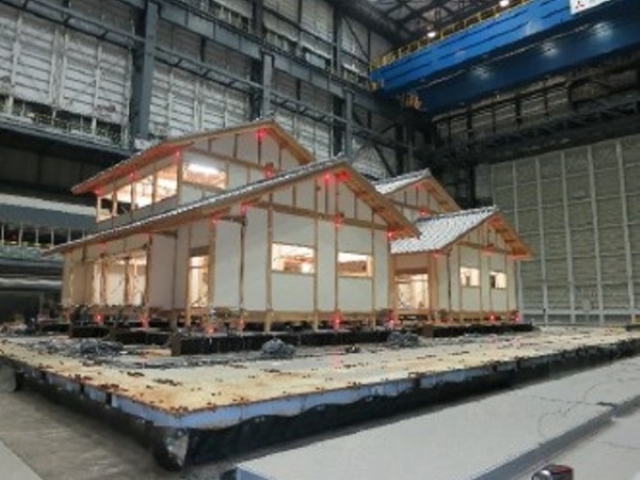
1105
Characteristics of Dynamic Behavior of Small-Scale Base-Isolated Structures under Long-Period Earthquake Motion, Part 2
(Dec. 2011) (
Test Number: E201105 )
【Facility Rental Experiment Conducted by H.R.D. Singapore Pte. Ltd., Ichijo Housing Research Institute Co., and Ichijo Co., Ltd.】
As a result of “Characteristics of Dynamic Behavior of Small-Scale Base-Isolated Structures under Long-Period Earthquake Motion, Part 1”, several issues with the method using displacement restraint devices were identified, and it became clear that research and development of displacement control devices for practical application were necessary. Based on these results, a “velocity-sensing performance-variable damper” was developed to detect situations where the seismic isolation layer is likely to undergo large deformations using relative velocity, and to increase stiffness and damping. The house test specimen constructed in (Part 1) was repaired, and the developed damper was installed to verify its performance through E-Defense experiments. The experimental results indicated that the device could control all input earthquake motions within the design limit displacement; however, there is still room for improvement in the response acceleration.
Detailed information and acquired data and images from this experiment are available in E-Defense Data Archive, ASEBI.
DOI: https://doi.org/10.17598/NIED.0020-E201105
Application for Use of Video Materials
×
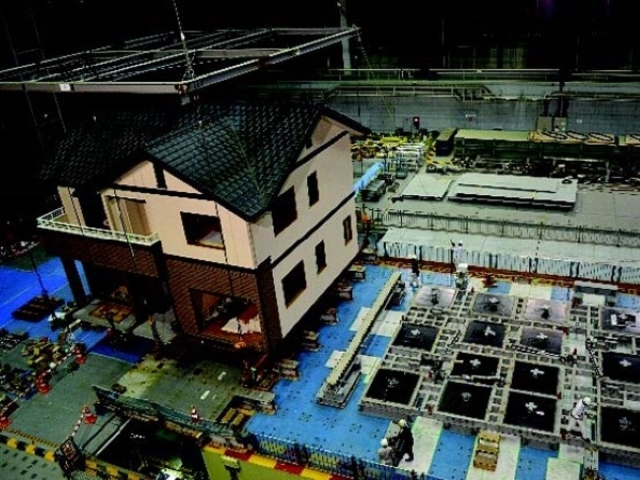
1201
Characteristics of Dynamic Behavior of Small-Scale Base-Isolated Structures under Long-Period Earthquake Motion, Part 4
(Jul. 2012) (
Test Number: E201201 )
【Facility Rental Experiment Conducted by H.R.D. Singapore Pte. Ltd., Ichijo Housing Research Institute Co., and Ichijo Co., Ltd.】
In December 2011, the experiment E201105—Vibration Characteristics of Small-Scale Seismically Isolated Structures under Long-Period Earthquake Motions (Part 2) was conducted. In this experiment, velocity-sensitive performance-variable dampers were installed to control displacement under various earthquake motions, and the response displacement, response acceleration, and dynamic mechanical characteristics of the damping devices themselves were examined. In this Part 4 experiment, the safety of a test specimen was confirmed by developing a “speed-sensing variable performance damper” that revises the relationship between speed and damping force based on a reexamination of issues identified in the previous test results, and by installing fail-safe sliders. The housing portion was newly constructed with the same structure and floor plan as the Part 2 experiment. The results of the experiment indicate that the special oil damper newly developed in this study can suppress the deformation of the seismic isolation layer to a realistic level for all seismic motions input in this experiment, while ensuring the safety of the building interior.
Detailed information and acquired data and images from this experiment are available in E-Defense Data Archive, ASEBI.
DOI: https://doi.org/10.17598/NIED.0020-E201201
Application for Use of Video Materials
×
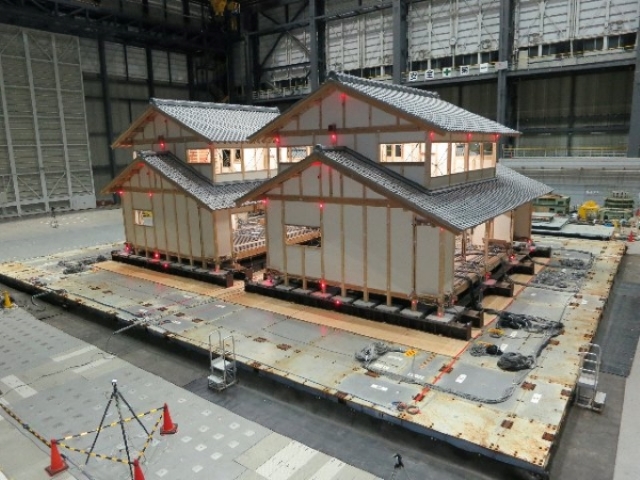
1204
Verification Experiment on Seismic Performance of Wooden Building built by Traditional Construction Method
(Sep. 2012) (
Test Number: E201204 )
【Facility Rental Experiment Conducted by Green Architectural.】
The objective of this study was to establish an earthquake-resistant design method suitable for traditional timber-frame buildings. In fiscal year 2010, a full-scale shake table test (E201005) was conducted, during which sliding of the column bases in the stone-based construction method was observed. To utilize this characteristic of the traditional construction method, a full-scale shake table test was conducted with the aim of reducing deformation on the first floor, mitigating column deformation, and preventing damage. Test specimens were constructed: a traditional wooden residential building with first-floor column bases directly placed on flat foundation stones, and a wooden residential building where “beam running” were installed between the first-floor column bases to connect them. BCJ motions and JMA Kobe motion were input into the specimens. The results indicated that no significant sliding of the column bases was observed in the level 1 of BCJ motion, but approximately 100 mm of sliding was confirmed in the level 2 of BCJ motion. Additionally, in the stone-based test specimen, some columns remained tilted, while in the test specimen with the beam running, although small cracks developed in the braces, no significant damage was observed.
Detailed information and acquired data and images from this experiment are available in E-Defense Data Archive, ASEBI.
DOI: https://doi.org/10.17598/NIED.0020-E201204
Application for Use of Video Materials
×
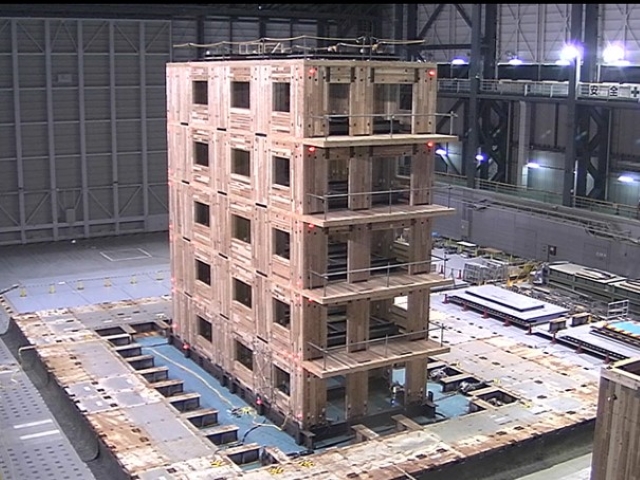
1402
Shaking Table Testing to verify the Seismic Performance of CLT Buildings
(Feb. 2015) (
Test Number: E201402 )
CLT (Cross Laminated Timber) is a wood-based material created by bonding layers of sawn boards (laminas) at right angles to each other to form panels. In Europe and North America, there are numerous examples of mid- to high-rise buildings constructed using CLT panels. In Japan as well, CLT panels are regarded as a promising building material for enabling mid-to-high-rise wooden buildings; however, to realize this in earthquake-prone Japan, it is necessary to establish new structural design methods. In light of the circumstances described above, an E-Defense experiment was conducted to collect data aimed at developing structural design methods for buildings using CLT panels. Two test structures were constructed: a five-story mid-rise building and a three-story low-rise building. Earthquake motions specified by the Building Standards Law and observed seismic motions from the 1995 Southern Hyogo Prefecture Earthquake were input into the structures.
Detailed information and acquired data and images from this experiment are available in E-Defense Data Archive, ASEBI.
DOI: https://doi.org/10.17598/NIED.0020-E201402
Application for Use of Video Materials
×
1504
Verification of Seismic Behavior and Structural Integrity of Single-Family Houses subjected to Large Earthquakes
(Aug. & Sep. 2015) (
Test Number: E201504 )
【Facility Rental Experiment Conducted by H.R.D. Singapore Pte. Ltd., Ichijo Housing Research Institute Co., and Ichijo Co., Ltd.】
To verify the seismic damping effects, the performance of high-strength load-bearing walls, and the maintenance of airtightness and thermal insulation performance after an earthquake in single-family wooden houses, E-Defense experiments were conducted on seven full-scale wooden house specimens over a period of approximately two months. The results clearly indicate that there is no significant difference in building damage with or without seismic damping devices, as well as many other findings.
Detailed information and acquired data and images from this experiment are available in E-Defense Data Archive, ASEBI.
DOI: https://doi.org/10.17598/NIED.0020-E201504
Application for Use of Video Materials
×
1508
Verification Experiments on Seismic Performance of CLT Buildings
(Jan. 2016) (
Test Number: E201508 )
CLT (Cross-Laminated Timber) is a wood-based material created by bonding layers of sawn boards (laminas) at right angles to each other to form panels. In Europe and North America, there are numerous examples of mid- to high-rise buildings constructed using CLT panels. In Japan, CLT panels are also regarded as a promising building material for mid-to-high-rise wooden buildings. However, to realize this in earthquake-prone Japan, it is necessary to establish new structural design standards. Regarding buildings using CLT panels in Japan, a full-scale shake table test was conducted in the 2014 fiscal year, and some insights into structural seismic performance have been obtained. To further collect data toward the development of structural design methods for CLT panel buildings, a second E-Defense experiment was conducted. A three-story CLT residential test structure compliant with the 2014 experiment was subjected to seismic motions specified by the Building Standards Law and observed seismic motions from the 1995 Southern Hyogo Prefecture Earthquake.
Detailed information and acquired data and images from this experiment are available in E-Defense Data Archive, ASEBI.
DOI: https://doi.org/10.17598/NIED.0020-E201508
Application for Use of Video Materials
×
1601
Seismic Performance Evaluation Tests of Wooden Houses and Carports in Recent Large Earthquakes
(Jan. 2017) (
Test Number: E201601 )
【Facility Rental Experiment Conducted by H.R.D. Singapore Pte. Ltd., Ichijo Housing Research Institute Co., and Ichijo Co., Ltd.】
In the 2016 Kumamoto earthquake, it was learned that some wooden houses built before the revision of the Building Standard Law in 2000 and wooden houses built after that time with little extra strength, even if they satisfied the Building Standard Law, could not hold up structurally. The Nankai Trough and earthquake beneath the Tokyo metropolitan area, which are anticipated to occur in the future, are expected to exceed the Kumamoto earthquake in terms of seismic intensity, duration, and frequency of aftershocks, and could cause extensive damage to buildings. In light of this, E-Defense experiments were conducted to 1) evaluate the seismic performance of existing buildings, develop realistic seismic reinforcement methods, and verify the effectiveness of the reinforcement, and 2) determine the limit state of seismically isolated buildings against huge earthquakes that exceeded expectations. 3) Seismic evaluation of a solar carport considering snow loads was also conducted. The test specimens were subjected to multiple inputs of seismic motions of seismic intensity classes 6+ to 7 observed in Japan to collect detailed data on the damage process of wooden houses and the carport.
Detailed information and acquired data and images from this experiment are available in E-Defense Data Archive, ASEBI.
DOI: https://doi.org/10.17598/NIED.0020-E201601
Application for Use of Video Materials
×
1703
Experiments on Verification of Seismic Performance of Wooden Houses with Different Seismic Grades
(Oct. 2017) (
Test Number: E201703 )
【Facility Rental Experiment Conducted by Tama Home Co., Ltd】
Three buildings with different seismic performance (a standard sales house with an seismic grade of 3, a high seismic resistance house equivalent to seismic grade 5, and a house with a seismic grade 1 as defined by the Building Standard Law) were constructed and subjected to multiple strong earthquake excitations recorded at the 1995 Southern Hyogo Prefecture Earthquake and 2016 Kumamoto Earthquake levels to compare their different seismic performance. Based on the data obtained from the experiments, analysis and verification have been conducted with greater precision and are utilized for future home sales and seismic design. In addition, by collecting visual data that is easy to understand and visualize even intuitively without specialized knowledge, it was possible to reemphasize the importance of the seismic performance of the houses.
Detailed information and acquired data and images from this experiment are available in E-Defense Data Archive, ASEBI.
DOI: https://doi.org/10.17598/NIED.0020-E201703
Application for Use of Video Materials
×
1704
Evaluation of Seismic Performance of Wooden Houses in Recent Large Earthquakes
(Nov. 2017) (
Test Number: E201704 )
【Facility Rental Experiment Conducted by H.R.D. Singapore Pte. Ltd., Ichijo Housing Research Institute Co., and Ichijo Co., Ltd.】
In the 2016 Kumamoto earthquake, it was learned that some wooden houses built before the revision of the Building Standard Law in 2000 and wooden houses built after that time with little extra strength, even if they satisfied the Building Standard Law, could not hold up structurally. The Nankai Trough and earthquake beneath the Tokyo metropolitan area, which are anticipated to occur in the future, are expected to exceed the Kumamoto earthquake in terms of seismic intensity, duration, and frequency of aftershocks, and could cause extensive damage to buildings. In light of this, an E-Defense experiment was conducted to 1) evaluate the seismic performance of existing buildings, study realistic seismic reinforcement methods, and verify the effectiveness of reinforcement, and 2) comprehensively verify the damage condition of new buildings to be constructed in the future, including interior, exterior, housing equipment, and furniture damage, as well as building damage. The test specimens were subjected to multiple inputs of seismic motions of seismic intensity 6+ to 7 class observed in Japan, and detailed data on the damage process of wooden houses were collected.
Detailed information and acquired data and images from this experiment are available in E-Defense Data Archive, ASEBI.
DOI: https://doi.org/10.17598/NIED.0020-E201704
Application for Use of Video Materials
×
1806
E-Defense Experiment to verify the Function of 3-story Wooden Building including Underground Piping Equipment
(Jan. & Feb. 2019) (
Test Number: E201806 )
In the “Tokyo Metropolitan Resilience Project ” - a project subsidized by the Ministry of Education, Culture, Sports, Science and Technology - E-Defense is being used to collect and maintain data on the maintenance of building functions, including interior and exterior materials, furniture, fixtures, and piping, and on the seismic margin of buildings until they collapse, with the aim of quickly restoring urban functions in the event of a major earthquake, identifying damage, and carrying out repairs.
In this experiment, two three-story wooden houses were tested on a shake table: one with an earthquake-resistant structure that had been reinforced to improve its earthquake resistance, and the other with a seismic isolation structure, which is known to be effective for earthquake countermeasures, from the perspective of ensuring the living functions of residential buildings in densely populated residential areas. The size of the test specimen was 4.5 m x 10 m in plan and approximately 10 m in height. For the seismic-resistant structure, a large-scale soil container with internal dimensions of 7 m x 13 m and a height of 2.5 m was constructed, and a 1.3 m deep soil layer was built inside the container to faithfully reproduce the building conditions from the solid foundation to be constructed on top of the soil layer. Valuable data was collected by inputting observation waves from the 1995 Southern Hyogo Prefecture Earthquake, etc.
Detailed information and acquired data and images from this experiment are available in E-Defense Data Archive, ASEBI.
DOI: https://doi.org/10.17598/NIED.0020-E201806
Application for Use of Video Materials
×
2202
AQ Group: Shaking Table Experiment of Mid- to High-Rise Pure Wood Structures
(Sep. 2022) (
Test Number: E202202 )
【Facility Rental Experiment Conducted by AQ Group Co., Ltd.】
A three-dimensional shaking table test was conducted on a five-story timber-frame building designed and constructed by AQ Group Co., Ltd. to verify the seismic performance and safety of a five-story timber-frame building as a standard model, with the aim of accelerating the adoption of mid-to-high-rise timber-frame construction. The test specimen is a 5-story timber-frame building constructed using timber-frame construction methods. It serves as a prototype aimed at establishing a medium-sized timber-frame building that can be designed and constructed using commonly available timber and metal materials, pre-cut technology, existing certified construction methods, and allowable stress calculations. The test specimen has a total floor area of 439.5 m2, with a plan layout of 8.19 m × 12.285 m from the first to fourth floors, and 5.005 m × 12.285 m on the fifth floor. with a height of 16.404 m. The building is intended for commercial use on the first floor, office space on the second floor, rental housing on the third floor, and owner-occupied housing on the fourth and fifth floors. Detailed response data of the test specimen has been obtained by inputting seismic waves observed in the 1995 Southern Hyogo Prefecture Earthquake and the Niigata-Chuetsu earthquake.
Detailed information and acquired data and images from this experiment are available in E-Defense Data Archive, ASEBI.
DOI: https://doi.org/10.17598/NIED.0020-E202202
Application for Use of Video Materials
×
2203
Seismic Performance Evaluation of Traditional Japanese Wooden Houses with Outer-Frame Reinforcement
(Dec. 2022) (
Test Number: E202203 )
This research project was carried out as a joint research project between the National Research Institute for Earth Science and Disaster Resilience (NIED) and Hyogo Prefecture, and as a cooperative joint research project between Hyogo Prefecture and Kobe University. In this experiment, a three-dimensional shaking table test was conducted using a full-scale wooden frame specimen, considering a two-story old wooden house. The data obtained from the experiment will be used to verify the effectiveness of the seismic reinforcement method applied to the seismic retrofit of old houses, as well as to verify the behavior of the actual outer-frame method during a large earthquake. The measurement data and images obtained in this experiment are available.
Detailed information and acquired data and images from this experiment are available in E-Defense Data Archive, ASEBI.
DOI: https://doi.org/10.17598/NIED.0020-E202203
Application for Use of Video Materials
×