
Experiment Videos and Materials
Experiment Videos
When using these videos or other materials in public settings, please click on “Application for Use of Video Materials” at the bottom of each experiment introduction page. After agreeing to the “Terms of Use” described on the application page, submit your application for use.
Steel Frame
-
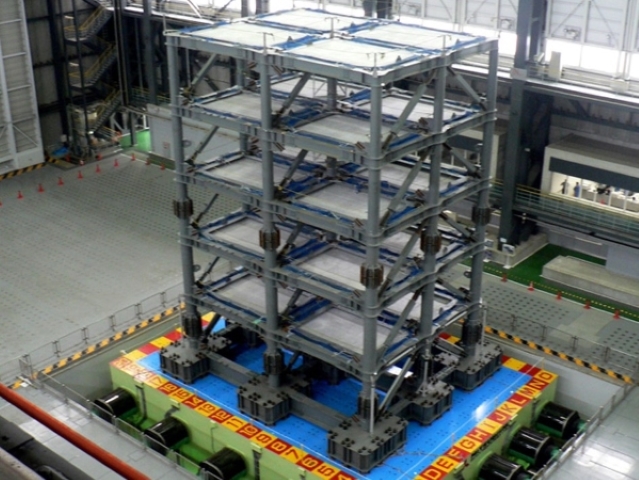
0501 Response Verification Test of E-Defense Shaking Table using Test Bed Structure
(Jul. 2005) ( Test Number: E200501 )Steel Frame - Input Ground Motion
-
Jul. 8 - JMA Kobe Motion (the 1995 Southern Hyogo Prefecture Earthquake) 90% : E200501_050708_1.mpeg
Jul. 8 - JR Takatori Motion (the 1995 Southern Hyogo Prefecture Earthquake) 90% : E200501_050708_2.mpeg
-
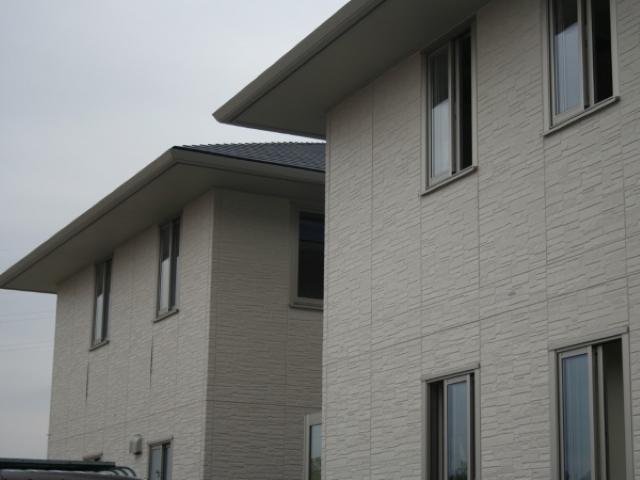
0601 Verification Experiment of Seismic Performance and Damping Effect of 2-story Steel Frame House
(Jun. 2006) ( Test Number: E200601 )Steel Frame Isolation/Damping Furniture - Input Ground Motion
-
Jun. 29 - K-NET Ojiya motion (the Mid Niigata prefecture Earthquake in 2004) 70%
Overall view: E200601_060629_1.mpeg
Living room at the 1st floor of seismic control housing: E200601_060629_2.mpeg
Kids room at the 2nd floor of earthquake-resistant housing: E200601_060629_3.mpeg
-
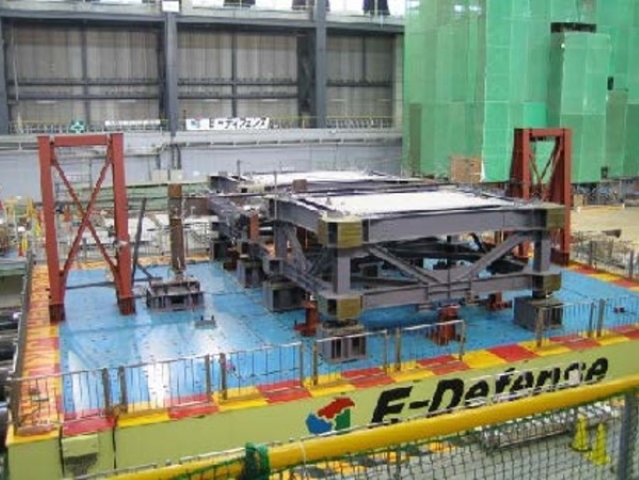
0701 Preliminary Experiment for Plane Frame Specimen with Testbed Loading Device
(Jul. 2007) ( Test Number: E200701 )Steel Frame - Input Ground Motion
-
Jul. 30 - JMA Kobe motion (the 1995 Southern Hyogo Prefecture Earthquake) Y-axis 100%
Overall view: E200701_070730_1.mpeg
Beam-column joint of plane frame specimen: E200701_070730_2.mpeg
-
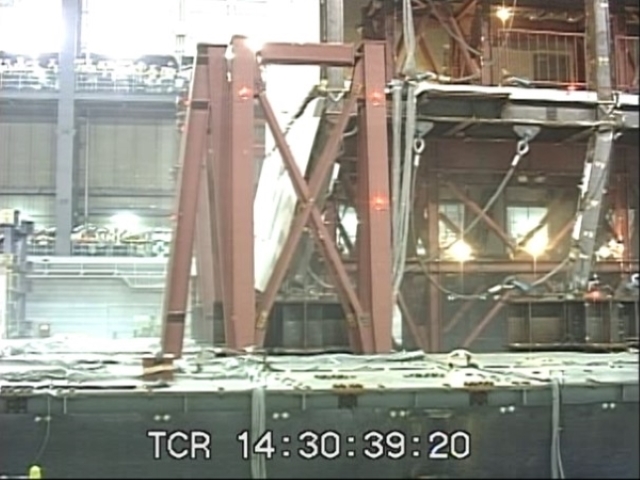
0703 Experimental Study on Complete Collapse of Steel Frame Building
(Sep. 2007) ( Test Number: E200703 )Steel Frame Non-structural - Input Ground Motion
-
Sep. 25 - JR Takatori motion (the 1995 Southern Hyogo Prefecture Earthquake) 40%
E200703_070925.wmv
Sep. 27 - JR Takatori motion 100%
E200703_070927.wmv
-
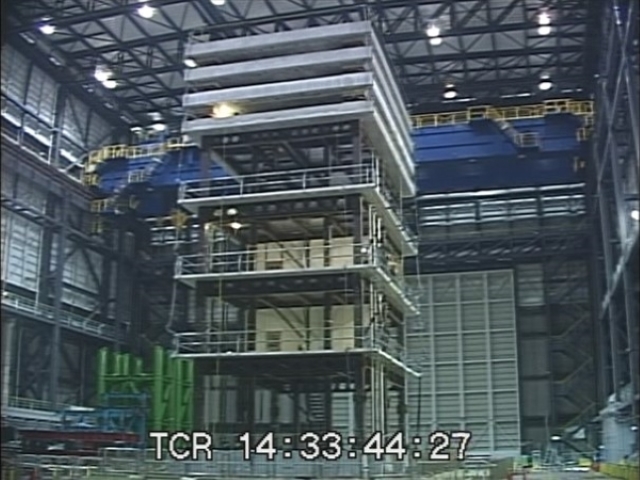
0709 Understanding the Damage Process and Marginal Seismic Performance of High-rise Buildings subjected to Long-period Ground Motions
(Mar. 2008) ( Test Number: E200709 )Steel Frame - Input Ground Motion
-
Mar. 21- Expected ground motion for Nagoya from a scenario Tokai-Tonankai earthquake
Panoramic view (front): E200709_080321_1.wmv
Panoramic view (skew): E200709_080321_2.wmv
Beam, beam-column joint, member: E200709_080321_3.wmv
-
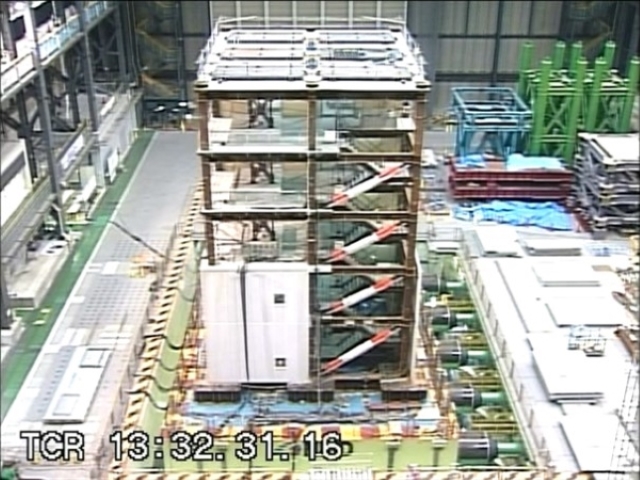
0807 Five-story Steel Building with Supplemental Dampers
(Mar. 2009) ( Test Number: E200807 )Steel Frame - Input Ground Motion
-
Mar. 5, Steel damper - JR Takatori motion (the 1995 Southern Hyogo Prefecture Earthquake) 100%
E200807_090305.wmv
Mar. 12, Viscous damper - JR Takatori motion 100%:
E200807_090312.wmv
Mar. 19, Oil damper - JR Takatori motion 100%
E200807_090319.wmv
Mar. 27, Viscoelastic damper - JR Takatori motion 100%
E200807_090327.wmv
-
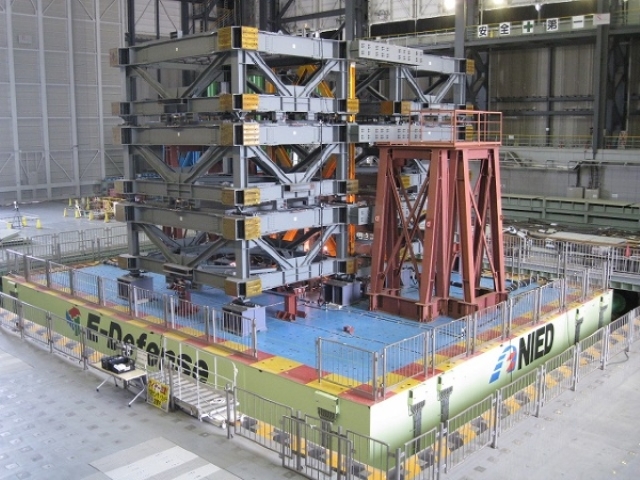
0904 NEES/E-Defense Collaborative Experimental Study on Controlled Steel Rocking Frame
(Aug. 2009) ( Test Number: E200904 )Steel Frame - Input Ground Motion
-
Aug. 10, FUSE-A1 - JMA Kobe motion (the 1995 Southern Hyogo Prefecture Earthquake) 65%
E200904_090810.wmv -
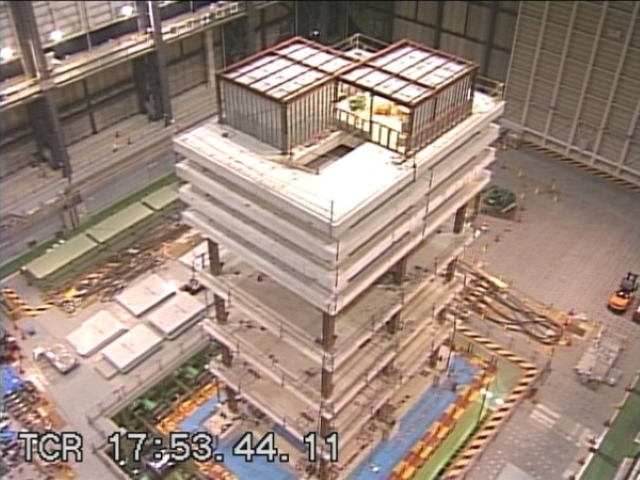
0905 Development of Response Mitigation Methods for High-rise Buildings subject to Long-period Ground Motion
(Sep. & Oct. 2009) ( Test Number: E200905 )Steel Frame Furniture - Input Ground Motion
-
Case 1 :
Sep. 15 - Expected ground motion for Nagoya from a scenario Tokai-Tonankai earthquake
Overall view of test structure:E200905_case1-4.wmv
Steel frames in lower part: E200905_case1-12.wmv
Brace steel damper: E200905_case1-19.wmv
Steel damper in upper substitute layer: E200905_case1-24.wmv
Meeting room on the roof level corresponding to 19th floor: E200905_case1-room.wmv
Case 2 : Sep. 18 - Expected ground motion for Nagoya from a scenario Tokai-Tonankai earthquake
Overall view of test structure: E200905_case2-4.wmv
Steel frames in lower part: E200905_case2-12.wmv
Brace steel damper: E200905_case2-19.wmv
Meeting room on roof level corresponding to 19th floor: E200905_case2-room.wmv
Case 3 : Sep. 25 - Expected ground motion for Nagoya from a scenario Tokai-Tonankai earthquake
Overall view of test structure: E200905_case3-4.wmv
Steel frames in lower part: E200905_case3-12.wmv
Oil brace damper: E200905_case3-19.wmv
Office room on roof level corresponding to 19th floor: E200905_case3-room.wmv
Case 4 : Oct. 2 - Expected ground motion for Nagoya from a scenario Tokai-Tonankai earthquake
Overall view of test structure:E200905_case4-4.wmv
Dining room on roof level corresponding to 19th floor: E200905_case4-room.wmv
-
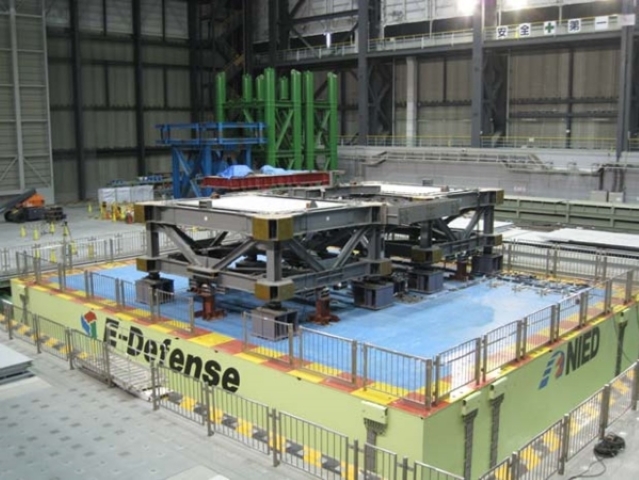
0908 Experiment Study of Steel Frame Building, Innovative Experiment
(Dec. 2009) ( Test Number: E200908 )Steel Frame Isolation/Damping - Input Ground Motion
-
Dec. 15, Plane frame with buckling-constrained braces - JR Takatori motion (the 1995 Southern Hyogo Prefecture Earthquake) EW-component 100%
Overall view: E200908_091215_1.mpg
Detailed view of buckling-constrained braces: E200908_091215_2.mpg
-
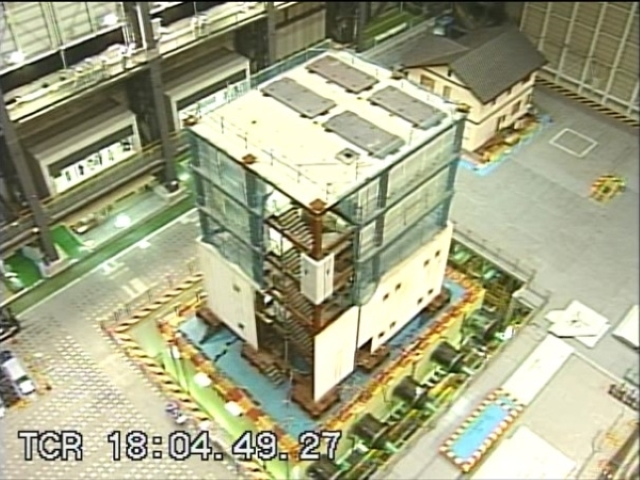
1102 Japan-US Collaborative Research on Innovative Seismic Isolation Solution
(Aug. 2011) ( Test Number: E201102 )Steel Frame Isolation/Damping Non-structural Furniture - Input Ground Motion
-
Aug. 18, 26 and 31 - K-NET Iwanuma motion (the 2011 off the Pacific Coast of Tohoku Earthquake) 70% and 100%:
E201102_1108en.mpeg
-
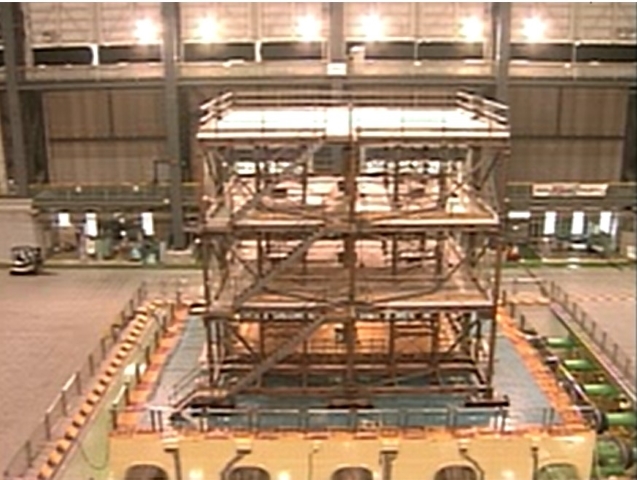
1303 Experimental Study on Seismic Measures for Steel Frame Buildings damaged by Past Earthquakes
(Oct. 2013) ( Test Number: E201303 )Steel Frame - Input Ground Motion
-
Oct. 10 - JR Takatori motion (the 1995 Southern Hyogo Prefecture Earthquake) 100%
Bird view: E201303_131010_ 1.mpeg
Overall view: E201303_131010_2.mpeg
Beam-end joint: E201303_131010_3.mpeg
-
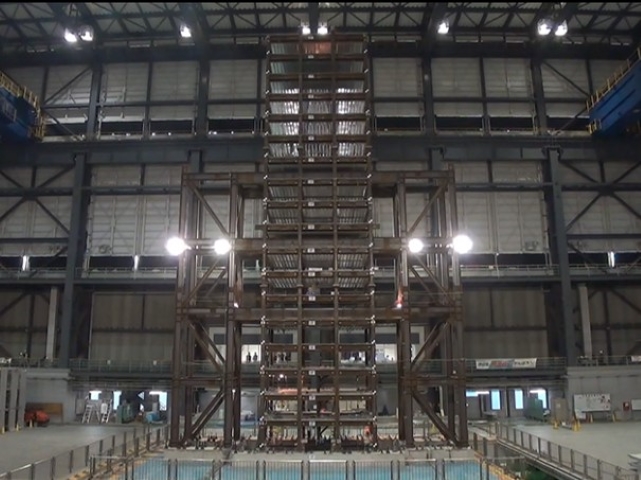
1305 Study for Quantifying Margin to Collapse of Steel Frame High-rise Buildings
(Dec. 2013) ( Test Number: E201305 )Steel Frame - Input Ground Motion
-
Dec. 11 - Nankai Trough Triple Earthquake 227.3 %
Overall view: E201305_131210_1.mp4
Column base at the 1st Floor: E201305_131210_2.mp4
Beam-column joint at the 2nd Floor: E201305_131210_3.mp4
-
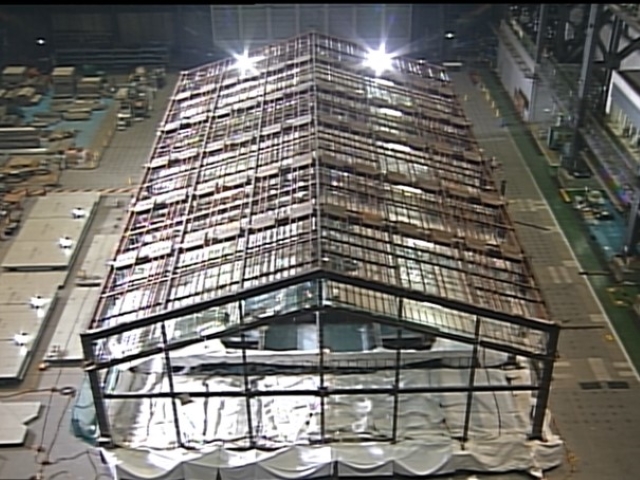
1306 Experiment on Non-Structural Components Installed in Large-Spanned Building Structures
(Jan. & Feb. 2014) ( Test Number: E201306 )Steel Frame Non-structural - Input Ground Motion
-
Jan. 28, Non-seismic-resistant ceiling
The 1st input of K-NET Sendai motion (the 2011 off the Pacific coast of the Tohoku earthquake) 50%: E201306_140128_1.wmv
The 2nd input of K-NET Sendai motion 50%: E201306_140128_2.wmv
Feb. 27, Seismic-resistant ceiling
K-NET Sendai motion 50%: E201306_140227.wmv
Feb. 28, Seismic-resistant ceiling
K-NET Sendai motion 100%: E201306_140228_1.wmv
JMA Kobe motion (the 1995 Southern Hyogo Prefecture Earthquake)100%: E201306_140228_2.wmv
JMA Kobe motion 150%: E201306_140228_3.wmv
-
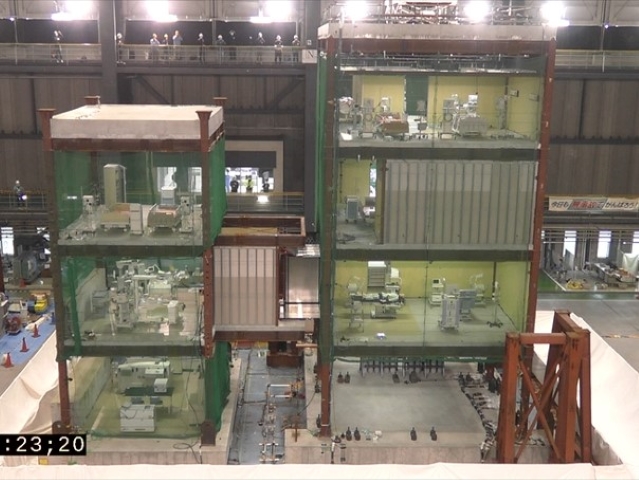
2003 Holistic Seismic Assessment of Critical Buildings with Due Consideration of Non-Structural Component and Equipment
(Dec. 2020) ( Test Number: E202003 )Steel Frame Isolation/Damping Non-structural Equipment Furniture - Input Ground Motion
-
Dec. 8 - JMA Kobe motion (the 1995 Southern Hyogo Prefecture Earthquake), 50% in X- and Y-dir., and 100% in Z-dir.
Overall view: E202003_201208_1.wmv
Operating room at the 3rd floor of earthquake-resistant building: E202003_201208_2.wmv
Dialysis room at the 3rd floor of seismic isolation building: E202003_201208_3.wmv
-
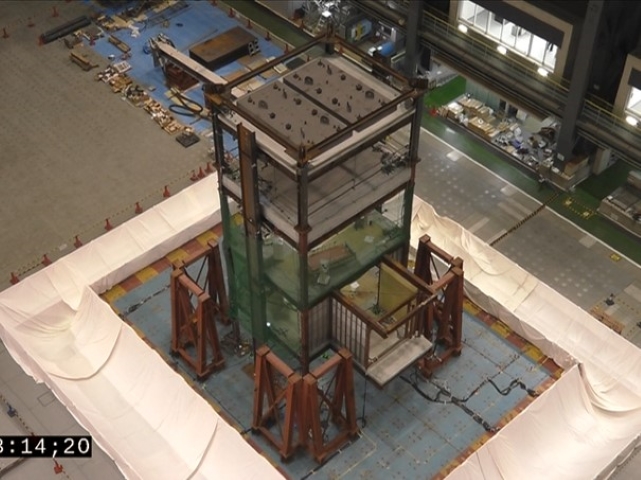
2004 Frame-Spine System with Force-Limiting Connections for Low-Damage Seismic-Resilient Buildings
(Dec. 2020) ( Test Number: E202004 )Steel Frame - Input Ground Motion
-
Dec. 17 - JMA Kobe motion (the 1995 Southern Hyogo Prefecture Earthquake) in Y-dir. 100%
Overall view: E202004_201217_1.mp4
T-shaped tongue damper, a joint at the second floor: E202004_201217_2.mp4
U-shaped dampers, a joint at the fourth floor: E202004_201217_3.mp4
-
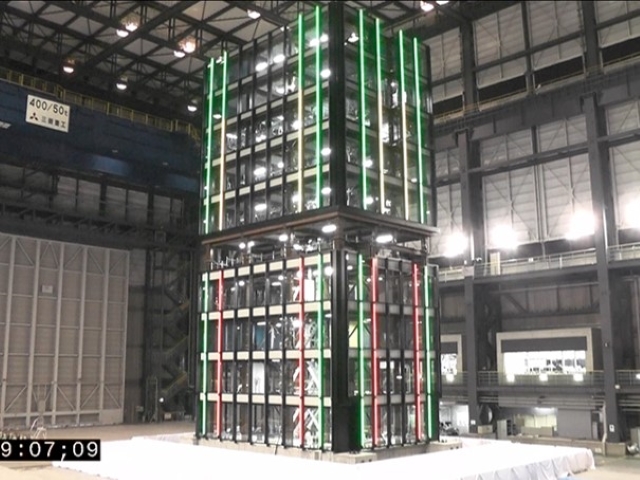
2204 Shake-table Test for Assessing Dynamic Characteristics of Building Structures using a 10-story Steel Office Building
(Feb. 2023) ( Test Number: E202204 )Steel Frame Non-structural Equipment Furniture - Input Ground Motion
-
Feb. 17 - JMA Kobe motion (the 1995 Southern Hyogo Prefecture Earthquake) 100%: E202204_230217.wmv
-
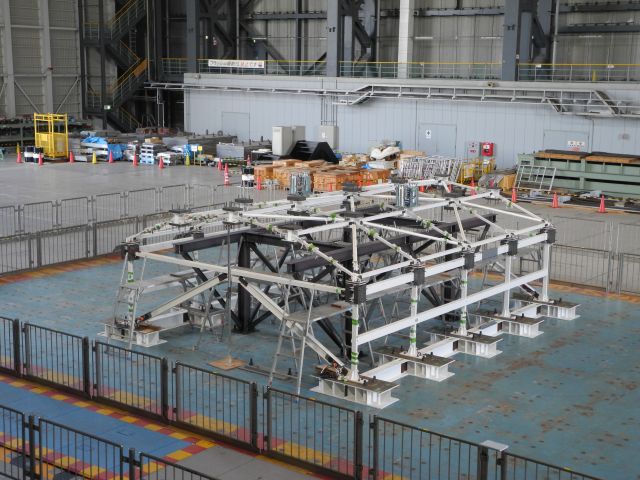
2301 An Experiment on Seismic Response Control of Gymnasium Structures
(July - August. 2022) ( Test Number: E202301 )Steel Frame - Input Ground Motion
-
Aug. 3 - 4.4 Hz Sinusoidal motion, in Y-axis, 1000 Gal: E202301_230803.mp4
0501
Response Verification Test of E-Defense Shaking Table using Test Bed Structure
(Jul. 2005) (
Test Number: E200501 )
Prior to the fully operational use of E-Defense, verification tests were conducted to confirm the response and performance of the shaking table and the measurement system when the full-scale test specimen was mounted on it. A five-story steel frame building 12 m wide, 9 m deep, and 20 m high was constructed as the test specimen, and seismic motions observed during the 1995 Southern Hyogo Prefecture Earthquake were input. As a result, it was found that the response of the shake table is affected by the resonance of the specimen, but this effect can be reduced by adjusting the input seismic motion.
Detailed information and acquired data and images from this experiment are available in E-Defense Data Archive, ASEBI.
DOI: https://doi.org/10.17598/NIED.0020-E200501
Application for Use of Video Materials
×
0601
Verification Experiment of Seismic Performance and Damping Effect of 2-story Steel Frame House
(Jun. 2006) (
Test Number: E200601 )
【Facility Rental Experiment Conducted by Daiwa House Industry Co., Ltd.】
In recent years, housing has been required to have seismic performance capable of withstanding earthquakes of the same intensity as the 1995 Southern Hyogo Prefecture Earthquake without collapsing. While this performance far exceeds design standards, if non-structural components can contribute to seismic performance, the load on the building structure can be reduced, making it possible to achieve the above performance. On the other hand, if the rigidity of the building increases significantly due to non-structural components, localized large stresses may act on the structure, potentially leading to a decrease in the building's seismic performance. To verify the above, experiments were conducted on each component, and based on the results, modeling and response analysis were performed. However, it is currently challenging to appropriately evaluate the combined effects of components and scale effects. Therefore, to understand the stiffness and damping of residential buildings and to develop numerical models, shake table tests were conducted on actual buildings using E-Defense.
Detailed information and acquired data and images from this experiment are available in E-Defense Data Archive, ASEBI.
DOI: https://doi.org/10.17598/NIED.0020-E200601
Application for Use of Video Materials
×
0701
Preliminary Experiment for Plane Frame Specimen with Testbed Loading Device
(Jul. 2007) (
Test Number: E200701 )
By using E-Defense shaking table, it is possible to excite full-scale large test specimens. However, experiments using such large test specimens cost considerably expensive, so depending on the purpose of the experiment, it may be more economical to test a key portion of a structure, such as a building's plan frame, to obtain the necessary data. Therefore, preliminary experiments were conducted to verify a method of loading a plane frame using a so-called “test bed” equipped with a multi-purpose inertial mass system. The test bed consists of a steel truss box with dimensions of 6m × 4.5m and a height of 2.7m, incorporating a concrete slab with dimensions of 3000mm × 4000mm and a mass of 30 tons. The plan frame of the test specimen was sandwiched between two test beds, and by connecting the test frame to the test beds, the horizontal inertial forces of the test bed during an earthquake were transmitted to the test frame. The detailed data and video obtained from this experiment are available.
Detailed information and acquired data and images from this experiment are available in E-Defense Data Archive, ASEBI.
DOI: https://doi.org/10.17598/NIED.0020-E200701
Application for Use of Video Materials
×
0703
Experimental Study on Complete Collapse of Steel Frame Building
(Sep. 2007) (
Test Number: E200703 )
A full-scale 4-story steel building was repeatedly subjected to ground shaking until it collapsed. The building satisfied the minimum requirements prescribed in the current Building Standard Law of Japan. Composite concrete slabs were provided to complete a very realistic structure. The building was furnished with a complete set of nonstructural elements including ALC (AAC) exterior walls, aluminum sash, glass windows, partition walls, and ceiling. The experiment was conducted by increasing the intensity of excitation gradually from small to the strongest motion that the E-Defense can produce.
Detailed information and acquired data and images from this experiment are available in E-Defense Data Archive, ASEBI.
DOI: https://doi.org/10.17598/NIED.0020-E200703
Experiment Overview: E200703.pdf
Application for Use of Video Materials
×
0709
Understanding the Damage Process and Marginal Seismic Performance of High-rise Buildings subjected to Long-period Ground Motions
(Mar. 2008) (
Test Number: E200709 )
A test structure to investigate the seismic performance of high-rise steel buildings represented a 21-story and 80-m-tall building corresponding to average high-rise buildings. The test structure was comprised of the lower part of full-scale 4-story steel frame structure and the higher part of substitute layers. The substitute layers were prepared in order to represent the seismic responses generated in 5th to 21st floors of the model building. The steel frame was designed and constructed in reference to the past design materials. Imposed ground motions were a synthetic ground motion for simulating the metropolitan area from a scenario Tokai earthquake and a synthetic ground motion for Nagoya from a scenario Tokai-Tonankai earthquake
Detailed information and acquired data and images from this experiment are available in E-Defense Data Archive, ASEBI.
DOI: https://doi.org/10.17598/NIED.0020-E200709
Experiment Overview: E200709.pdf
Application for Use of Video Materials
×
0807
Five-story Steel Building with Supplemental Dampers
(Mar. 2009) (
Test Number: E200807 )
The performance enhancement by damping devices was examined in a full-scale, 5-story, steel moment-resisting frame building. Validation of supplemental damping systems was needed because these systems have never been exposed to a major earthquake event. The building was tested under five conditions: with steel, viscous, oil, and viscoelastic dampers, and without dampers. Nonstructural elements (cladding, ceiling, partition walls) were installed to simulate a realistic office building. The JR Takatori record was used with various amplitudes.
Detailed information and acquired data and images from this experiment are available in E-Defense Data Archive, ASEBI.
DOI: https://doi.org/10.17598/NIED.0020-E200807
Experiment Overview: E200807.pdf
Application for Use of Video Materials
×
0904
NEES/E-Defense Collaborative Experimental Study on Controlled Steel Rocking Frame
(Aug. 2009) (
Test Number: E200904 )
This experiment was conducted under the international collaborative research agreement between NIED and the George E. Brown, Jr. Network for Earthquake Engineering Simulation (NEES). Participants comprised US researchers from Stanford University and the University of Illinois and Japanese researchers from NIED, Tokyo Institute of Technology, Hokkaido University, and the private sector. The objective of the experiment was to evaluate the dynamic properties of a new structural system named the Controlled-Rocking Frame. The study focused on the self-centering mechanism of the system and the performance of the energy absorbing devices. The test specimen is seen in the video as a two-dimensional frame painted in yellow. Six horizontal-mass devices referred to as testbeds, three of which piled up on each side of the test structure, delivered inertia to the specimen. The specimen was subjected to unidirectional motions (JMA Kobe and Northridge records) with varying amplitude.
Detailed information and acquired data and images from this experiment are available in E-Defense Data Archive, ASEBI.
DOI: https://doi.org/10.17598/NIED.0020-E200904
Experiment Overview: E200904.pdf
Application for Use of Video Materials
×
0905
Development of Response Mitigation Methods for High-rise Buildings subject to Long-period Ground Motion
(Sep. & Oct. 2009) (
Test Number: E200905 )
The test structure was designed to reproduce the seismic response of an 80-m-tall, 21-story building. The lower four stories of the test structure were constructed as an actual steel frame. Substitute layers, which consisted of concrete slabs and rubber bearings, were placed above the steel frame to simulate the 5th to 21st floors of the building. The structure was subjected to a series of synthetic long-period ground motions: one for Tokyo from a scenario Tokai earthquake and another for Nagoya from a scenario Tokai-Tonankai earthquake.
Detailed information and acquired data and images from this experiment are available in E-Defense Data Archive, ASEBI.
DOI: https://doi.org/10.17598/NIED.0020-E200905
Experiment Overview: E200905_1.pdf
、E200905_2.pdf
Application for Use of Video Materials
×
0908
Experiment Study of Steel Frame Building, Innovative Experiment
(Dec. 2009) (
Test Number: E200908 )
E-Defense experiments were conducted using the methods validated in “E200701 - Preliminary Experiment for Plane Frame Specimen with Testbed Loading Device” to load plane frames with seismic damping devices. Buckling-constrained braces, innovative dampers, and steel pipe dampers were used as seismic damping devices. These specimens were subjected to inputs of mainly JR Takatori motion of various levels to compare and verify their performance.
Detailed information and acquired data and images from this experiment are available in E-Defense Data Archive, ASEBI.
DOI: https://doi.org/10.17598/NIED.0020-E200908
Application for Use of Video Materials
×
1102
Japan-US Collaborative Research on Innovative Seismic Isolation Solution
(Aug. 2011) (
Test Number: E201102 )
In collaboration with the University of Nevada, Reno in USA and National Research Institute for Earth Science and Disaster Resilience, the shake table experiments on a base-isolated building were conducted to evaluate the effectiveness of seismic isolation technology. Specimen was a five-story steel building and isolation devices were installed at the base of the specimen. In the experiment, two different types of isolation system were used; 1) nine triple-pendulum bearings and 2) combination of five lead-rubber bearings and four cross linear sliders. Base-fixed specimen also excited to compare response of the specimen and behavior of furniture installed in the specimen. The record observed at K-NET Iwanuma station during the 2011 Off the Pacific coast of Tohoku earthquake was imposed. Duration of this record is about three minutes and it affects various structures because it contains long-period components, which resonate with base-isolated buildings, and short-period components, which affects low to middle height base-fixed buildings.
Detailed information and acquired data and images from this experiment are available in E-Defense Data Archive, ASEBI.
DOI: https://doi.org/10.17598/NIED.0020-E201102
Experiment Overview: E201102en.pdf
Application for Use of Video Materials
×
1303
Experimental Study on Seismic Measures for Steel Frame Buildings damaged by Past Earthquakes
(Oct. 2013) (
Test Number: E201303 )
In the 1995 Southern Hyogo Prefecture Earthquake, there were cases of damage associated with the rupture of beam end welded joints in steel-frame buildings with new seismic design standards. On the other hand, there were many cases where the damage to the exterior materials was relatively minor, and it was difficult to detect damage to the joints just by visual inspection of the exterior, and there were concerns that undetected damage remained. In light of this background, this experimental research was conducted with the aim of developing technology to estimate the soundness of steel-frame buildings and estimating the extent of damage to steel-frame buildings damaged in past earthquakes when the Nankai Trough Mega Earthquake occurs as collaboration with Hyogo Prefecture and Kobe University. In the experiment, a full-scale three-story steel-frame building was constructed, and the JR Takatori motion and expected motion in the Nankai Trough earthquake in Kobe area were input to the building. The measurement data and images obtained in this experiment are available.
Detailed information and acquired data and images from this experiment are available in E-Defense Data Archive, ASEBI.
DOI: https://doi.org/10.17598/NIED.0020-E201303
Experiment Overview: E201303.pdf
Application for Use of Video Materials
×
1305
Study for Quantifying Margin to Collapse of Steel Frame High-rise Buildings
(Dec. 2013) (
Test Number: E201305 )
As part of the Ministry of Education, Culture, Sports, Science and Technology (MEXT)-commissioned research project titled “Special Project for Reducing Vulnerability in Urban Mega Earthquake Disasters - develop technology for rapid damage assessment of high-rise office buildings which may be damaged during earthquakes,” for the purposes of “quantifying the collapse margin of steel-framed high-rise buildings” and “developing a monitoring system for evaluating building integrity,” the E-Defense shake table experiment was conducted on steel-framed high-rise buildings. This experiment involved gradually inducing damage until collapse to verify the building's margin of safety, etc. As the test specimen, a 1/3-scale model of an 18-story steel-frame building designed and constructed in the 1980s to 1990s was fabricated (1×3 spans, plan dimensions 5×6 m, height 25.3 m, weight approximately 420 tons). This test specimen was the world's largest of its kind for shake table testing. When the simulated earthquake motions developed for the “Nankai Trough Triple Earthquake” were applied to the test specimen, collapse modes similar to those expected were confirmed.
Detailed information and acquired data and images from this experiment are available in E-Defense Data Archive, ASEBI.
DOI: https://doi.org/10.17598/NIED.0020-E201305
Experiment Overview: E201305.pdf
Application for Use of Video Materials
×
1306
Experiment on Non-Structural Components Installed in Large-Spanned Building Structures
(Jan. & Feb. 2014) (
Test Number: E201306 )
In a project to experimental research large-scale buildings in school facilities, shaking tests were conducted using a test specimen that simulated a gymnasium with the world's largest area of ceiling test specimen, and the damage caused by the falling of suspended ceilings in many facilities during the 2011 Tohoku Pacific Offshore Earthquake was reproduced. Through this experiment, it was possible to capture on film for the first time in the world the process of the metal fittings of suspended ceilings attached to actual buildings coming loose and the ceiling falling. In addition, the effectiveness of the fail-safe function, which prevents human injury by catching the falling ceiling and stopping it from reaching the floor, was also confirmed. Experiments were also conducted on ceilings (earthquake-resistant ceilings) that complied with the technical standards enacted in April 2014, and it was confirmed that they were able to withstand the shaking of the 2011 Tohoku Earthquake, which was more than double that assumed in the design.
Detailed information and acquired data and images from this experiment are available in E-Defense Data Archive, ASEBI.
DOI: https://doi.org/10.17598/NIED.0020-E201306
Experiment Overview: E201306.pdf
Application for Use of Video Materials
×
2003
Holistic Seismic Assessment of Critical Buildings with Due Consideration of Non-Structural Component and Equipment
(Dec. 2020) (
Test Number: E202003 )
In the “Tokyo Metropolitan Resilience Project ” - a project subsidized by the Ministry of Education, Culture, Sports, Science and Technology - E-Defense is being used to collect and maintain data on the maintenance of building functions, including interior and exterior materials, furniture, fixtures, and piping, and on the seismic margin of buildings until they collapse, with the aim of quickly restoring urban functions in the event of a major earthquake, identifying damage, and carrying out repairs.
In this research project, with the aim of developing a system to support safe and efficient decision-making by hospital administrators in the aftermath of a disaster, a large-scale shaking table experiment was conducted on hospital buildings equipped with high-performance facilities. The experiment was designed to propose a method for quantitatively assessing the degree of functional loss immediately after an earthquake in regional core hospitals and other facilities expected to maintain continuous operations during disasters, thereby avoiding unnecessary confusion. Two test structures, a four-story earthquake-resistant building and a three-story earthquake-isolated building, are connected by a bridge corridor. Medical equipment was installed inside the test structures to reproduce the conditions of an actual medical facility. Based on the results of the experiment, this study proposes a quantitative evaluation method for determining the building collapse margin, identifying factors that cause a decline in hospital functions, evaluating the performance of individual high-performance facilities, and assessing the loss of facility functions.
Detailed information and acquired data and images from this experiment are available in E-Defense Data Archive, ASEBI.
DOI: https://doi.org/10.17598/NIED.0020-E202003
Application for Use of Video Materials
×
2004
Frame-Spine System with Force-Limiting Connections for Low-Damage Seismic-Resilient Buildings
(Dec. 2020) (
Test Number: E202004 )
Conventional ductile steel frame systems have significant potential for lateral story drift concentration and single-story mechanisms, with associated damage to drift-sensitive non-structural systems, and potential for collapse. A stiff / strong spine combined with a conventional ductile frame helps eliminate story drift concentration, but spine-like systems develop large seismic forces and accelerations from higher mode response. Recent work shows that significantly reduced seismic forces and floor accelerations can be achieved using deformable force-limiting connections (FLCs) to isolate the floors of a building from a stiff lateral-force-resisting system. To verify this, as part of a collaborative research project with the Disaster Prevention Research Institute at Kyoto University and the University of Illinois at Urbana-Champaign, E-Defense shake table tests were conducted on a full-scale 4-story steel frame building connected to a spine with U-shaped and T-shaped tongue dampers. The lower three stories of the 4-story steel frame building were reused from the seismic isolation building used in the previous tests (E202003). Shake table tests show that elastic spines added to a deficient MRF can enforce a more uniform drift profile, and that increased floor accelerations arising from addition of the elastic spines can be reduced by employing FLC.
Detailed information and acquired data and images from this experiment are available in E-Defense Data Archive, ASEBI.
DOI: https://doi.org/10.17598/NIED.0020-E202004
Application for Use of Video Materials
×
2204
Shake-table Test for Assessing Dynamic Characteristics of Building Structures using a 10-story Steel Office Building
(Feb. 2023) (
Test Number: E202204 )
To save lives and keep society and the economy going in the event of a big earthquake like the one expected in the Nankai Trough in the near future, it is essential to get ready now and have a plan for after the earthquake so decisions can be made quickly. The National Research Institute for Earth Science and Disaster Resilience is developing a “dynamic characteristic evaluation method” that assesses the dynamic characteristics of buildings, such as their shaking period and ease of settling, based on their shaking patterns. To this end, a joint research project with a private company is underway to develop exterior materials (LED light alert system) that incorporate sensors to measure building shaking and LED lights that instantly display the measurement and evaluation results. Here, shake table tests were conducted to verify and validate the dynamic characteristic evaluation method and LED light alert system. The test specimen was a full-scale 10-story office building with a floor area of 12.0 m × 8.0 m, 10 stories, a height of 26.9 m, and a weight of approximately 700 tons. In the experiments, the test specimen was subjected to repeated small earthquakes with seismic intensities of 2 to 4 and large earthquakes with seismic intensities exceeding 5 to capture changes in dynamic characteristics. An LED light alert system was also installed on the test specimen to demonstrate the immediate light emission display of deformations. The results of the experiments demonstrated that the developed dynamic characteristic evaluation method could capture changes in dynamic characteristics, and that the LED light alert system could accurately measure building deformation and display it in real time using LED lights. Additionally, through a framework for joint research and the provision of surplus space, various interior materials, furniture, fixtures, and equipment were installed inside the building, enabling the acquisition of valuable data on the shaking, movement, and damage caused by earthquakes.
Detailed information and acquired data and images from this experiment are available in E-Defense Data Archive, ASEBI.
DOI: https://doi.org/10.17598/NIED.0020-E202204
Application for Use of Video Materials
×
2301
An Experiment on Seismic Response Control of Gymnasium Structures
(July - August. 2022) (
Test Number: E202301 )
In Japan, gymnasia are often used as evacuation shelters, when disasters occur. In this research, a shake table test of a scaled gymnasium was conducted to study elastic and elastoplastic seismic responses and ensure the effectiveness of seismic countermeasures such as dampers.
The test specimen is 1/4 scaled gymnasium with arched roof. The span width, length and height are 6m, 8m and 3.2m, respectively. With considering a similarity rule, the structural members were designed and the roof weight was adjusted. Friction dampers and tuned mass dampers were installed in the span directional framing and on the roof, respectively.
Three days of testing has been conducted. In the first day, the elastic seismic responses, the dominant vibration mode and roof response accelerations were studied. In the second day, the friction and tuned mass dampers were activated and it was demonstrated how much these dampers can reduce the roof seismic responses. In the third day, the collapse test was conducted and the collapse mechanism and ultimate behavior were investigated.
Detailed information and acquired data and images from this experiment are available in E-Defense Data Archive, ASEBI.
DOI: https://doi.org/10.17598/NIED.0020-E202301
Application for Use of Video Materials
×