
Experiment Videos and Materials
Experiment Videos
When using these videos or other materials in public settings, please click on “Application for Use of Video Materials” at the bottom of each experiment introduction page. After agreeing to the “Terms of Use” described on the application page, submit your application for use.
Reinforced Concrete
-
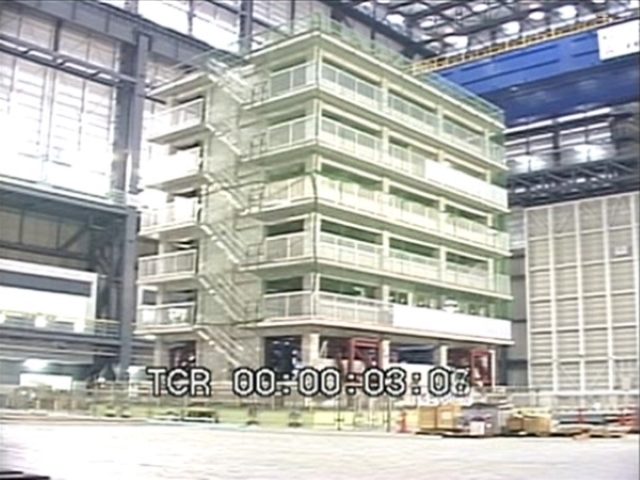
0506 Three-dimensional Seismic Structural Failure Experiment of Full-scale Reinforced Concrete Buildings
(Jan. 2006) ( Test Number: E200506 )Reinforced Concrete - Input Ground Motion
-
Jan. 13 - JMA Kobe motion (the 1995 Southern Hyogo Prefecture Earthquake) 100%
E200506_060113.wmv
Jan. 16 - JMA Kobe motion 60%
E200506_060116.wmv
-
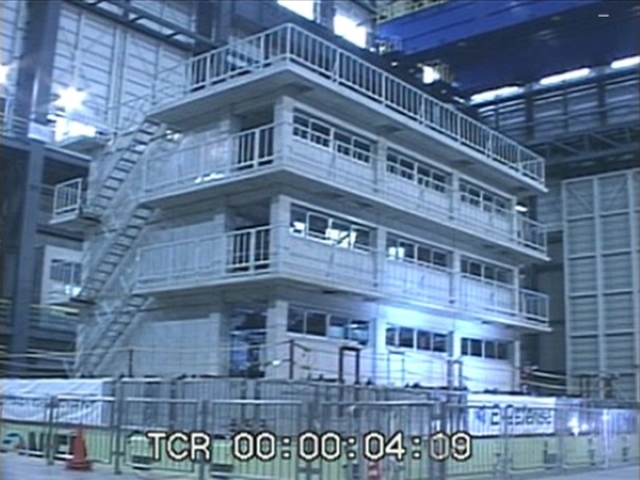
0604 Experiment of 3-stories RC Building imitating School Structure
(Sep. - Oct. 2006) ( Test Number: E200604 )Reinforced Concrete Furniture - Input Ground Motion
-
Oct. 2, Unreinforced specimen - JMA Kobe motion (the 1995 Southern Hyogo Prefecture Earthquake) 100%
E200604_061002.wmv
Nov. 1, Retrofit specimen - JMA Kobe motion 130%
E200604_061101.wmv
-
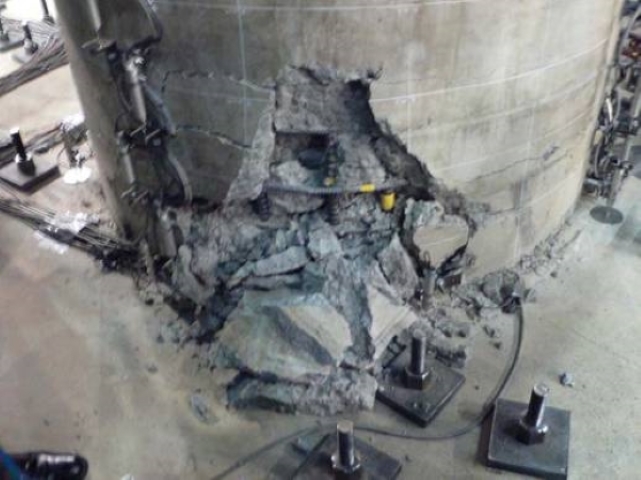
0705 Experimental Study of Seismic Performance of Bridge Component (C1-1)
(Dec. 2007) ( Test Number: E200705 )Reinforced Concrete - Input Ground Motion
-
Dec. 13 - JR Takatori motion (1995 Southern Hyogo Prefecture Earthquake) 100%
E200705_071213.wmv -
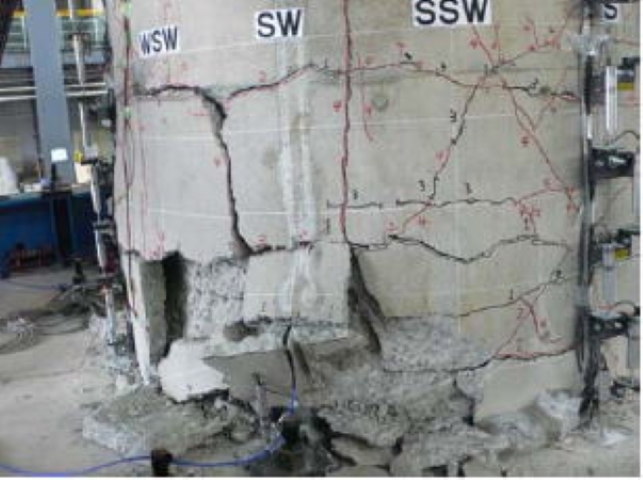
0802 Experimental Study of Seismic Performance of Bridge Component (C1-5)
(Aug. - Sep. 2008) ( Test Number: E200802 )Reinforced Concrete - Input Ground Motion
-
Aug. 26 – The 2nd input of 100% JR Takatori motion (the 1995 Southern Hyogo Prefecture Earthquake)
E200802_080826.wmv
Sep. 2 - The third time input of 125% JR Takatori motion
E200802_080902.wmv
-
0802.1 Experimental Study of Seismic Performance of Bridge Component (C1-2)
(Oct. 2008) ( Test Number: E200802 )Reinforced Concrete - Input Ground Motion
-
Oct. 2 - JR Takatori motion (the 1995 Southern Hyogo Prefecture Earthquake) 100%
E200802_081002.wmv -
0805 Experiment to Evaluate Maintenance of Functions of Important Facility, Medical Facility
(Dec. 2008 & Jan. 2009) ( Test Number: E200805 )Reinforced Concrete Isolation/Damping Equipment Furniture - Input Ground Motion
-
JMA Kobe motion (the 1995 Southern Hyogo Prefecture Earthquake) 80%,
near fault earthquake & Expected ground motion for Sannomaru area,
Nagoya from a scenario Tokai-Tonankai earthquake
Comparison of the fixed- and isolated-base structures
E200805_090122.wmv
-
0902 Study on Operation and Control of Shaking Table in Structural Failure Process
(Jun. 2009) ( Test Number: E200902 )Reinforced Concrete - Input Ground Motion
-
Jun. 18 - JR Takatori motion (the 1995 Southern Hyogo Prefecture Earthquake) 150%
Overall view: E200902_090618_1.mpg
Detailed view of column specimens: E200902_090618_2.mpg
-
0909 Experimental Study of Seismic Performance of Bridge Component (C1-6)
(Feb. & Mar. 2010) ( Test Number: E200909 )Reinforced Concrete - Input Ground Motion
-
Feb. 26 - The 2nd excitation of JR Takatori motion (the 1995 Southern Hyogo Prefecture Earthquake) 100%
E200909_100226_1.wmv
E200909_100226_2.wmv
Mar. 2 - The 4th excitation of JR Takatori motion 125%
E200909_100302_1.wmv
E200909_100302_2.wmv
-
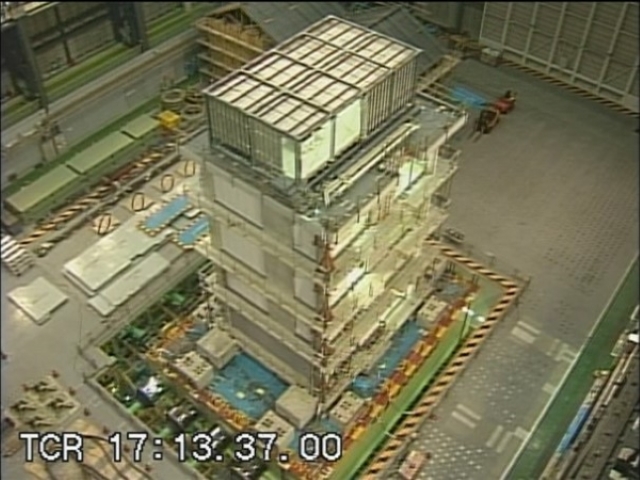
1002 Shaking Table Experiments for Enhancing the Functional Integrity of Important Facilities
(Aug. & Oct. 2010) ( Test Number: E201002 )Reinforced Concrete Isolation/Damping Equipment Furniture - Input Ground Motion
-
Oct. 10, Seismic-resistant structure - JMA Kobe motion (the 1995 Southern Hyogo Prefecture Earthquake) 2-horizontal directions 80%
Overall view: E201002_101021_1.mpeg
Staff station at the 2nd floor: E201002_101021_2.mpeg
Operation room at the 3rd floor: E201002_101021_3.mpeg
-
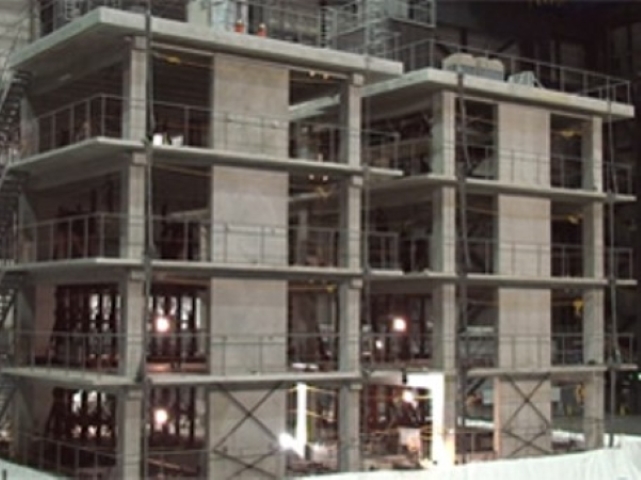
1004 Experiment of Concrete Building, Equipment and Piping
(Dec. 2010) ( Test Number: E201004 )Reinforced Concrete Equipment - Input Ground Motion
-
Dec. 13 - JMA Kobe motion (the 1995 Southern Hyogo Prefecture Earthquake) 50%
E201004_101213.wmv
-
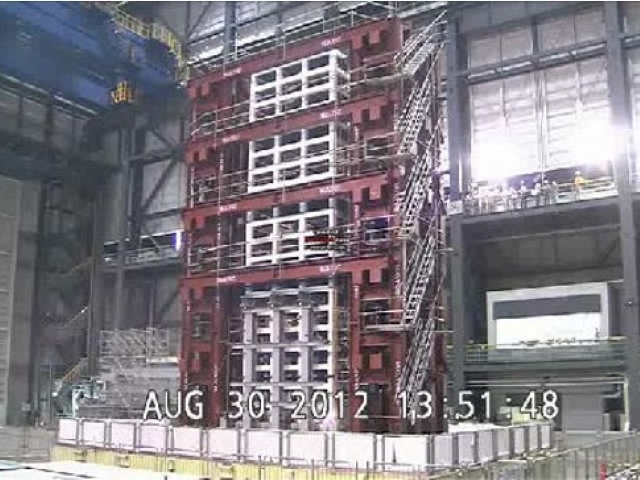
1203 Study on Verification of Seismic Performance of RC Buildings subjected to Long-Period Ground Motion
(Aug. 2012) ( Test Number: E201203 )Reinforced Concrete - Input Ground Motion
-
Aug. 30 - Expected seismic motion in Nankai Trough Earthquake, Tsushima motion 200%
Overall view from South: E201203_120830_1.mpeg
Around a column base at the 1st floor: E201203_120830_2.mpeg
Around a beam-column joint at the 6th floor: E201203_120830_3.mpeg
-
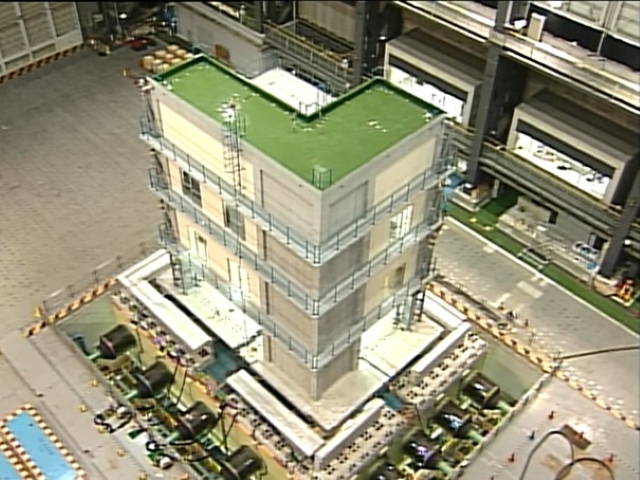
1206 Performance Verification Test on Long-periodization Upgrade of E-Defense
(Mar. & Apr., 2013) ( Test Number: E201206 )Reinforced Concrete Isolation/Damping - Input Ground Motion
-
Apr. 1 - K-NET Furukawa motion (the 2011 off the Pacific coast of the Tohoku earthquake) 100%
Bird view: E201206_130401.wmv -
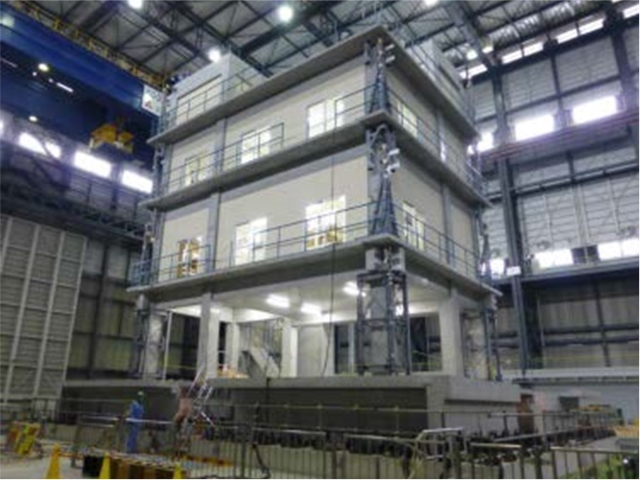
1301 Shake Table Test for Development of the Measure to Mitigate the Damage by Collision of Base-isolation Building to Retaining Wall
(Aug. 2013) ( Test Number: E201301 )Reinforced Concrete Isolation/Damping - Input Ground Motion
-
Aug. 26 - K-NET Furukawa motion (the 2011 off the Pacific coast of the Tohoku earthquake) 136%
Overall view: E201301_130826_1.mp4
Isolated building and retaining wall: E201301_130826_2.mp4
4F Art room: E201301_130826_3.mp4
4F Classroom: E201301_130826_4.mp4
-
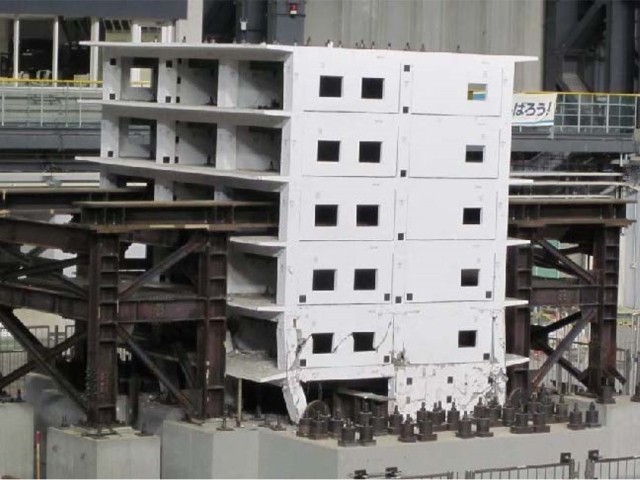
1401 Shake Table Experiment of Downsized 6-story RC Building with Earthquake Resisting Wall Frame
(Jan. 2015) ( Test Number: E201401 )Reinforced Concrete - Input Ground Motion
-
Jan. 22 - JMA Kobe motion (the 1995 Southern Hyogo Prefecture Earthquake) 140%
Overall view: E201401_150122_1.mp4
Wall at the 1st floor: E201401_150122_2.mp4
Wall at the 2nd floor: E201401_150122_3.mp4
-
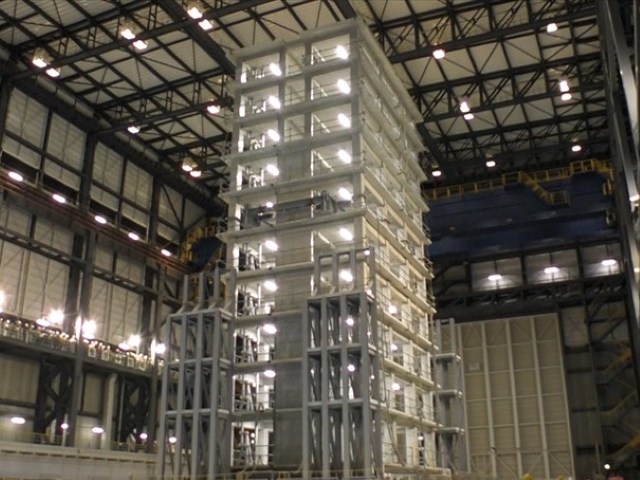
1506 Experiments on the Collapse Mechanism of a 10-story RC Structure based on the Current Seismic Design Standards and on Popular High-seismic-resistant Technology
(Dec. 2015) ( Test Number: E201506 )Reinforced Concrete - Input Ground Motion
-
Dec. 11 - JMA Kobe motion (the 1995 Southern Hyogo Prefecture Earthquake) 100%
Overall view: E201506_151211_1.wmv
Beam-column joint at the fourth floor: E201506_151211_2.wmv
-
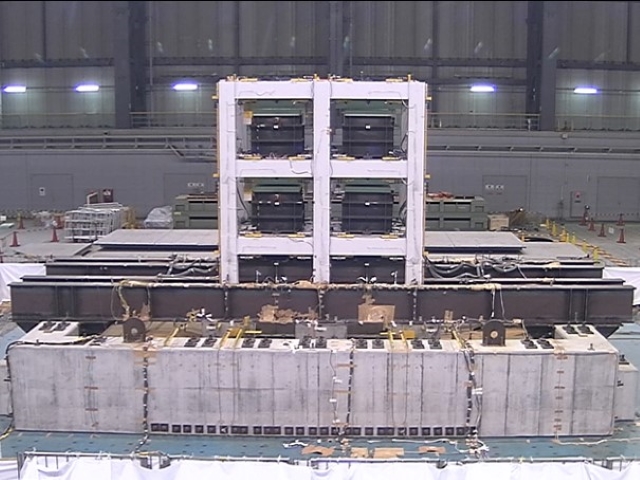
1602 Shake Table Experiment of RC Frame Building and Pile Foundation to verify Monitoring Technology
(Feb. 2017) ( Test Number: E201602 )Reinforced Concrete Geotech - Input Ground Motion
-
Feb. 6 - Artificial motion simulated by assuming Magnitude 8.0, Depth of epicenter 30 km, and Distance from epicenter 50 km 300%
Column base at the first floor: E201602_170206_1.mp4
Footing: E201602_170206_2.mp4
Steel beam close to the top of the soil container: E201602_170206_3.mp4
Overall view from North: E201602_170206_4.mp4
-
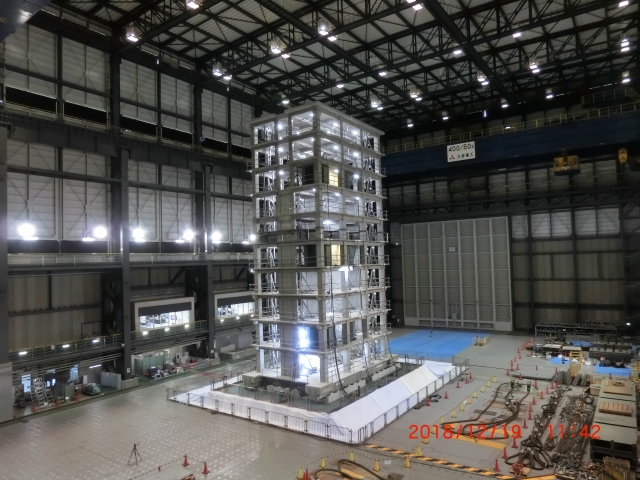
1805 Experiment on Seismic Performance of High Earthquake Resistance RC Building and Popular-type High Seismic Performance Technology
(Dec. 2018 & Jan. 2019) ( Test Number: E201805 )Reinforced Concrete - Input Ground Motion
- Jan. 9 - JMA Kobe motion (the 1995 Southern Hyogo Prefecture Earthquake) 100%: E201805_190109.mpeg
-
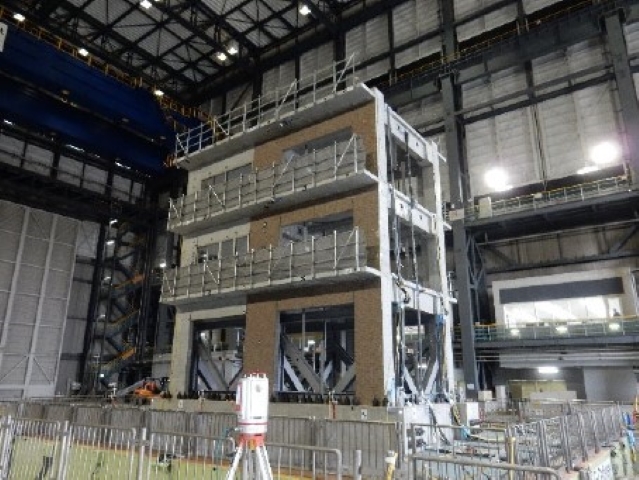
1905 Shaking Experiment to develop the Method for Evaluation of Safety and Continuous Usage of Disaster Bases
(Dec. 2019) ( Test Number: E201905 )Reinforced Concrete - Input Ground Motion
-
Dec. 4 - Artificial motion in Y-direction
Overall view from South: E201905_191204_1.wmv.wmv
Above ceiling at the second floor: E201905_191204_2.wmv.wmv
The first and the second floors from South: E201905_191204_3.wmv.wmv
-
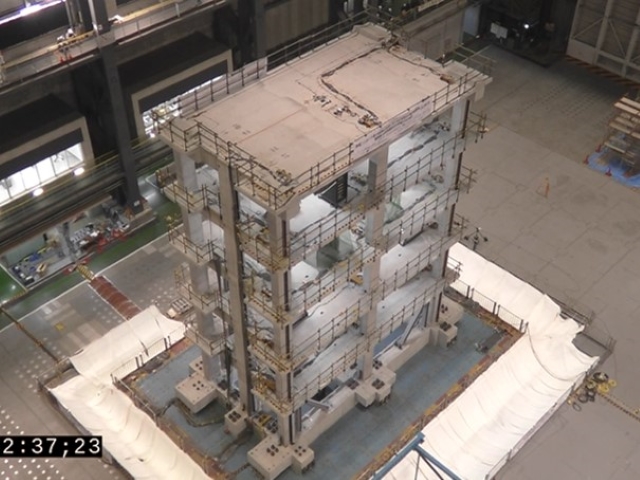
2002 Experiment of Evaluation of Yield Point and Attenuation of 5-story RC Construction Building / Medium-rise RC Construction Building
(Oct. 2020) ( Test Number: E202002 )Reinforced Concrete - Input Ground Motion
-
Oct. 19 - Notice wave El Centro NS-component wave phase 125%
Overall view: E202002_201019_1.mp4
4F & 5F: E202002_201019_2.mp4
0506
Three-dimensional Seismic Structural Failure Experiment of Full-scale Reinforced Concrete Buildings
(Jan. 2006) (
Test Number: E200506 )
As a part of “Special Project for Earthquake Disaster Mitigation in Urban Areas,” supported by the Ministry of Education, Culture, Sports, Science and Technology (MEXT), a shaking table experiment of full-scale 6-story reinforced concrete (RC) building had been conducted. The test specimen was 12 m long, 17 m wide, 16 m tall, 6-story building and its weight was around 1,000 tonf which was the heaviest test structure ever since E-Defense started running. The structure was designed based on the code of design and practice in 1970’s. The test specimen was subjected to the record of the 1995 Southern Hyogo Prefecture Earthquake and the behavior was studied to obtain necessary data for upgrading earthquake-resistance improvement technology of RC building.
Detailed information and acquired data and images from this experiment are available in E-Defense Data Archive, ASEBI.
DOI: https://doi.org/10.17598/NIED.0020-E200506
Experiment Overview:E200506.pdf
Application for Use of Video Materials
×
0604
Experiment of 3-stories RC Building imitating School Structure
(Sep. - Oct. 2006) (
Test Number: E200604 )
As a part of “Special Project for Earthquake Disaster Mitigation in Urban Areas,” supported by the Ministry of Education, Culture, Sports, Science and Technology (MEXT), shaking table experiments of 3-story reinforced concrete (RC) school buildings was conducted under the leadership of Prof. Toshimi Kabeyasawa of Earthquake Research Institute, the University of Tokyo. The main objectives were to validate input dissipation and seismic retrofit effect. The test specimens were two 3-story RC building structures. One was a bare RC specimen, simulating an old and non-ductile school building. The other was a retrofit specimen, which was constructed in the exactly same design as the bare RC specimen but strengthened with attached steel braces. Those test structures were constructed on a pool-shaped container each which were simulating the flexible boundary condition of the spread foundation and neighborhood soils.
Detailed information and acquired data and images from this experiment are available in E-Defense Data Archive, ASEBI.
DOI: https://doi.org/10.17598/NIED.0020-E200604
Experiment Overview: E200604.pdf
Application for Use of Video Materials
×
0705
Experimental Study of Seismic Performance of Bridge Component (C1-1)
(Dec. 2007) (
Test Number: E200705 )
To investigate the failure mechanisms of reinforced concrete (RC) bridge piers that sustained extensive damage during the 1995 Southern Hyogo Prefecture Earthquake, shaking table tests were conducted on full-scale RC bridge pier specimens designed according to 1960s design standards. The input ground motion applied to the shaking table was equivalent to that observed at JR Takatori Station during the 1995 Southern Hyogo Prefecture Earthquake.
Detailed information and acquired data and images from this experiment are available in E-Defense Data Archive, ASEBI.
DOI: https://doi.org/10.17598/NIED.0020-E200705
Experiment Overview: E200705.pdf
Application for Use of Video Materials
×
0802
Experimental Study of Seismic Performance of Bridge Component (C1-5)
(Aug. - Sep. 2008) (
Test Number: E200802 )
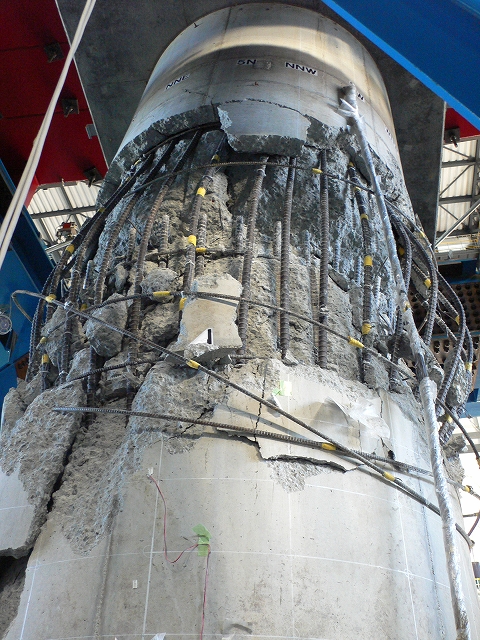
In order to reproduce the severe damage caused to RC bridge piers by the Southern Hyogo Prefecture Earthquake, shaking table tests were conducted on a test specimen of an RC bridge pier with step-down main reinforcement bars, which was constructed in the 1970s. The column of the test specimen had a circular cross-section with a diameter of 1.8m, a height of 7.5m, and the foundation was 7.0m long, 7.0m wide and 1.8m high, with a total weight of approximately 300t. When the actual observation record of the Southern Hyogo Prefecture Earthquake was input, it was possible to reproduce the actual damage situation, and data was obtained that captured the destruction process, which had never been seen before.
Detailed information and acquired data and images from this experiment are available in E-Defense Data Archive, ASEBI.
DOI: https://doi.org/10.17598/NIED.0020-E200802
Experiment Overview: E200802_1.pdf
,
E200802_2.pdf
Application for Use of Video Materials
×
0802.1
Experimental Study of Seismic Performance of Bridge Component (C1-2)
(Oct. 2008) (
Test Number: E200802 )
To confirm whether RC bridge piers designed and constructed using current design methods have sufficient strength to withstand earthquakes of the magnitude of the Southern Hyogo Prefecture Earthquake, a shaking table test was conducted using a test specimen of an RC pier based on current design standards. The test specimen had a circular cross-section with a diameter of 2.0m, a column height of 7.5m, a foundation with dimensions of 7.0m x 7.0m x 1.8m, and a total weight of approximately 310t. The observed seismic motion of the Southern Hyogo Prefecture Earthquake was input into the specimen. This experiment proved that bridge piers designed and constructed using current design methods have sufficient strength.
Detailed information and acquired data and images from this experiment are available in E-Defense Data Archive, ASEBI.
DOI: https://doi.org/10.17598/NIED.0020-E200802
Experiment Overview: E200802_3.pdf
Application for Use of Video Materials
×
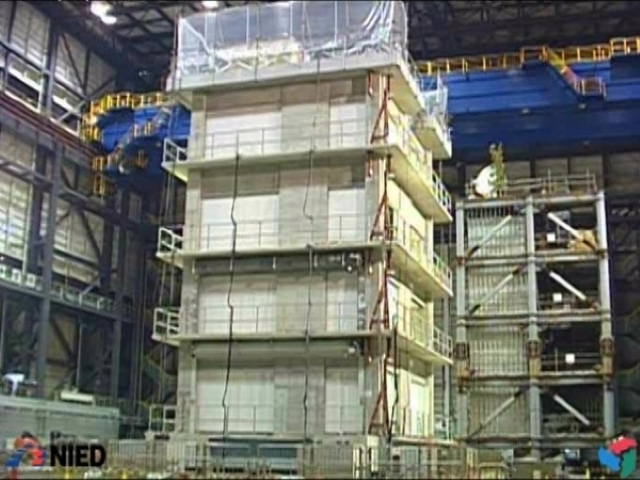
0805
Experiment to Evaluate Maintenance of Functions of Important Facility, Medical Facility
(Dec. 2008 & Jan. 2009) (
Test Number: E200805 )
Shaking table experiments had been conducted to evaluate ability of functional maintenance of medical facilities under earthquake disaster. A full-scale 4-story reinforced concrete building specimen simulating a hospital which contained a stuff station, a dialysis room, an operating room and a patient’s room each furnished with real medical equipment and furniture was set up to reproduce function of the medical facility more faithfully. Two hospitals of different kind of structure each, one for a base-fixed structure and the other for a seismic isolated structure, were compared and evaluated their functional maintenance by shaking table experiments. Comparative video of the experiments shows risk of the aseismic hospital and ability of functional maintenance of the seismic isolated hospital under a near fault earthquake ground motion. But even a seismic isolated structure which widely reduces damages against earthquake in general can be exposed to risk by long-period, long-duration earthquake ground motion such as synthetic ground motion for Sannomaru area, Nagoya from a scenario Tokai-Tonankai earthquake if one fails to take earthquake countermeasures.
Detailed information and acquired data and images from this experiment are available in E-Defense Data Archive, ASEBI.
DOI: https://doi.org/10.17598/NIED.0020-E200805
Experiment Overview: E200805.pdf
Application for Use of Video Materials
×
0902
Study on Operation and Control of Shaking Table in Structural Failure Process
(Jun. 2009) (
Test Number: E200902 )
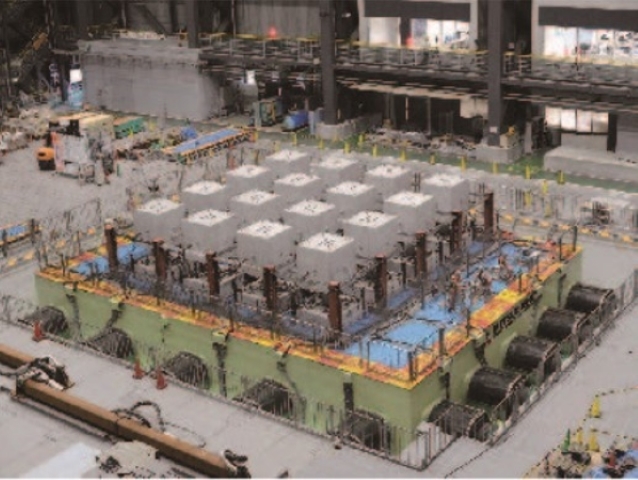
In this study, 16 RC column specimens were subjected to simultaneous excitation using E-Defense in order to evaluate uncertainties in their dynamic response. The test specimens were constructed by assuming a real pier with a square cross section of 2.4 m x 2.4 m and a girder of approximately 560 t at a height of 12 m from the base, which was reduced so that the aspect ratio of the length of the pier was 1/7.5. The specimen consists of a footing, a column and a deadweight. The column section was 320 mm x 320 mm square, and a reinforced concrete deadweight was fabricated on top of the column section to load the column with axial stresses. According to the scaling law, the center of gravity of the weight is designed to be 1600 mm above the pier base so that the axial stress at the pier base is equal to that of the original model. Seismic response and fracture characteristics such as input earthquake motion, response acceleration and response displacement of the specimens, and the variation in the behavior of the 16 specimens were considered, and their distribution shapes were quantitatively evaluated using the mean, standard deviation and coefficient of variation. As a result of inputting JR Takatori motions with gradually increasing scaling law consideration, it is found that the distribution shapes of various responses change as the response changes from linear to nonlinear.
Detailed information and acquired data and images from this experiment are available in E-Defense Data Archive, ASEBI.
DOI: https://doi.org/10.17598/NIED.0020-E200902
Application for Use of Video Materials
×
0909
Experimental Study of Seismic Performance of Bridge Component (C1-6)
(Feb. & Mar. 2010) (
Test Number: E200909 )
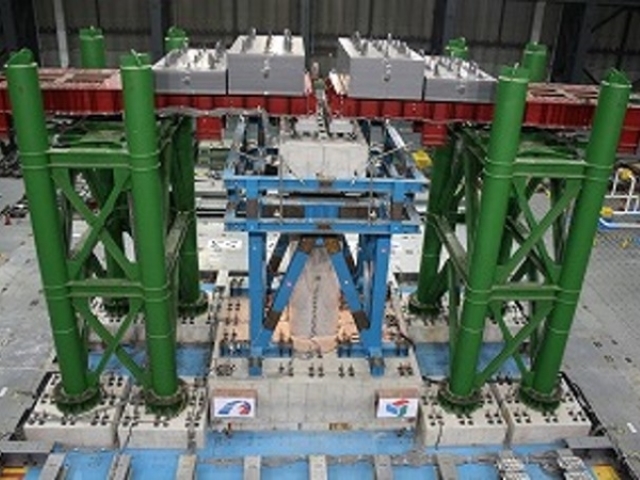
Shaking experiments of damage free reinforced concrete bridge pier were conducted at E-Defense. The bridge pier specimen was designed based on the current design specifications; however, the specimen had two special attributes, one was a new material, polypropylene fiber mixed reinforced cementitious composite, used to enhance the ductility capacity of the pier base where the severe damage occurs under strong excitation and the other was 0.4 m round corners in a square cross-section of the pier specimen. The pier specimen was 7.5 m tall and its foundation was 7.0 m long, 7.0 m wide and 1.8 m tall. Weight of superstructure was 310 tons. Shaking experiments were conducted for three days. The specimen was subjected to JR Takatori record (the 1995 Southern Hyogo Prefecture Earthquake) with varying amplitude. Small cracks were found at the base of the pier specimen after design level excitation, which was expected result. After that the specimen was excited twice same as before simulating aftershocks, it developed large crack but covering concrete of the new material did not spall off. It was clarified that damage free bridge pier with the new material enhanced seismic performance.
Detailed information and acquired data and images from this experiment are available in E-Defense Data Archive, ASEBI.
DOI: https://doi.org/10.17598/NIED.0020-E200909
Experiment Overview: E200909.pdf
Application for Use of Video Materials
×
1002
Shaking Table Experiments for Enhancing the Functional Integrity of Important Facilities
(Aug. & Oct. 2010) (
Test Number: E201002 )
In the event of a major earthquake in an urban area, it is important to maintain and continue urban functions such as politics, economy, medical care, and information distribution even after the disaster. However, the functional integrity of important facilities that constitute these urban functions is mostly unknown, and effective methods to enhance their functional integrity have not been adequately established. Therefore, as part of the “Special Project for Earthquake Disaster Mitigation in the Tokyo Metropolitan Area” commissioned by the Ministry of Education, Culture, Sports, Science and Technology (MEXT), a series of E-Defense experiments were conducted to investigate the functional integrity of important facilities with seismic-resistant and seismic-isolation structures.
The test specimen was a four-story reinforced concrete (RC) structure modeled a typical medical facility, with actual span and floor heights. First, an experiment was conducted on the seismic isolation structure by installing seismic isolation devices between the test specimen and the shaking table. Subsequently, the seismic isolation devices were removed, and the test specimen was bolted to the shaking table to conduct an experiment on the seismic-resistant structure. Main medical equipment and information and communication systems were installed in each room of the test structure, along with equipment such as sprinklers, fire hydrants, and medical gas pipes. During the shaking tests, short-period earthquake motions such as the El Centro and JMA Kobe motions, and long-period earthquake motions such as the San'no-maru motion were applied. The experiments provided various data and video footage regarding indoor and equipment damage in both earthquake-resistant and seismic isolation structures.
Detailed information and acquired data and images from this experiment are available in E-Defense Data Archive, ASEBI.
DOI: https://doi.org/10.17598/NIED.0020-E201002
Application for Use of Video Materials
×
1004
Experiment of Concrete Building, Equipment and Piping
(Dec. 2010) (
Test Number: E201004 )
A series of full-scale shaking experiments on a precast and post-tensioned concrete (PPC) structure were conducted to establish high-quake-resistant, productive and reparable concrete buildings. And experiments on a reinforced concrete (RC) structure with almost the same shape of the PPC structure were conducted to acquire usable data for the future development of seismic design method. In the experiments, both the PPC and RC structures were shaken at the same time (the PPC structure at the front and the RC structure at the back of the video). As for the two 4-story buildings, the story height of each floor was 3.0 m, and the long side of the rectangular plane was 14.4 m and the short side was 7.2 m.
Detailed information and acquired data and images from this experiment are available in E-Defense Data Archive, ASEBI.
DOI: https://doi.org/10.17598/NIED.0020-E201004
Experiment Overview: E201004.pdf
Application for Use of Video Materials
×
1203
Study on Verification of Seismic Performance of RC Buildings subjected to Long-Period Ground Motion
(Aug. 2012) (
Test Number: E201203 )
As part of the Ministry of Land, Infrastructure, Transport and Tourism's Building Standards Improvement Promotion Project for Fiscal Years 2010–2012, titled “Study on Verification of Seismic Performance of Reinforced Concrete Buildings Subjected to Long-Period Earthquake Motions,” E-Defense shake table tests were conducted to verify the seismic performance of super-high-rise reinforced concrete buildings under long-period earthquake motions. In the experiment, a 20-story super-high-rise RC test specimen (1/4 scale model) was constructed, and long-period seismic motions, including the observed ground motion of the 2011 Off the Pacific Coast of Tohoku Earthquake (Shinonome motion) and expected seismic motions of the Nankai Trough earthquake (Tsushima motion), were input to directly verify the behavior of the structure under these conditions. As planned, the maximum response inter-story drift angle of 1/200, 1/100, and 1/50 was achieved, and damage to beam ends, buckling, and slab deformation behavior were identified.
Detailed information and acquired data and images from this experiment are available in E-Defense Data Archive, ASEBI.
DOI: https://doi.org/10.17598/NIED.0020-E201203
Application for Use of Video Materials
×
1206
Performance Verification Test on Long-periodization Upgrade of E-Defense
(Mar. & Apr., 2013) (
Test Number: E201206 )
In the 2011 off the Pacific coast of Tohoku Earthquake, the complicated rupture process of the fault that was the source of the seismic motion caused large earthquakes to continue for a long time. Research and development to clarify the damage caused by long-duration, long-period seismic motion and to develop mitigation technology for such damage, which occurs when a large subduction earthquake occurs, is an important issue, as is research and development for directly below earthquakes.
The National Research Institute for Earth Science and Disaster Resilience (NIED) is engaged in research and development using the E-Defense facility, and to promote research and development into long-period, long-duration seismic motion that occurs when a major subduction earthquake occurs, facilities have been upgraded to increase the long-period, long-duration capabilities of E-Defense. As a test to verify the performance improvements made by this upgrade, a full-scale 4-story seismic isolation building (reinforced concrete construction, size: 11.8m x 8.0m x 14.9mH) weighing approximately 1,000 tons was placed on the shake table and shaken by earthquake motion containing a large amount of long-period components, which could not be fully reproduced before the upgrade.
Detailed information and acquired data and images from this experiment are available in E-Defense Data Archive, ASEBI.
DOI: https://doi.org/10.17598/NIED.0020-E201206
Application for Use of Video Materials
×
1301
Shake Table Test for Development of the Measure to Mitigate the Damage by Collision of Base-isolation Building to Retaining Wall
(Aug. 2013) (
Test Number: E201301 )
Seismic isolation technology is one of the most effective methods for not only reducing damage to buildings during earthquakes, but also for maintaining the functionality of buildings. Some of the seismic isolation buildings experienced the 2011 off the Pacific coast of Tohoku Earthquake, and they greatly contributed to reducing the damage to the buildings. However, there were some cases where the damage had a negative impact on the functionality of the buildings, such as the runaway of equipment with casters inside the room, and it has become clear that earthquake countermeasures are also necessary for seismic isolation buildings. In addition, in recent years, there have been concerns about the lack of verification of the safety of seismic isolation devices that are repeatedly subjected to large deformations due to long-period, long-duration seismic motion, which has not been considered in most designs to date. Therefore, a seismic isolation building and retaining wall were placed on the E-Defense shake table, and seismic motions observed in the 1995 Southern Hyogo Prefecture Earthquake and the 2011 Tohoku Pacific Offshore Earthquake were input. As a result, it became clear that if the clearance between the base-isolated building and the surrounding retaining wall is not designed appropriately, there is a possibility that the base-isolated building will collide with the retaining wall.
Detailed information and acquired data and images from this experiment are available in E-Defense Data Archive, ASEBI.
DOI: https://doi.org/10.17598/NIED.0020-E201301
Experiment Overview: E201301.pdf
Application for Use of Video Materials
×
1401
Shake Table Experiment of Downsized 6-story RC Building with Earthquake Resisting Wall Frame
(Jan. 2015) (
Test Number: E201401 )
The 2011 off the coast of Tohoku earthquake, the largest earthquake ever recorded in Japan, caused unprecedented damage mainly in eastern Japan, disrupting business and daily life in the Tokyo metropolitan area for an extended period and highlighting the vulnerability of large cities. As part of the Ministry of Education, Culture, Sports, Science and Technology (MEXT)-commissioned research project titled “Special Project for Reducing Vulnerability in Urban Mega Earthquake Disasters - develop technology for rapid damage assessment of high-rise office buildings which may be damaged during earthquakes,” a large-scale shake table experiment was conducted at the E-Defense facility. The experiment aimed to verify the detailed damage progression characteristics of buildings until full collapse, quantify the collapse margin of reinforced concrete buildings, and validate a monitoring system for assessing building integrity. In this experiment, reinforced concrete buildings were subjected to gradual destruction until collapse to verify their residual capacity and other characteristics.
A 30% scaled-down test specimen of a six-story reinforced concrete building (plan dimensions: 4.6 m × 5.4 m, height: 6.5 m, weight: approximately 320 tons) designed and constructed in accordance with current building codes was constructed. The test specimen was subjected to input of seismic waves observed during the 1995 Great Hanshin Earthquake (JMA Kobe motion). The results of the experiment provided a large amount of data on the damage progression process leading to collapse of structural members, as well as the relationship between the failure of walls and columns and the overall safety of the building.
Detailed information and acquired data and images from this experiment are available in E-Defense Data Archive, ASEBI.
DOI: https://doi.org/10.17598/NIED.0020-E201401
Application for Use of Video Materials
×
1506
Experiments on the Collapse Mechanism of a 10-story RC Structure based on the Current Seismic Design Standards and on Popular High-seismic-resistant Technology
(Dec. 2015) (
Test Number: E201506 )
Since the Southern Hyogo Prefecture Earthquake, there have been demands not only for the seismic performance, but also for the continued usability of important facilities such as hospitals and city halls. Since then, Japan has experienced a number of earthquakes, and in recent years there has been a growing demand for buildings such as houses and offices to be able to withstand earthquakes and continue to be used, in order to ensure the continuity of economic activity and rapid recovery.
In order to improve the seismic resilience of reinforced concrete buildings, which are often used for housing complexes, in November 2015 a shaking table test was conducted on a model of a housing complex, with a cast iron bearing (cast iron plate) installed at the base of the foundation. In addition, in December 2015, a shaking table test was conducted using the same specimen, but this time with the base of the specimen fixed to the shaking table. The series of tests confirmed that damage to the building structure could be mitigated by allowing the foundation to slip, and confirmed the building response characteristics during a major earthquake and the process by which the building structure reaches the point of damage.
Detailed information and acquired data and images from this experiment are available in E-Defense Data Archive, ASEBI.
DOI: https://doi.org/10.17598/NIED.0020-E201506
Experiment Overview: E201506.pdf
Application for Use of Video Materials
×
1602
Shake Table Experiment of RC Frame Building and Pile Foundation to verify Monitoring Technology
(Feb. 2017) (
Test Number: E201602 )
In the face of the major earthquake that could strike in the near future, improving the resilience of cities has become an urgent issue. In order to improve resilience, it is essential to be able to assess the structural condition of buildings immediately after a major earthquake. As part of the “the Special Project for Reducing Vulnerability in Urban Mega Earthquake Disasters”, in February 2017 an experiment was conducted to verify the structural health monitoring technology for buildings and foundation structures. The experiment was conducted on a reinforced concrete building supported by pile foundations in the ground, with the structure, piles and ground as a single coupled system. In this experiment, two stages of shaking table tests were conducted, consisting of damage to the soil-pile coupled system and damage to the superstructure. In the first stage, damage to the soil-pile coupled system was reproduced by conducting coupled system tests of the superstructure, soil and pile, and in the second stage, damage to the superstructure was reproduced by conducting tests on a building with a fixed foundation. The shaking level was gradually increased, and detailed data was measured until the pile itself and the building were damaged. The series of experiments has provided valuable data that is necessary for understanding the behavior of the coupled system of soil-pile-structure and the process by which each part reaches the point of damage.
Detailed information and acquired data and images from this experiment are available in E-Defense Data Archive, ASEBI.
DOI: https://doi.org/10.17598/NIED.0020-E201602
Experiment Overview: E201602.pdf
Application for Use of Video Materials
×
1805
Experiment on Seismic Performance of High Earthquake Resistance RC Building and Popular-type High Seismic Performance Technology
(Dec. 2018 & Jan. 2019) (
Test Number: E201805 )
Even if buildings do not collapse after a major earthquake, damage may occur that renders them unusable, causing significant disruptions to post-earthquake life. The National Research Institute for Earth Science and Disaster Resilience aim to develop new seismic resistance technologies that will enable buildings to continue to be used even after a major earthquake. In fiscal 2015, shake table tests (E201506) were conducted on a 10-story reinforced concrete structure designed for mid-rise apartment buildings in the current design standard to verify the damage process of test specimens. Based on the results of this experiment, another experiment was conducted to verify the new seismic resistance technology, the foundation sliding method developed through research and development in fiscal 2018.
The test specimen used in this experiment is the same as that used in the 2015 experiment: a 10-story reinforced concrete building (plan shape: 13.5 m × 9.5 m, height: 27.45 m, weight: approximately 930 tons). In the experiment, seismic motions observed in the Southern Hyogo Prefecture earthquake were reproduced on a shaking table to obtain further data for the promotion of the foundation sliding method and to verify a construction method that suppresses damage to the joints between columns and beams, which was observed in the previous experiment. The results of the experiment confirmed that the sliding and uplift behavior of the foundation of the building with the foundation sliding method was observed, and that the deformation of the building was suppressed by the sliding of the foundation. Additionally, after multiple inputs of the seismic ground motion observed during the Southern Hyogo Prefecture earthquake, no significant cracks were observed in the column-beam joints reinforced with additional bracing.
Detailed information and acquired data and images from this experiment are available in E-Defense Data Archive, ASEBI.
DOI: https://doi.org/10.17598/NIED.0020-E201805
Application for Use of Video Materials
×
1905
Shaking Experiment to develop the Method for Evaluation of Safety and Continuous Usage of Disaster Bases
(Dec. 2019) (
Test Number: E201905 )
In the “Tokyo Metropolitan Resilience Project ” - a project subsidized by the Ministry of Education, Culture, Sports, Science and Technology - E-Defense is being used to collect and maintain data on the maintenance of building functions, including interior and exterior materials, furniture, fixtures, and piping, and on the seismic margin of buildings until they collapse, with the aim of quickly restoring urban functions in the event of a major earthquake, identifying damage, and carrying out repairs.
In this experiment, focusing on buildings that serve as bases in the event of a disaster, shaking table experiments were conducted on a three-story reinforced concrete structure with reinforced earthquake resistance, from the perspective of ensuring the continued usability of base buildings after an earthquake, and data was collected and organized that would contribute to the development of a system for assessing the functionality of non-structural components such as ceilings, windows, exterior wall tiles, and rooftop piping, as well as for assessing damage to structural and non-structural components. The test specimen is a three-story building that is almost the same size as a full-scale building, and is designed to be a disaster response base. It is designed in accordance with the Design Guideline for Buildings at Disaster Bases, and has a floor plan of 1 x 2 spans, with a size of approximately 5m x 10m. It is vibrated in the two-span direction. The floor height is 4m on the first floor and 3.2m on the second floor and above, based on a typical government office building.
Detailed information and acquired data and images from this experiment are available in E-Defense Data Archive, ASEBI.
DOI: https://doi.org/10.17598/NIED.0020-E201905
Application for Use of Video Materials
×
2002
Experiment of Evaluation of Yield Point and Attenuation of 5-story RC Construction Building / Medium-rise RC Construction Building
(Oct. 2020) (
Test Number: E202002 )
In disaster base facilities, where strong continuity of function after an earthquake is required, not only is a careful damage assessment of the structural framework supporting the building, such as columns and walls, important, but the building's response deformation from the perspective of the deformation followability of non-structural components and equipment is also an important design criterion. Structural analysis for determining the ultimate capacity of buildings is the only structural analysis method that can clearly evaluate the seismic response deformation of buildings, except for time-history response analysis, which requires certification by the Minister of Land, Infrastructure, Transport and Tourism. However, the verification accuracy of the calculated response deformation varies significantly depending on the evaluation method for seismic damping characteristics, which is derived from the plasticity ratio of members. Based on the above, an E-Defense experiment was conducted in collaboration with the Horie Architectural Engineering Research Institute, Chubu University, the Earthquake Research Institute of the University of Tokyo, and others, with the aim of developing a new evaluation method for the yield point of members, the primary cause of variability and improving the accuracy of response deformation calculations in limit load capacity assessments. A test specimen was fabricated with a scale of 80%, consisting of a five-story reinforced concrete pure frame structure, weighing approximately 660 tons, with a standard floor area of 12 m × 6 m = 72 m², and a height of 17.6 m. The specimen was subjected to the maximum acceleration of approximately 600 gal of the El Centro NS wave phase of the notice wave. The data obtained from the experiment were analyzed, and the results were used to make recommendations for the current design method.
Detailed information and acquired data and images from this experiment are available in E-Defense Data Archive, ASEBI.
DOI: https://doi.org/10.17598/NIED.0020-E202002
Application for Use of Video Materials
×