
Experiment Videos and Materials
Experiment Videos
When using these videos or other materials in public settings, please click on “Application for Use of Video Materials” at the bottom of each experiment introduction page. After agreeing to the “Terms of Use” described on the application page, submit your application for use.
Others
-
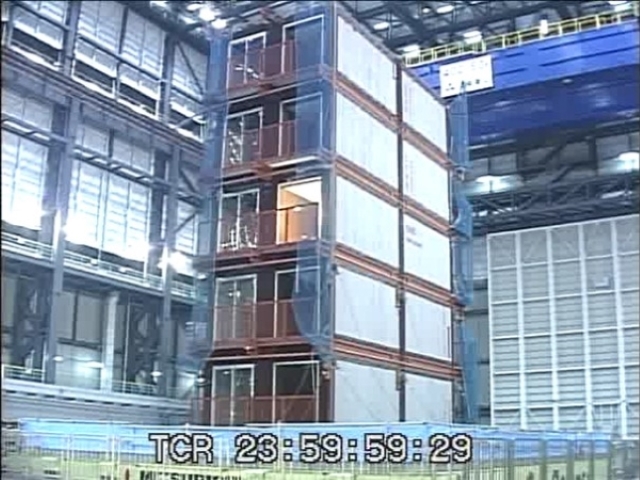
0602 Soleil Project: Seismic Experiment for Unit Houses
(Jul. 2006) ( Test Number: E200602 )Others - Input Ground Motion
-
Jul. 20 - JR Takatori motion (the 1995 Southern Hyogo Prefecture Earthquake) 75 kine
E200602_060720.mpeg
-
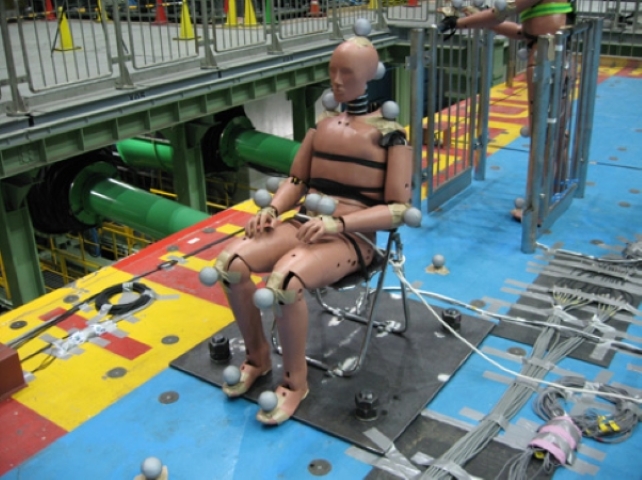
0901 Human Body Dummy Test
(Jun. 2009) ( Test Number: E200901 )Others - Input Ground Motion
-
Jun.10 - JMA Kobe motion (the 1995 Southern Hyogo Prefecture Earthquake) 155%
A male pedestrian type & a male seated type: E200901_090610_1.mpeg
A female seated type, and a 3-year-old child seated type: E200901_090610_2.mpeg
-
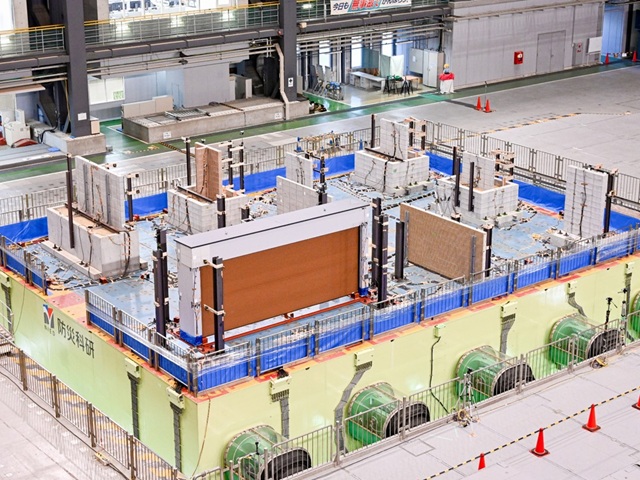
2302 Verification of Seismic Performance of Concrete Block Walls
(Oct. 2023) ( Test Number: E202302 )Others - Input Ground Motion
-
Oct. 16 - Notification wave (El Centro NS-component phase) in Y-axis, E202302_231016.mp4
0602
Soleil Project: Seismic Experiment for Unit Houses
(Jul. 2006) (
Test Number: E200602 )
【Facility Rental Experiment Conducted by Soleil Project Co., Ltd.】
Using a construction method that stack 40-foot containers (2.5 m × 12 m × 2.9 m) as residential units, a five-story building test specimen was constructed (two units per floor × five floors = 10 units). with the aim of confirming its seismic performance. Using the JR Takatori motion of the 1995 Southern Hyogo Prefecture Earthquake as the excitation input, the test specimen survived without collapse at the motion with 50 kine of the maximum velocity, and the results were in good agreement with the pre-analysis up to 50 kine. At 75 kine, responses exceeding the pre-analysis values were observed.
Detailed information and acquired data and images from this experiment are available in E-Defense Data Archive, ASEBI.
DOI: https://doi.org/10.17598/NIED.0020-E200602
Application for Use of Video Materials
×
0901
Human Body Dummy Test
(Jun. 2009) (
Test Number: E200901 )
In order to investigate the psychological effects of seismic motion on humans, it is necessary to expose test subjects to seismic motion by placing people on a shaking table. However, because E-Defense can destroy structures, there is also a risk of injuring test subjects. Therefore, when considering experiments that involve placing test subjects on E-Defense, it is necessary to take precautions against the inherent risks. To help make a quantitative assessment of the response of the human body when subjected to large input motions on a shake table, shaking table tests were conducted using human body dummies. To see the differences in response between individuals and the differences due to posture, four dummies were used: a male pedestrian type, a male seated type, a female seated type, and a 3-year-old child seated type. Inputs such as the observed motion of the 1995 Southern Hyogo Prefecture Earthquake were used. Based on the results, an examination was carried out into the impact of seismic motion on the human body during an earthquake.
Detailed information and acquired data and images from this experiment are available in E-Defense Data Archive, ASEBI.
DOI: https://doi.org/10.17598/NIED.0020-E200901
Application for Use of Video Materials
×
2302
Verification of Seismic Performance of Concrete Block Walls
(Oct. 2023) (
Test Number: E202302 )
The Japanese Building Standards Law and the Architectural Institute of Japan (AIJ) currently specify standards for the height and structure of concrete block walls. However, the construction of certain concrete block walls was undertaken without adherence to these established standards, while others have experienced deterioration over time. Garage gates composed of concrete blocks are susceptible to overturning and necessitate enhancements in seismic performance. Concrete block walls have been the subject of numerous studies, which have verified their structural performance through static and dynamic loading tests. However, there is still a lack of knowledge regarding seismic reinforcement methods and the influence of foundation embedment on dynamic response. In consideration of these factors, the E-Defense experiment sought to elucidate the dynamic response characteristics and seismic performance of concrete block walls and steel garage gates equipped with shutters. The objective of the experiment was twofold: first, to substantiate the validity of prevailing design standards, and second, to acquire knowledge that could contribute to the establishment of new standards for concrete block walls and the development of seismic reinforcement methods for walls with inadequate seismic performance.
The test specimens utilized in the E-Defense experiment are listed below:
(1) Seismic reinforcement steel frames for concrete block walls embedded in the ground;
(2) A new construction method for concrete block walls;
(3) Concrete block walls with a retaining wall embedded in the ground designed according to AIJ guidelines;
(4) A noncompliant reinforced concrete block wall;
(5) A steel garage gate with a shutter;
(6) Large void reinforced masonry walls with an L-shaped foundation;
(7) A concrete block wall with an L-shaped foundation;
(8) A concrete block wall with an I-shaped foundation embedded in the ground;
(9) A concrete block wall with an L-shaped foundation embedded in the ground.
The objectives were achieved by verifying the seismic performance and other characteristics of the specimens through vibration testing.
Detailed information and acquired data and images from this experiment are available in E-Defense Data Archive, ASEBI.
DOI: https://doi.org/10.17598/NIED.0020-E202302
Application for Use of Video Materials
×