
Experiment Videos and Materials
Experiment Videos
When using these videos or other materials in public settings, please click on “Application for Use of Video Materials” at the bottom of each experiment introduction page. After agreeing to the “Terms of Use” described on the application page, submit your application for use.
Non-structural
-
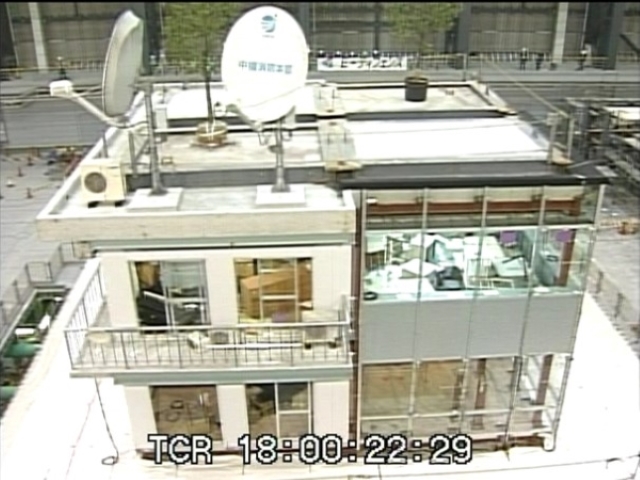
0608 Examination of Destruction of Non-structural Members and Fall of Utensils by Long-period Earthquake Ground Motion in High-rise Building
(Mar. 2007) ( Test Number: E200608 )Non-structural Furniture - Input Ground Motion
-
Mar. 29 - Expected ground motion from a scenario Nankai earthquake (continued period: 180 seconds)
E200608_070329.wmv
-
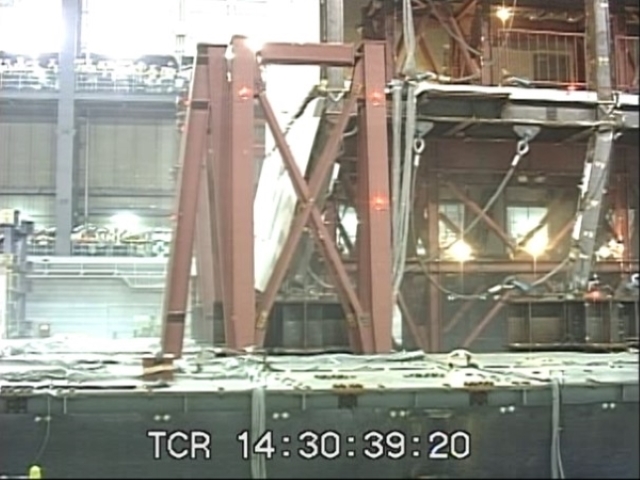
0703 Experimental Study on Complete Collapse of Steel Frame Building
(Sep. 2007) ( Test Number: E200703 )Steel Frame Non-structural - Input Ground Motion
-
Sep. 25 - JR Takatori motion (the 1995 Southern Hyogo Prefecture Earthquake) 40%
E200703_070925.wmv
Sep. 27 - JR Takatori motion 100%
E200703_070927.wmv
-
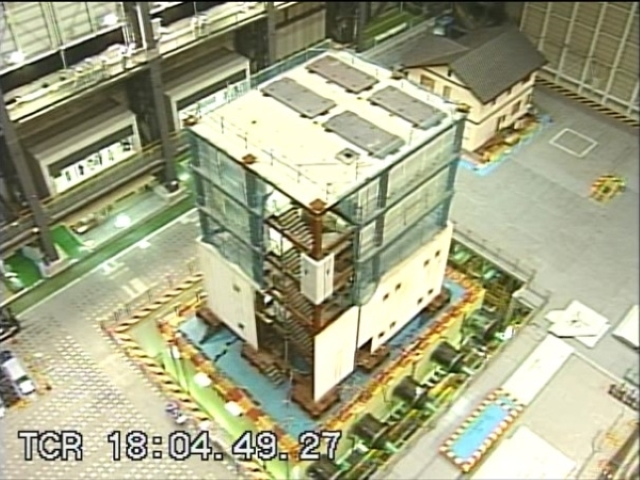
1102 Japan-US Collaborative Research on Innovative Seismic Isolation Solution
(Aug. 2011) ( Test Number: E201102 )Steel Frame Isolation/Damping Non-structural Furniture - Input Ground Motion
-
Aug. 18, 26 and 31 - K-NET Iwanuma motion (the 2011 off the Pacific Coast of Tohoku Earthquake) 70% and 100%:
E201102_1108en.mpeg
-
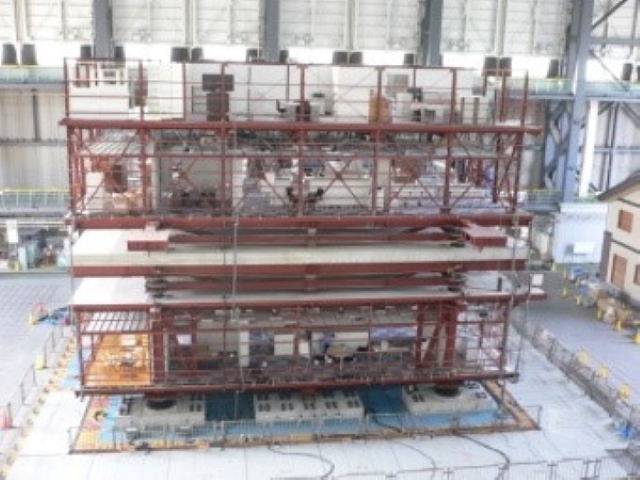
1103 Research and Development of the Measures for Damage Mitigation caused by Long-period Ground Motion
(Oct. 2011) ( Test Number: E201103 )Non-structural Equipment Furniture - Input Ground Motion
-
Oct. 7, Case 1 The high-rise building model
Nishi-Shinjuku motion (aftershock in the 2011 Off the Pacific Coast of Tohoku Earthquake) 330%
1007Shinjuku330_CCD1.wmv: E201103_1007_1.wmv
1007Shinjuku330_CCD4.wmv: E201103_1007_2.wmv
1007Shinjuku330_HV1.wmv: E201103_1007_3.wmv
1007Shinjuku330_HV3.wmv: E201103_1007_4.wmv
Oct. 12, Case 2 The low-rise building model
JMA Kobe motion (the 1995 Southern Hyogo Prefecture Earthquake) 75%
1012Kobe75_CCD1.wmv: E201103_1012_1.wmv
1012Kobe75_CCD4.wmv: E201103_1012_2.wmv
1012Kobe75_HV1.wmv: E201103_1012_3.wmv
1012Kobe 75_HV3.wmv: E201103_1012_4.wmv
Comparison between the high- and low-rise building models
Shinjuku330%_CCD.wmv: E201103_1007.wmv
Kobe25%_CCD.wmv: E201103_1012.wmv
-
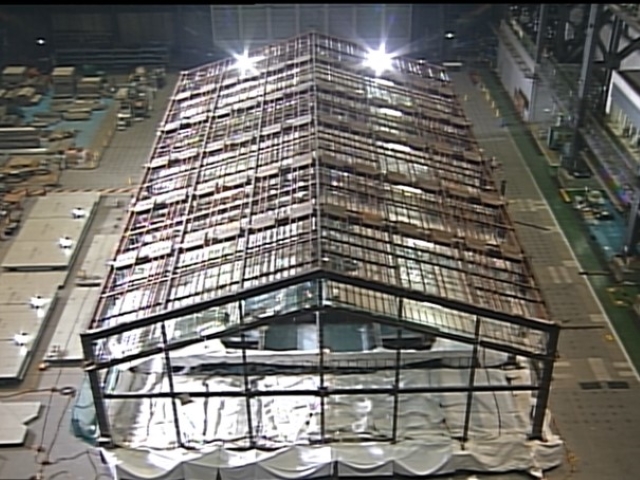
1306 Experiment on Non-Structural Components Installed in Large-Spanned Building Structures
(Jan. & Feb. 2014) ( Test Number: E201306 )Steel Frame Non-structural - Input Ground Motion
-
Jan. 28, Non-seismic-resistant ceiling
The 1st input of K-NET Sendai motion (the 2011 off the Pacific coast of the Tohoku earthquake) 50%: E201306_140128_1.wmv
The 2nd input of K-NET Sendai motion 50%: E201306_140128_2.wmv
Feb. 27, Seismic-resistant ceiling
K-NET Sendai motion 50%: E201306_140227.wmv
Feb. 28, Seismic-resistant ceiling
K-NET Sendai motion 100%: E201306_140228_1.wmv
JMA Kobe motion (the 1995 Southern Hyogo Prefecture Earthquake)100%: E201306_140228_2.wmv
JMA Kobe motion 150%: E201306_140228_3.wmv
-
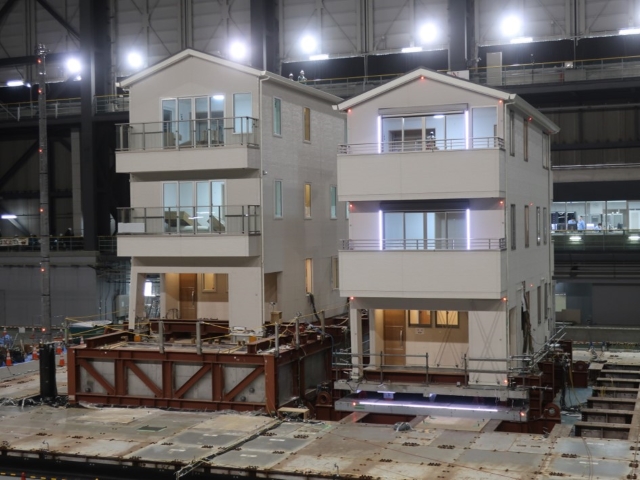
1806 E-Defense Experiment to verify the Function of 3-story Wooden Building including Underground Piping Equipment
(Jan. & Feb. 2019) ( Test Number: E201806 )Timber Geotech Isolation/Damping Non-structural Equipment Furniture - Input Ground Motion
-
Jan. 31 - JMA Kobe motion (the 1995 Southern Hyogo Prefecture Earthquake) 100%
Overall view from North E201806_190131_1.mp4
Overall view from South: E201806_190131_2.mp4
Dining room at the first floor of the isolated house: E201806_190131_3.mp4
Bedroom at the second floor of the seismic-resistant house: E201806_190131_4.mp4
-
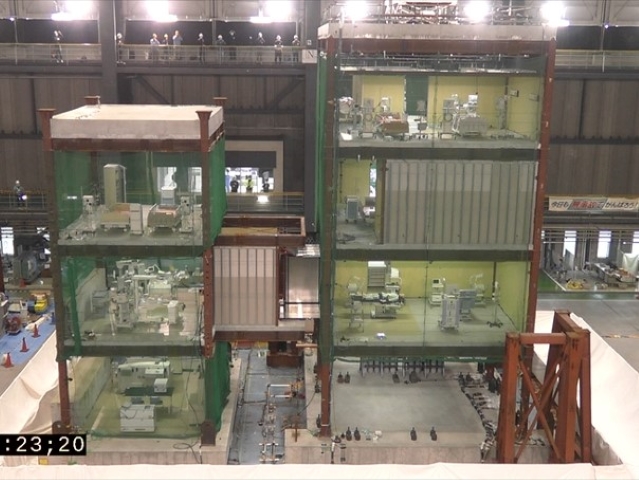
2003 Holistic Seismic Assessment of Critical Buildings with Due Consideration of Non-Structural Component and Equipment
(Dec. 2020) ( Test Number: E202003 )Steel Frame Isolation/Damping Non-structural Equipment Furniture - Input Ground Motion
-
Dec. 8 - JMA Kobe motion (the 1995 Southern Hyogo Prefecture Earthquake), 50% in X- and Y-dir., and 100% in Z-dir.
Overall view: E202003_201208_1.wmv
Operating room at the 3rd floor of earthquake-resistant building: E202003_201208_2.wmv
Dialysis room at the 3rd floor of seismic isolation building: E202003_201208_3.wmv
-
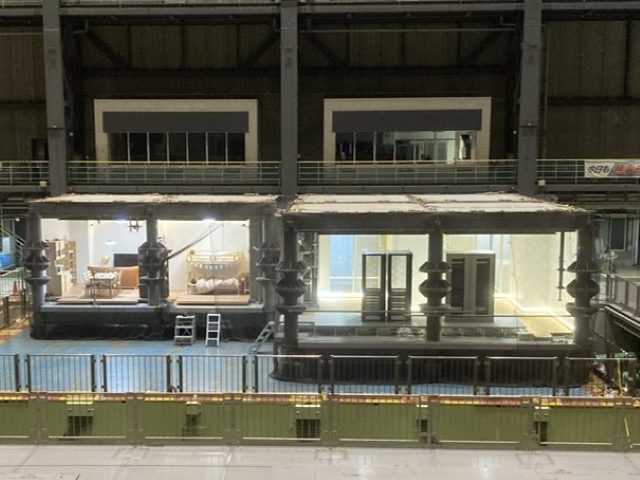
2104 E-Defense Experiment for Earthquake Damage Mitigation and Damage Assessment for Indoor Spaces and Functions
(Dec. 2021 & Jan. 2022) ( Test Number: E202104 )Non-structural Equipment Furniture - Input Ground Motion
-
Jan. 19 - JMA Kobe motion (the 1995 Southern Hyogo Prefecture Earthquake) 75%:
E202104_220119.wmv
-
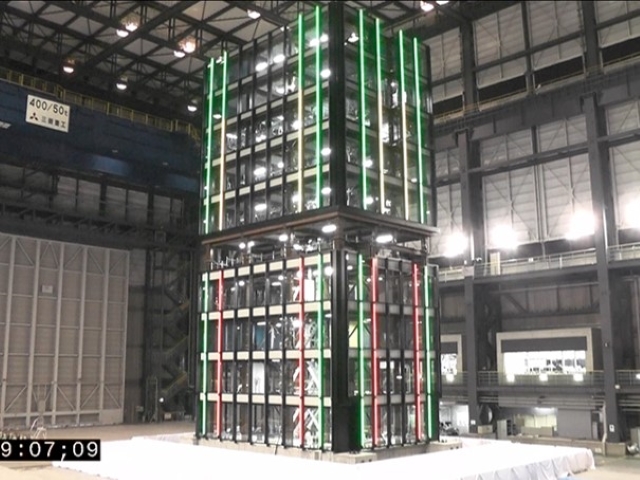
2204 Shake-table Test for Assessing Dynamic Characteristics of Building Structures using a 10-story Steel Office Building
(Feb. 2023) ( Test Number: E202204 )Steel Frame Non-structural Equipment Furniture - Input Ground Motion
-
Feb. 17 - JMA Kobe motion (the 1995 Southern Hyogo Prefecture Earthquake) 100%: E202204_230217.wmv
0608
Examination of Destruction of Non-structural Members and Fall of Utensils by Long-period Earthquake Ground Motion in High-rise Building
(Mar. 2007) (
Test Number: E200608 )
A full-scale test structure which was partially extracted from a high-rise building was shaken to reproduce the floor response and story drift. The experiment was conducted in order to clarify those phenomena which may occur in and outside of high-rise buildings under a long-period ground motion. Damage of nonstructural components including exterior wall and ceiling as well as dangerous behavior including overturning and scattering of fixtures and fittings were observed in the test structure. Adopted earthquakes were Nankai earthquake expected in near future and the 1995 Southern Hyogo Prefecture Earthquake.
Detailed information and acquired data and images from this experiment are available in E-Defense Data Archive, ASEBI.
DOI: https://doi.org/10.17598/NIED.0020-E200608
Experiment Overview: E200608.pdf
Application for Use of Video Materials
×
0703
Experimental Study on Complete Collapse of Steel Frame Building
(Sep. 2007) (
Test Number: E200703 )
A full-scale 4-story steel building was repeatedly subjected to ground shaking until it collapsed. The building satisfied the minimum requirements prescribed in the current Building Standard Law of Japan. Composite concrete slabs were provided to complete a very realistic structure. The building was furnished with a complete set of nonstructural elements including ALC (AAC) exterior walls, aluminum sash, glass windows, partition walls, and ceiling. The experiment was conducted by increasing the intensity of excitation gradually from small to the strongest motion that the E-Defense can produce.
Detailed information and acquired data and images from this experiment are available in E-Defense Data Archive, ASEBI.
DOI: https://doi.org/10.17598/NIED.0020-E200703
Experiment Overview: E200703.pdf
Application for Use of Video Materials
×
1102
Japan-US Collaborative Research on Innovative Seismic Isolation Solution
(Aug. 2011) (
Test Number: E201102 )
In collaboration with the University of Nevada, Reno in USA and National Research Institute for Earth Science and Disaster Resilience, the shake table experiments on a base-isolated building were conducted to evaluate the effectiveness of seismic isolation technology. Specimen was a five-story steel building and isolation devices were installed at the base of the specimen. In the experiment, two different types of isolation system were used; 1) nine triple-pendulum bearings and 2) combination of five lead-rubber bearings and four cross linear sliders. Base-fixed specimen also excited to compare response of the specimen and behavior of furniture installed in the specimen. The record observed at K-NET Iwanuma station during the 2011 Off the Pacific coast of Tohoku earthquake was imposed. Duration of this record is about three minutes and it affects various structures because it contains long-period components, which resonate with base-isolated buildings, and short-period components, which affects low to middle height base-fixed buildings.
Detailed information and acquired data and images from this experiment are available in E-Defense Data Archive, ASEBI.
DOI: https://doi.org/10.17598/NIED.0020-E201102
Experiment Overview: E201102en.pdf
Application for Use of Video Materials
×
1103
Research and Development of the Measures for Damage Mitigation caused by Long-period Ground Motion
(Oct. 2011) (
Test Number: E201103 )
In this study, two cases were used for the experiment: a high-rise building model and a low-rise building model. The high-rise building model was based on a 30-story building with a height of 120 meters. The test specimen consisted of the lowest steel frame, which was designed to produce the same shaking as a 6-story high-rise building, and the two upper steel frames, which were designed to produce the same shaking as a 27-story and 28-story high-rise building. The remaining middle part was replaced with a heavy concrete slab and laminated rubber. In the low-rise building model, the middle part was fixed with steel plates to prevent the laminated rubber from working. The test specimen had the widest floor area of any of the previous experiments, and included office and residential spaces. The office space had a suspended ceiling, incorporating both the line ceiling that has been used in many buildings to date, and the grid ceiling, which is advantageous from the perspective of earthquake resistance. Furthermore, the ceiling also incorporated general equipment such as air conditioning units, as well as firefighting equipment such as sprinklers, fire alarms and emergency lighting, reproducing the same equipment functions as in a real building.
Detailed information and acquired data and images from this experiment are available in E-Defense Data Archive, ASEBI.
DOI: https://doi.org/10.17598/NIED.0020-E201103
Experiment Overview: E201103.pdf
Application for Use of Video Materials
×
1306
Experiment on Non-Structural Components Installed in Large-Spanned Building Structures
(Jan. & Feb. 2014) (
Test Number: E201306 )
In a project to experimental research large-scale buildings in school facilities, shaking tests were conducted using a test specimen that simulated a gymnasium with the world's largest area of ceiling test specimen, and the damage caused by the falling of suspended ceilings in many facilities during the 2011 Tohoku Pacific Offshore Earthquake was reproduced. Through this experiment, it was possible to capture on film for the first time in the world the process of the metal fittings of suspended ceilings attached to actual buildings coming loose and the ceiling falling. In addition, the effectiveness of the fail-safe function, which prevents human injury by catching the falling ceiling and stopping it from reaching the floor, was also confirmed. Experiments were also conducted on ceilings (earthquake-resistant ceilings) that complied with the technical standards enacted in April 2014, and it was confirmed that they were able to withstand the shaking of the 2011 Tohoku Earthquake, which was more than double that assumed in the design.
Detailed information and acquired data and images from this experiment are available in E-Defense Data Archive, ASEBI.
DOI: https://doi.org/10.17598/NIED.0020-E201306
Experiment Overview: E201306.pdf
Application for Use of Video Materials
×
1806
E-Defense Experiment to verify the Function of 3-story Wooden Building including Underground Piping Equipment
(Jan. & Feb. 2019) (
Test Number: E201806 )
In the “Tokyo Metropolitan Resilience Project ” - a project subsidized by the Ministry of Education, Culture, Sports, Science and Technology - E-Defense is being used to collect and maintain data on the maintenance of building functions, including interior and exterior materials, furniture, fixtures, and piping, and on the seismic margin of buildings until they collapse, with the aim of quickly restoring urban functions in the event of a major earthquake, identifying damage, and carrying out repairs.
In this experiment, two three-story wooden houses were tested on a shake table: one with an earthquake-resistant structure that had been reinforced to improve its earthquake resistance, and the other with a seismic isolation structure, which is known to be effective for earthquake countermeasures, from the perspective of ensuring the living functions of residential buildings in densely populated residential areas. The size of the test specimen was 4.5 m x 10 m in plan and approximately 10 m in height. For the seismic-resistant structure, a large-scale soil container with internal dimensions of 7 m x 13 m and a height of 2.5 m was constructed, and a 1.3 m deep soil layer was built inside the container to faithfully reproduce the building conditions from the solid foundation to be constructed on top of the soil layer. Valuable data was collected by inputting observation waves from the 1995 Southern Hyogo Prefecture Earthquake, etc.
Detailed information and acquired data and images from this experiment are available in E-Defense Data Archive, ASEBI.
DOI: https://doi.org/10.17598/NIED.0020-E201806
Application for Use of Video Materials
×
2003
Holistic Seismic Assessment of Critical Buildings with Due Consideration of Non-Structural Component and Equipment
(Dec. 2020) (
Test Number: E202003 )
In the “Tokyo Metropolitan Resilience Project ” - a project subsidized by the Ministry of Education, Culture, Sports, Science and Technology - E-Defense is being used to collect and maintain data on the maintenance of building functions, including interior and exterior materials, furniture, fixtures, and piping, and on the seismic margin of buildings until they collapse, with the aim of quickly restoring urban functions in the event of a major earthquake, identifying damage, and carrying out repairs.
In this research project, with the aim of developing a system to support safe and efficient decision-making by hospital administrators in the aftermath of a disaster, a large-scale shaking table experiment was conducted on hospital buildings equipped with high-performance facilities. The experiment was designed to propose a method for quantitatively assessing the degree of functional loss immediately after an earthquake in regional core hospitals and other facilities expected to maintain continuous operations during disasters, thereby avoiding unnecessary confusion. Two test structures, a four-story earthquake-resistant building and a three-story earthquake-isolated building, are connected by a bridge corridor. Medical equipment was installed inside the test structures to reproduce the conditions of an actual medical facility. Based on the results of the experiment, this study proposes a quantitative evaluation method for determining the building collapse margin, identifying factors that cause a decline in hospital functions, evaluating the performance of individual high-performance facilities, and assessing the loss of facility functions.
Detailed information and acquired data and images from this experiment are available in E-Defense Data Archive, ASEBI.
DOI: https://doi.org/10.17598/NIED.0020-E202003
Application for Use of Video Materials
×
2104
E-Defense Experiment for Earthquake Damage Mitigation and Damage Assessment for Indoor Spaces and Functions
(Dec. 2021 & Jan. 2022) (
Test Number: E202104 )
This research aims to collect data on seismic damage to nonstructural members, indoor facilities, furniture, fixtures, etc., and to propose guidelines for damage verification methods, damage prevention methods, and seismic damage sensing methods. Specifically, a large shaking table test specimen that can reproduce damage caused by earthquake motion to various nonstructural members, indoor facilities, furniture, fixtures, etc. (a test unit that can be used repeatedly by replacing nonstructural members, indoor facilities, furniture, fixtures, etc. installed inside it for each test while the main structural members remain undamaged) was prepared and tested for various types of earthquake motion. The data on damage to each nonstructural member under various earthquake ground motions would be collected. Furthermore, these data sets have been developed and examined with the aim of constructing a damage monitoring method.
In order to achieve the objectives of this research, large-scale shaking table experiments were conducted to evaluate damage to indoor spaces under various seismic motions and to obtain data related to post-earthquake business continuity and so on.
Detailed information and acquired data and images from this experiment are available in E-Defense Data Archive, ASEBI.
DOI: https://doi.org/10.17598/NIED.0020-E202104
Application for Use of Video Materials
×
2204
Shake-table Test for Assessing Dynamic Characteristics of Building Structures using a 10-story Steel Office Building
(Feb. 2023) (
Test Number: E202204 )
To save lives and keep society and the economy going in the event of a big earthquake like the one expected in the Nankai Trough in the near future, it is essential to get ready now and have a plan for after the earthquake so decisions can be made quickly. The National Research Institute for Earth Science and Disaster Resilience is developing a “dynamic characteristic evaluation method” that assesses the dynamic characteristics of buildings, such as their shaking period and ease of settling, based on their shaking patterns. To this end, a joint research project with a private company is underway to develop exterior materials (LED light alert system) that incorporate sensors to measure building shaking and LED lights that instantly display the measurement and evaluation results. Here, shake table tests were conducted to verify and validate the dynamic characteristic evaluation method and LED light alert system. The test specimen was a full-scale 10-story office building with a floor area of 12.0 m × 8.0 m, 10 stories, a height of 26.9 m, and a weight of approximately 700 tons. In the experiments, the test specimen was subjected to repeated small earthquakes with seismic intensities of 2 to 4 and large earthquakes with seismic intensities exceeding 5 to capture changes in dynamic characteristics. An LED light alert system was also installed on the test specimen to demonstrate the immediate light emission display of deformations. The results of the experiments demonstrated that the developed dynamic characteristic evaluation method could capture changes in dynamic characteristics, and that the LED light alert system could accurately measure building deformation and display it in real time using LED lights. Additionally, through a framework for joint research and the provision of surplus space, various interior materials, furniture, fixtures, and equipment were installed inside the building, enabling the acquisition of valuable data on the shaking, movement, and damage caused by earthquakes.
Detailed information and acquired data and images from this experiment are available in E-Defense Data Archive, ASEBI.
DOI: https://doi.org/10.17598/NIED.0020-E202204
Application for Use of Video Materials
×