
Experiment Videos and Materials
Experiment Videos
When using these videos or other materials in public settings, please click on “Application for Use of Video Materials” at the bottom of each experiment introduction page. After agreeing to the “Terms of Use” described on the application page, submit your application for use.
Isolation/Damping
-
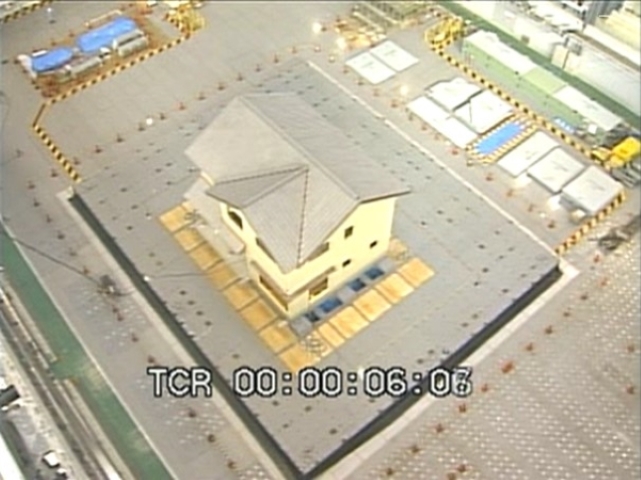
0503 E-Defense Experiment on Wooden House, Restore from Earthquake Disaster and Seismic Isolation
(Oct. 2025) ( Test Number: E200503 )Timber Isolation/Damping - Input Ground Motion
-
Test date: October 20 and 21, 2005.
Oct. 20 - JR Takatori motion (the 1995 Southern Hyogo Prefecture Earthquake) YZ-2 directional input 100% : E200503_051020.mpg
Oct. 20 – The 3rd input of JR Takatori motion 3-directional input 100% : E200503_051021.mpg
-
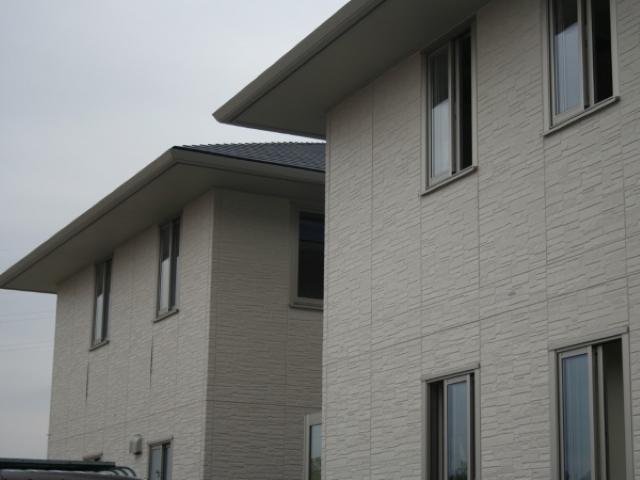
0601 Verification Experiment of Seismic Performance and Damping Effect of 2-story Steel Frame House
(Jun. 2006) ( Test Number: E200601 )Steel Frame Isolation/Damping Furniture - Input Ground Motion
-
Jun. 29 - K-NET Ojiya motion (the Mid Niigata prefecture Earthquake in 2004) 70%
Overall view: E200601_060629_1.mpeg
Living room at the 1st floor of seismic control housing: E200601_060629_2.mpeg
Kids room at the 2nd floor of earthquake-resistant housing: E200601_060629_3.mpeg
-
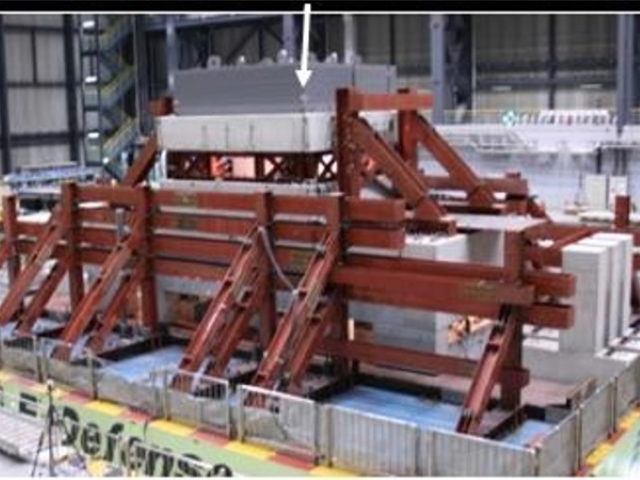
0708 Study on the Response Characteristics of Horizontal Seismically Isolated Plants to Inputs Exceeding Design Motions
(Feb. 2008) ( Test Number: E200708 )Isolation/Damping Equipment - Input Ground Motion
- ・・・
-
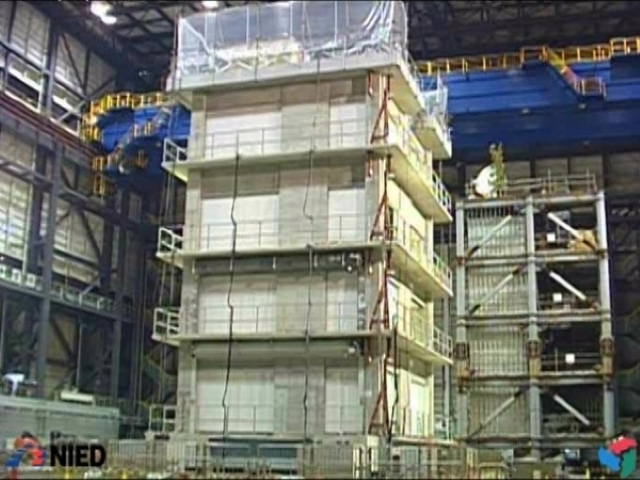
0805 Experiment to Evaluate Maintenance of Functions of Important Facility, Medical Facility
(Dec. 2008 & Jan. 2009) ( Test Number: E200805 )Reinforced Concrete Isolation/Damping Equipment Furniture - Input Ground Motion
-
JMA Kobe motion (the 1995 Southern Hyogo Prefecture Earthquake) 80%,
near fault earthquake & Expected ground motion for Sannomaru area,
Nagoya from a scenario Tokai-Tonankai earthquake
Comparison of the fixed- and isolated-base structures
E200805_090122.wmv
-
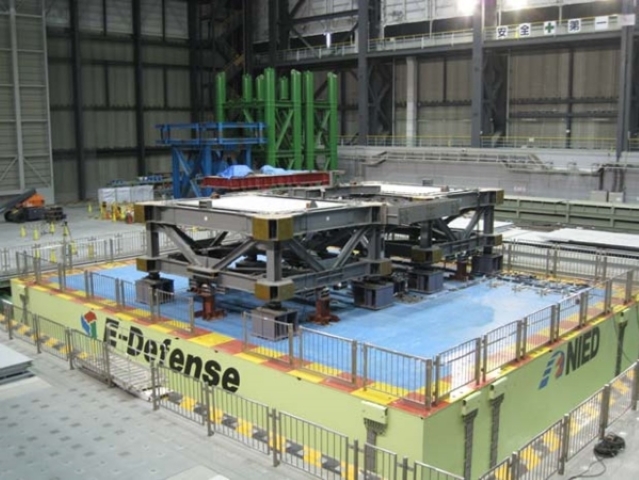
0908 Experiment Study of Steel Frame Building, Innovative Experiment
(Dec. 2009) ( Test Number: E200908 )Steel Frame Isolation/Damping - Input Ground Motion
-
Dec. 15, Plane frame with buckling-constrained braces - JR Takatori motion (the 1995 Southern Hyogo Prefecture Earthquake) EW-component 100%
Overall view: E200908_091215_1.mpg
Detailed view of buckling-constrained braces: E200908_091215_2.mpg
-
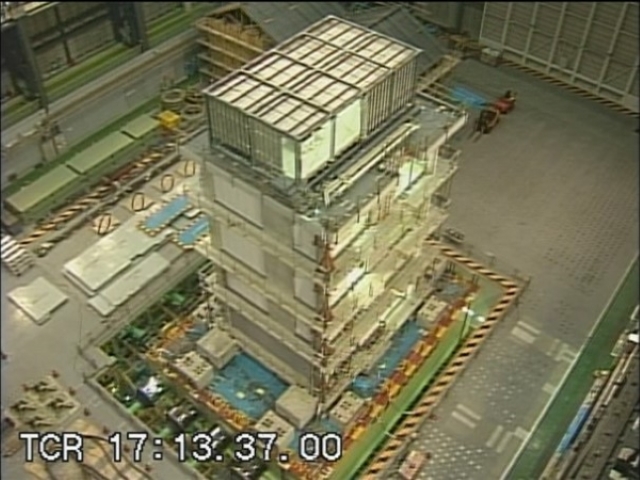
1002 Shaking Table Experiments for Enhancing the Functional Integrity of Important Facilities
(Aug. & Oct. 2010) ( Test Number: E201002 )Reinforced Concrete Isolation/Damping Equipment Furniture - Input Ground Motion
-
Oct. 10, Seismic-resistant structure - JMA Kobe motion (the 1995 Southern Hyogo Prefecture Earthquake) 2-horizontal directions 80%
Overall view: E201002_101021_1.mpeg
Staff station at the 2nd floor: E201002_101021_2.mpeg
Operation room at the 3rd floor: E201002_101021_3.mpeg
-
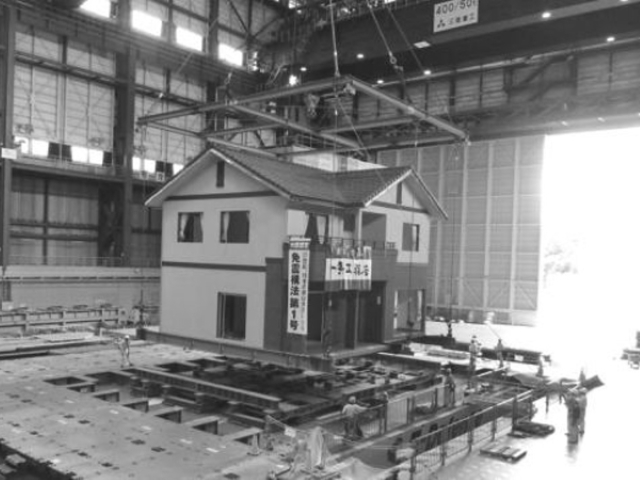
1101 Characteristics of Dynamic Behavior of Small-Scale Base-Isolated Structures under Long-Period Earthquake Motion, Part 1
(Jul. 2011) ( Test Number: E201101 )Timber Isolation/Damping Furniture - Input Ground Motion
-
Jul. 25, Isolated house with no displacement restraint device - Kashiwazaki motion (the Niigataken Chuetsu-oki Earthquake in 2007) 100%
Top view: E201101_110725_1.mpg
Around a base isolation device: E201101_110725_2.mpg
Indoor: E201101_110725_3.mpg
-
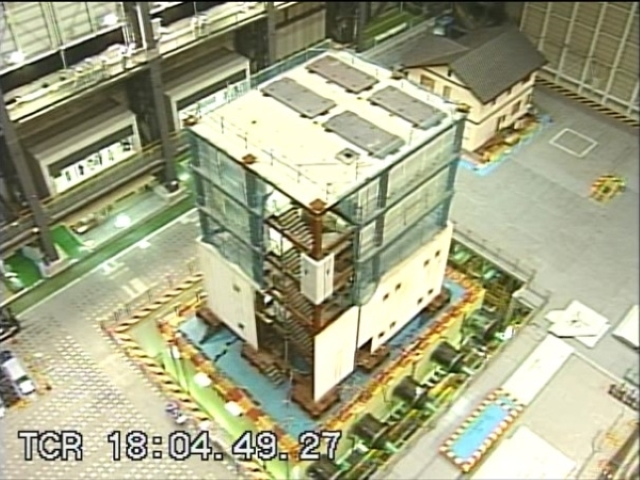
1102 Japan-US Collaborative Research on Innovative Seismic Isolation Solution
(Aug. 2011) ( Test Number: E201102 )Steel Frame Isolation/Damping Non-structural Furniture - Input Ground Motion
-
Aug. 18, 26 and 31 - K-NET Iwanuma motion (the 2011 off the Pacific Coast of Tohoku Earthquake) 70% and 100%:
E201102_1108en.mpeg
-
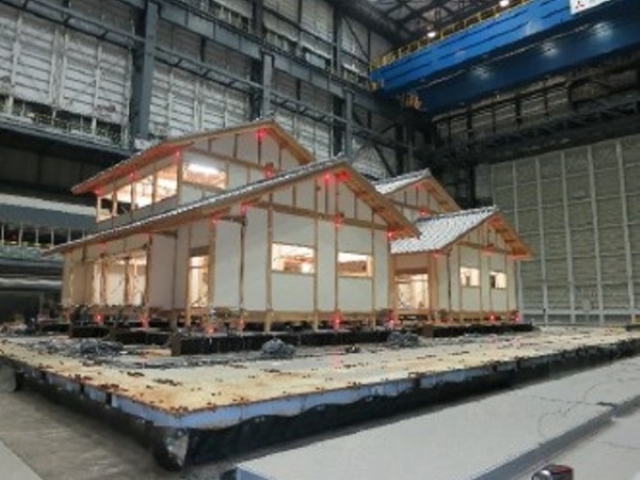
1105 Characteristics of Dynamic Behavior of Small-Scale Base-Isolated Structures under Long-Period Earthquake Motion, Part 2
(Dec. 2011) ( Test Number: E201105 )Timber Isolation/Damping - Input Ground Motion
-
Dec. 26 - Kashiwazaki motion (the Niigataken Chuetsu-oki Earthquake in 2007) in 45-degree input 100%
Bird view: E201105_111226_1.mpg
Around a velocity-sensing performance-variable damper: E201105_111226_2.mpg
Around a base isolation device: E201105_111226_3.mpg )
-
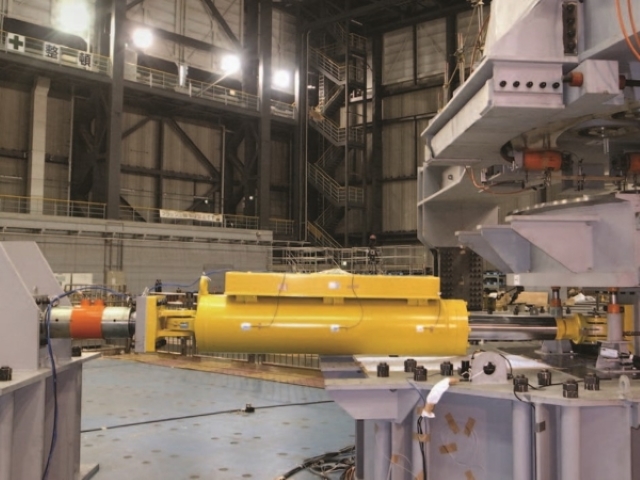
1106 Study on Verification Methods for Isolated Buildings in Long-period Earthquakes, Part 1
(Jan. and Feb. 2012) ( Test Number: E201106 )Isolation/Damping - Input Ground Motion
-
Feb. 7, Oil damper - Sine motion, period 2.5 s, 100 %
Bird view: E201106_120207_1.mpg
Oil damper: E201106_120207_2.mpg
-
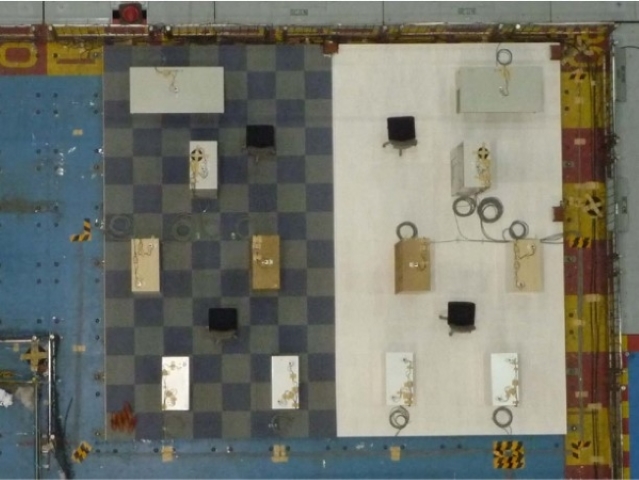
1108 Verification of Shake Table Performance and the Behaviors of Indoor Utensils under the Shake of 6 Degrees of Freedom
(Mar. 2012) ( Test Number: E201108 )Isolation/Damping Furniture - Input Ground Motion
-
Mar.15 - Kashiwazaki motion (the Niigataken Chuetsu-oki Earthquake in 2007)
Bird view: E201108_120315_1.mpg
Small-scale base-isolated structure model: E201108_120315_2.mpeg
-
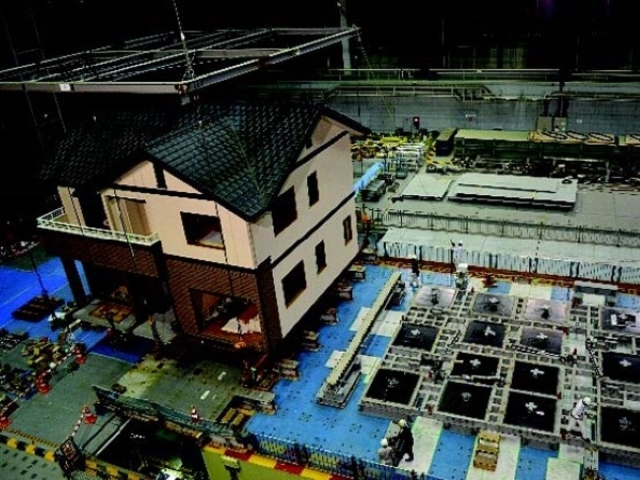
1201 Characteristics of Dynamic Behavior of Small-Scale Base-Isolated Structures under Long-Period Earthquake Motion, Part 4
(Jul. 2012) ( Test Number: E201201 )Timber Isolation/Damping - Input Ground Motion
-
Jul. 19 - Kashiwazaki motion (the Niigataken Chuetsu-oki Earthquake in 2007) 100%
Bird view: E201201_120719_1.mpg
Around a velocity-sensing performance-variable damper: E201201_120719_2.mpg
Around a base isolation device: E201201_120719_3.mpg
-
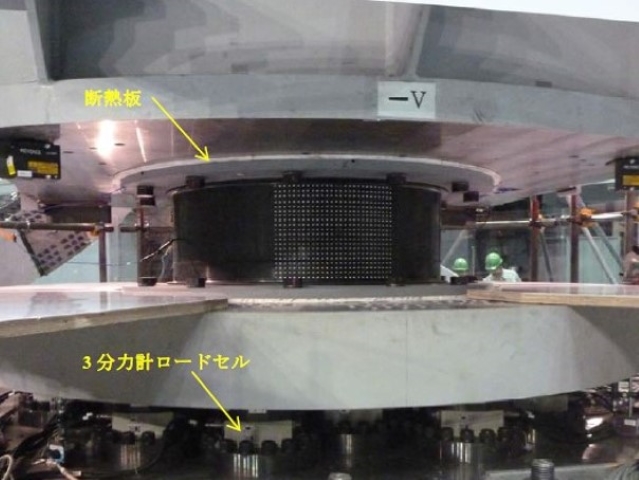
1205 Study on Verification Methods for Isolated Buildings in Long-period Earthquakes, Part 2
(Oct. 2012) ( Test Number: E201205 )Isolation/Damping - Input Ground Motion
-
Oct. 12, High-damping rubber bearing - 2 cycles of sinusoidal motion, maximum displacement 400 mm
Bird view: E201205_121012_1.mpeg
High-damping rubber bearing: E201205_121012_2.mpeg
-
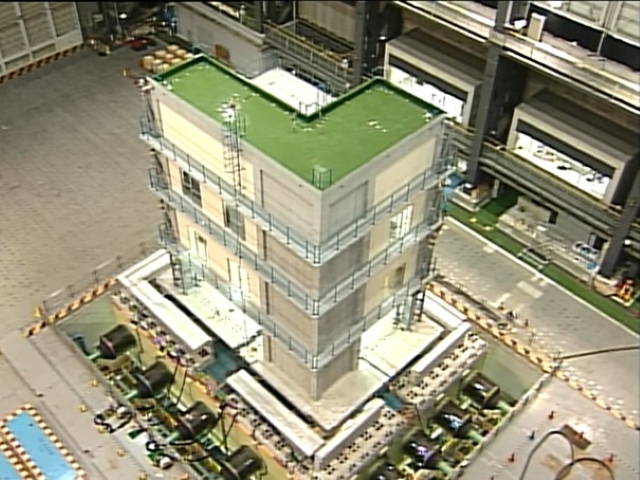
1206 Performance Verification Test on Long-periodization Upgrade of E-Defense
(Mar. & Apr., 2013) ( Test Number: E201206 )Reinforced Concrete Isolation/Damping - Input Ground Motion
-
Apr. 1 - K-NET Furukawa motion (the 2011 off the Pacific coast of the Tohoku earthquake) 100%
Bird view: E201206_130401.wmv -
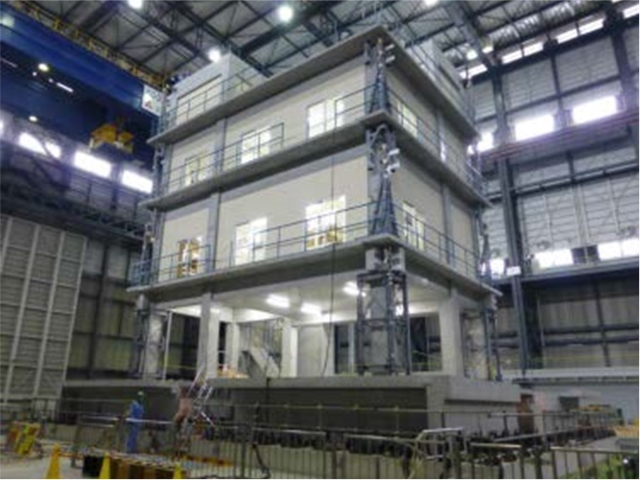
1301 Shake Table Test for Development of the Measure to Mitigate the Damage by Collision of Base-isolation Building to Retaining Wall
(Aug. 2013) ( Test Number: E201301 )Reinforced Concrete Isolation/Damping - Input Ground Motion
-
Aug. 26 - K-NET Furukawa motion (the 2011 off the Pacific coast of the Tohoku earthquake) 136%
Overall view: E201301_130826_1.mp4
Isolated building and retaining wall: E201301_130826_2.mp4
4F Art room: E201301_130826_3.mp4
4F Classroom: E201301_130826_4.mp4
-
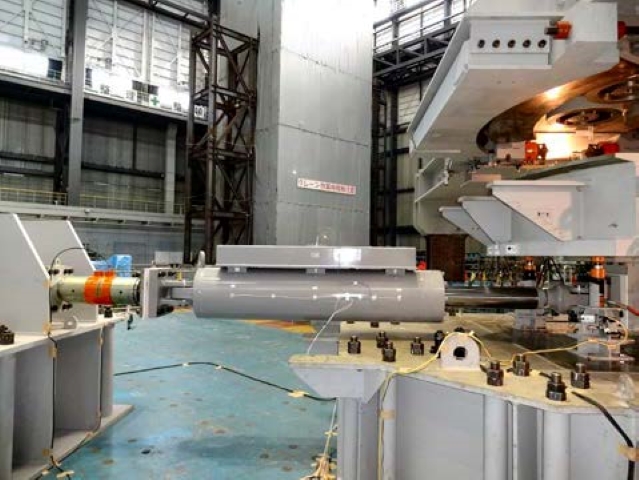
1304 Study on Verification Methods for Isolated Buildings in Long-period Earthquakes, Part 3
(Nov. 2013) ( Test Number: E201304 )Isolation/Damping - Input Ground Motion
-
Nov. 18 - Response displacement motion of seismic isolation buildings due to four-linked earthquakes
Overall view: E201304_131118_1.mp4
Oil damper: E201304_131118_2.mp4
Detailed view of oil damper: E201304_131118_3.mp4
-
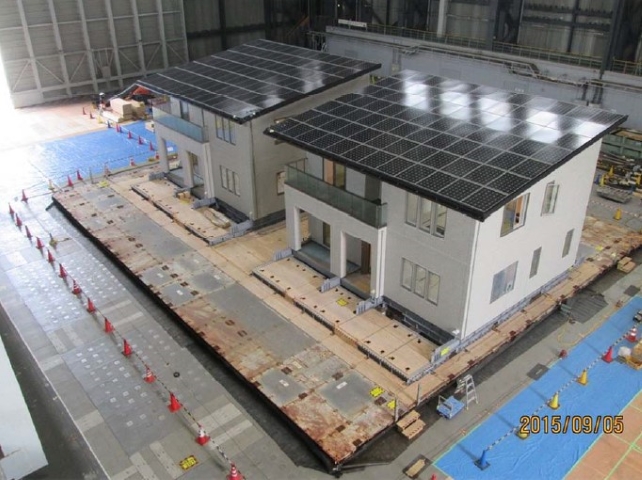
1504 Verification of Seismic Behavior and Structural Integrity of Single-Family Houses subjected to Large Earthquakes
(Aug. & Sep. 2015) ( Test Number: E201504 )Timber Isolation/Damping - Input Ground Motion
-
Sep. 1, Seismic control house specimens - JR Takatori motion (the 1995 Southern Hyogo Prefecture Earthquake) 100%
Overall view E201504_150901_1.wmv
In-room 1: E201504_150901_2.wmv
In-room 2: E201504_150901_3.wmv
-
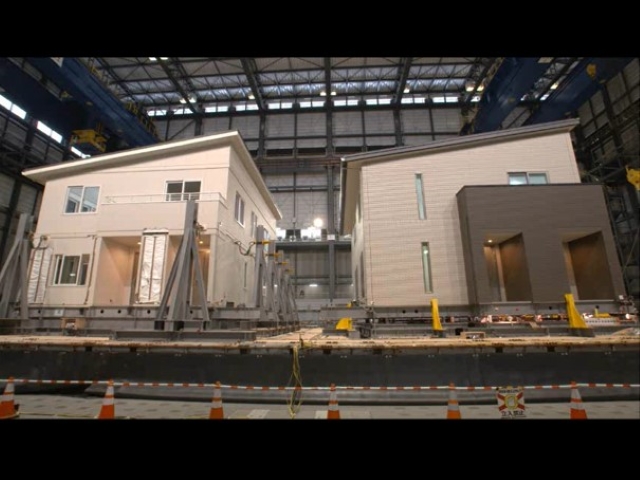
1601 Seismic Performance Evaluation Tests of Wooden Houses and Carports in Recent Large Earthquakes
(Jan. 2017) ( Test Number: E201601 )Timber Isolation/Damping Equipment - Input Ground Motion
-
Jan. 23, seismically reinforced house and isolated house - JMA Mashiki (aftershock in the 2016 Kumamoto Earthquake) 100 %
Bird view from North-east: E201601_170123_1.mp4
Overall and isolation layer: E201601_170123_2.mp4
Indoor at the 1st floor in the reinforced house: E201601_170123_3.mp4
Indoor at the 1st floor in the isolated house: E201601_170123_4.mp4
-
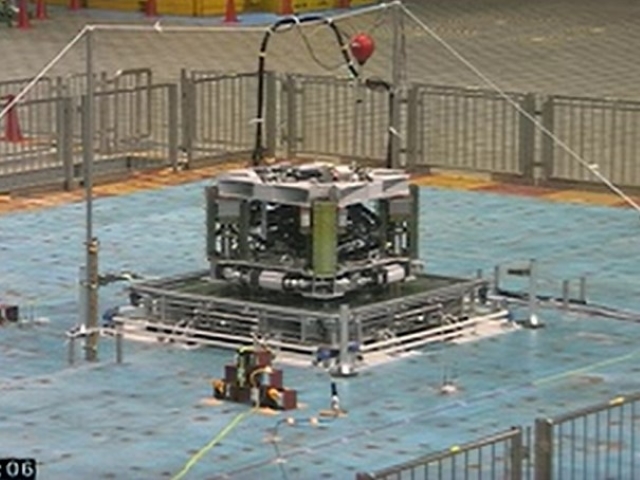
1701 Verification Experiment of Super Base-isolation System
(Jun. 2017) ( Test Number: E201701 )Isolation/Damping - Input Ground Motion
-
Jun. 16 - JR Takatori motion (the 1995 Southern Hyogo Prefecture Earthquake) 100%
Overall view from North-west: E201701_170616.mpeg
-
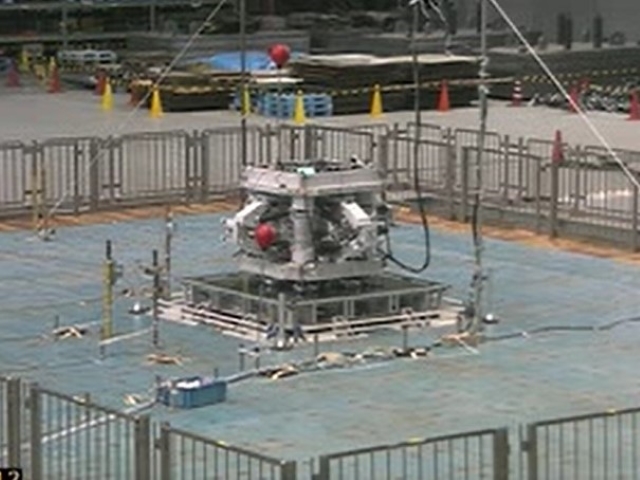
1709 Test for Improvement in Vertical Isolation Performance of Small Seismic Isolation Device
(Mar. 2018) ( Test Number: E201709 )Isolation/Damping - Input Ground Motion
-
Mar. 20 - JR Takatori motion (the 1995 Southern Hyogo Prefecture Earthquake) 100%: E201709_180320.mpeg
-
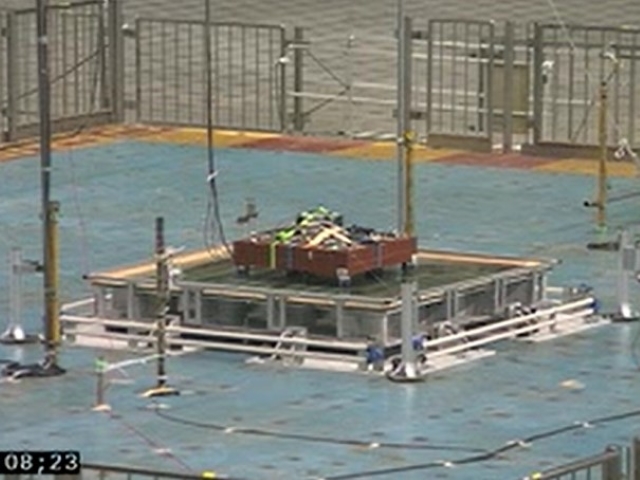
1803 Performance Verification Test of Small Seismic Isolation Device under High Vertical Loading
(Aug. 2018) ( Test Number: E201803 )Isolation/Damping - Input Ground Motion
-
Aug. 9 - Kumamoto Foreshock (the 2016 Kumamoto Earthquake) 120%: E201803_180809.mpeg
-
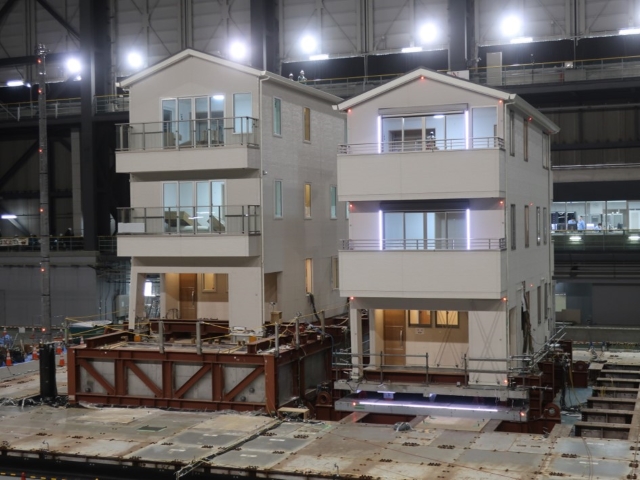
1806 E-Defense Experiment to verify the Function of 3-story Wooden Building including Underground Piping Equipment
(Jan. & Feb. 2019) ( Test Number: E201806 )Timber Geotech Isolation/Damping Non-structural Equipment Furniture - Input Ground Motion
-
Jan. 31 - JMA Kobe motion (the 1995 Southern Hyogo Prefecture Earthquake) 100%
Overall view from North E201806_190131_1.mp4
Overall view from South: E201806_190131_2.mp4
Dining room at the first floor of the isolated house: E201806_190131_3.mp4
Bedroom at the second floor of the seismic-resistant house: E201806_190131_4.mp4
-
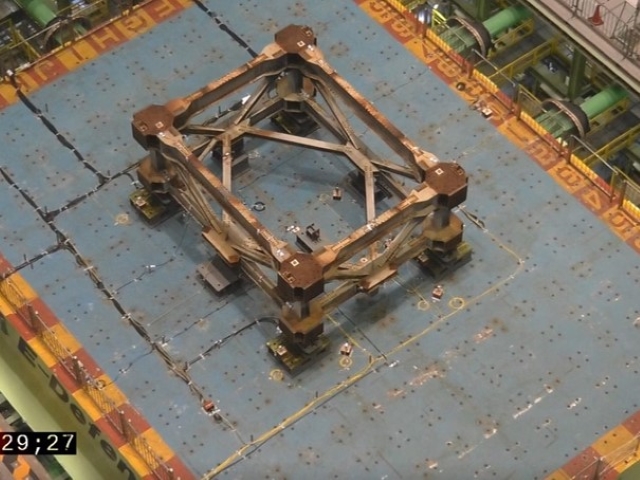
1901 Shaking Table Tests of Semi-active Seismic Isolation Structures for Performance Evaluation of Seismic Control Systems
(Jul. 2019) ( Test Number: E201901 )Isolation/Damping - Input Ground Motion
-
Jul. 5 - JR Takatori motion (the 1995 Southern Hyogo Prefecture Earthquake) NS-component in Y-direction 40%: E201901_190705.mp4
-
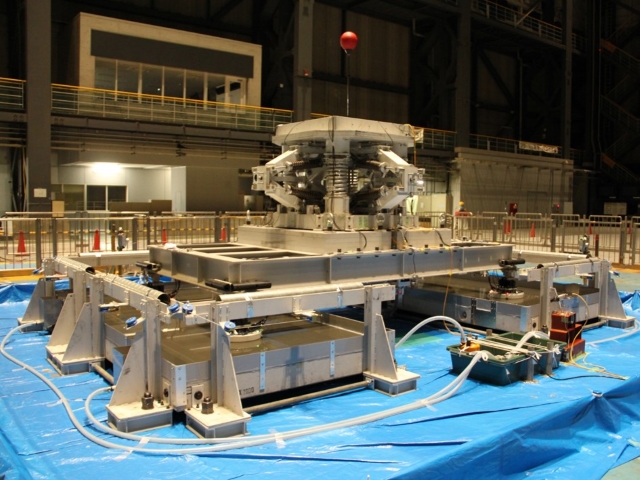
1902 Performance Verification Test of Seismic Isolation Device Installed under Steel Stand
(Jul. 2019) ( Test Number: E201902 )Isolation/Damping - Input Ground Motion
-
Jul. 18 - Kumamoto mainshock (the 2016 Kumamoto Earthquake) 100%: E201902_190718.mp4
-
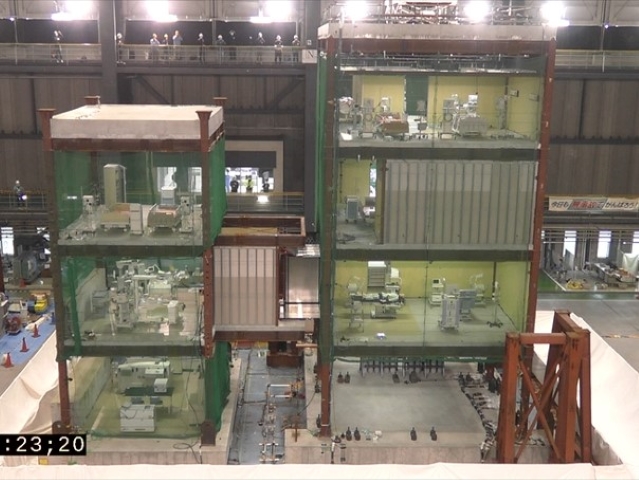
2003 Holistic Seismic Assessment of Critical Buildings with Due Consideration of Non-Structural Component and Equipment
(Dec. 2020) ( Test Number: E202003 )Steel Frame Isolation/Damping Non-structural Equipment Furniture - Input Ground Motion
-
Dec. 8 - JMA Kobe motion (the 1995 Southern Hyogo Prefecture Earthquake), 50% in X- and Y-dir., and 100% in Z-dir.
Overall view: E202003_201208_1.wmv
Operating room at the 3rd floor of earthquake-resistant building: E202003_201208_2.wmv
Dialysis room at the 3rd floor of seismic isolation building: E202003_201208_3.wmv
-
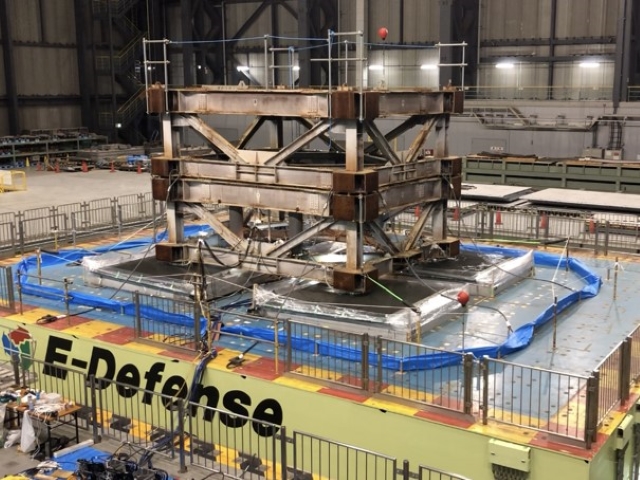
2006 Shake Table Test of Floating Base-isolation Device using 60-ton Test Bed
(Feb. 2021) ( Test Number: E202006 )Isolation/Damping - Input Ground Motion
-
Feb. 24 - JR Takatori motion (the 1995 Southern Hyogo Prefecture Earthquake) 130%: E202006_200224.wmv
-
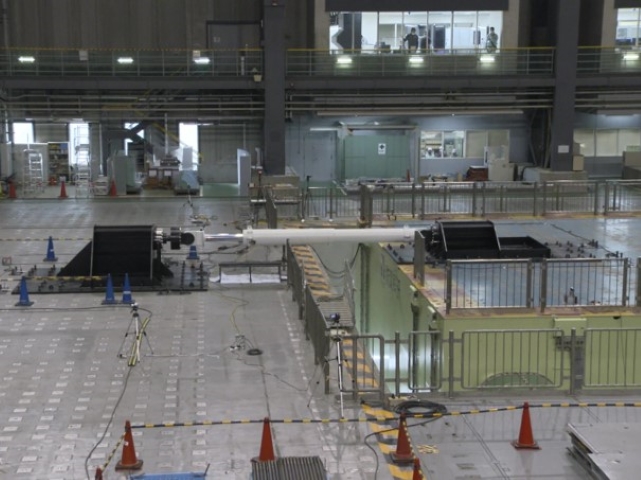
2103 Seismic Damper Performance Test
(Nov. 2021) ( Test Number: E202103 )Isolation/Damping - Input Ground Motion
-
Nov. 17 - Sinusoidal motion, 3 cycles, max. displacement 780 mm: E202103_211117.wmv
-
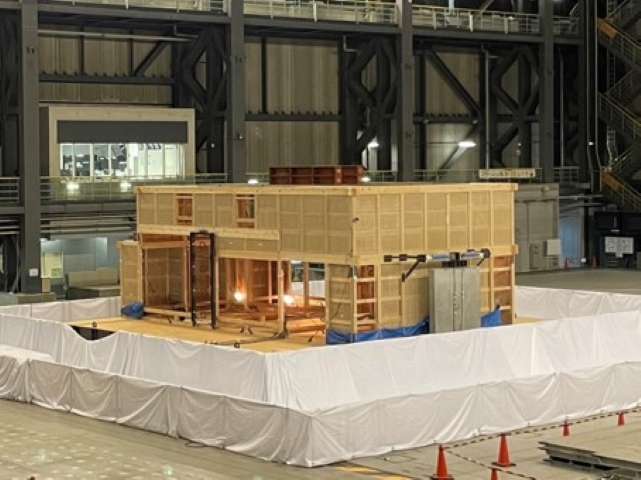
2203 Seismic Performance Evaluation of Traditional Japanese Wooden Houses with Outer-Frame Reinforcement
(Dec. 2022) ( Test Number: E202203 )Timber Isolation/Damping - Input Ground Motion
-
Dec. 14 - Level 2 simulated motion determined by the Building Center of Japan 100%
Bird view from South-west: E202203_221214_1.wmv
Around oil dampers: E202203_221214_2.wmv
-
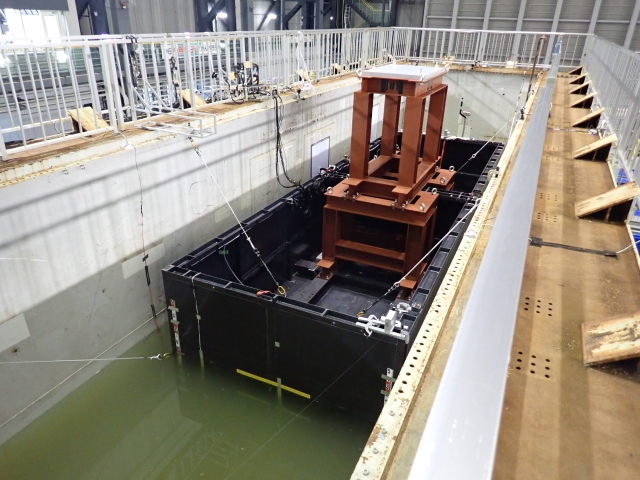
2303 Study on Vibration Stability of a Floating Seismic Isolation Structure for Nuclear Power Plants
(Feb. 2024) ( Test Number: E202303 )Isolation/Damping Equipment - Input Ground Motion
- Feb. 9 - Nakaminato Motion (the 2011 off the Pacific coast of Tohoku Earthquake), large-level: E202303_240209.wmv
0503
E-Defense Experiment on Wooden House, Restore from Earthquake Disaster and Seismic Isolation
(Oct. 2025) (
Test Number: E200503 )
As a part of “Special Project for Earthquake Disaster Mitigation in Urban Areas” supported by Ministry of Education, Culture, Sports, Science and Technology (MEXT), E-Defense tests were conducted on a wooden seismic isolation housing system, and data was obtained on the limit behavior of seismic isolation and seismic capacity of wooden seismic isolation housing systems, which are composed of seismic isolation rubber, sliding bearings, dampers, etc.
As a test specimen, a two-story wooden house was built using the conventional wooden frame construction method (building area: 72.87 m2, 1st floor area: 67.49 m2, 2nd floor area: 62.93 m2, total floor area: 130,42 m2), and the observed seismic motion of the 1995 Southern Hyogo Prefecture Earthquake, such as the JR Takatori wave, was input. Shaking table tests were also conducted for cases where the maximum response exceeded the design limit of the seismic isolation system, and the results obtained are being used to develop seismic isolation housing that is safe even in the event of unexpected seismic activity, and to estimate the seismic behavior of seismic isolation housing.
Detailed information and acquired data and images from this experiment are available in E-Defense Data Archive, ASEBI.
DOI: https://doi.org/10.17598/NIED.0020-E200503
Application for Use of Video Materials
×
0601
Verification Experiment of Seismic Performance and Damping Effect of 2-story Steel Frame House
(Jun. 2006) (
Test Number: E200601 )
【Facility Rental Experiment Conducted by Daiwa House Industry Co., Ltd.】
In recent years, housing has been required to have seismic performance capable of withstanding earthquakes of the same intensity as the 1995 Southern Hyogo Prefecture Earthquake without collapsing. While this performance far exceeds design standards, if non-structural components can contribute to seismic performance, the load on the building structure can be reduced, making it possible to achieve the above performance. On the other hand, if the rigidity of the building increases significantly due to non-structural components, localized large stresses may act on the structure, potentially leading to a decrease in the building's seismic performance. To verify the above, experiments were conducted on each component, and based on the results, modeling and response analysis were performed. However, it is currently challenging to appropriately evaluate the combined effects of components and scale effects. Therefore, to understand the stiffness and damping of residential buildings and to develop numerical models, shake table tests were conducted on actual buildings using E-Defense.
Detailed information and acquired data and images from this experiment are available in E-Defense Data Archive, ASEBI.
DOI: https://doi.org/10.17598/NIED.0020-E200601
Application for Use of Video Materials
×
0708
Study on the Response Characteristics of Horizontal Seismically Isolated Plants to Inputs Exceeding Design Motions
(Feb. 2008) (
Test Number: E200708 )
【Facility Rental Experiment Conducted by Central Research Institute of Electric Power Industry】
To understand the seismic behavior of the isolation system in ground motions exceeding the design seismic motion level and design motions, shake table tests of a horizontally isolated system were conducted using E-Defense at a scale closer to that of the actual structure. A test specimen consisting of an upper building model composed of an upper foundation plate and wall structure, and an isolation layer containing Lead Rubber Bearings (LRB), was constructed. Temporary design seismic motions and observed seismic motions from past earthquakes were input into the test specimen. The experimental results showed that, under design seismic motion levels, the horizontal acceleration response was reduced, while the vertical response exhibited amplification, among other phenomena.
Detailed information and acquired data and images from this experiment are available in E-Defense Data Archive, ASEBI.
DOI: https://doi.org/10.17598/NIED.0020-E200708
Application for Use of Video Materials
×
0805
Experiment to Evaluate Maintenance of Functions of Important Facility, Medical Facility
(Dec. 2008 & Jan. 2009) (
Test Number: E200805 )
Shaking table experiments had been conducted to evaluate ability of functional maintenance of medical facilities under earthquake disaster. A full-scale 4-story reinforced concrete building specimen simulating a hospital which contained a stuff station, a dialysis room, an operating room and a patient’s room each furnished with real medical equipment and furniture was set up to reproduce function of the medical facility more faithfully. Two hospitals of different kind of structure each, one for a base-fixed structure and the other for a seismic isolated structure, were compared and evaluated their functional maintenance by shaking table experiments. Comparative video of the experiments shows risk of the aseismic hospital and ability of functional maintenance of the seismic isolated hospital under a near fault earthquake ground motion. But even a seismic isolated structure which widely reduces damages against earthquake in general can be exposed to risk by long-period, long-duration earthquake ground motion such as synthetic ground motion for Sannomaru area, Nagoya from a scenario Tokai-Tonankai earthquake if one fails to take earthquake countermeasures.
Detailed information and acquired data and images from this experiment are available in E-Defense Data Archive, ASEBI.
DOI: https://doi.org/10.17598/NIED.0020-E200805
Experiment Overview: E200805.pdf
Application for Use of Video Materials
×
0908
Experiment Study of Steel Frame Building, Innovative Experiment
(Dec. 2009) (
Test Number: E200908 )
E-Defense experiments were conducted using the methods validated in “E200701 - Preliminary Experiment for Plane Frame Specimen with Testbed Loading Device” to load plane frames with seismic damping devices. Buckling-constrained braces, innovative dampers, and steel pipe dampers were used as seismic damping devices. These specimens were subjected to inputs of mainly JR Takatori motion of various levels to compare and verify their performance.
Detailed information and acquired data and images from this experiment are available in E-Defense Data Archive, ASEBI.
DOI: https://doi.org/10.17598/NIED.0020-E200908
Application for Use of Video Materials
×
1002
Shaking Table Experiments for Enhancing the Functional Integrity of Important Facilities
(Aug. & Oct. 2010) (
Test Number: E201002 )
In the event of a major earthquake in an urban area, it is important to maintain and continue urban functions such as politics, economy, medical care, and information distribution even after the disaster. However, the functional integrity of important facilities that constitute these urban functions is mostly unknown, and effective methods to enhance their functional integrity have not been adequately established. Therefore, as part of the “Special Project for Earthquake Disaster Mitigation in the Tokyo Metropolitan Area” commissioned by the Ministry of Education, Culture, Sports, Science and Technology (MEXT), a series of E-Defense experiments were conducted to investigate the functional integrity of important facilities with seismic-resistant and seismic-isolation structures.
The test specimen was a four-story reinforced concrete (RC) structure modeled a typical medical facility, with actual span and floor heights. First, an experiment was conducted on the seismic isolation structure by installing seismic isolation devices between the test specimen and the shaking table. Subsequently, the seismic isolation devices were removed, and the test specimen was bolted to the shaking table to conduct an experiment on the seismic-resistant structure. Main medical equipment and information and communication systems were installed in each room of the test structure, along with equipment such as sprinklers, fire hydrants, and medical gas pipes. During the shaking tests, short-period earthquake motions such as the El Centro and JMA Kobe motions, and long-period earthquake motions such as the San'no-maru motion were applied. The experiments provided various data and video footage regarding indoor and equipment damage in both earthquake-resistant and seismic isolation structures.
Detailed information and acquired data and images from this experiment are available in E-Defense Data Archive, ASEBI.
DOI: https://doi.org/10.17598/NIED.0020-E201002
Application for Use of Video Materials
×
1101
Characteristics of Dynamic Behavior of Small-Scale Base-Isolated Structures under Long-Period Earthquake Motion, Part 1
(Jul. 2011) (
Test Number: E201101 )
【Facility Rental Experiment Conducted by H.R.D. Singapore Pte. Ltd., Ichijo Housing Research Institute Co., and Ichijo Co., Ltd.】
To confirm the behavior of seismic isolation houses under inputs exceeding the movable range of the isolation devices, and to investigate the method that minimizes damage to the superstructure and interior furnishings while constraining displacement within the movable range, an E-Defense shaking table test was conducted. First, shaking tests were conducted without displacement restraint devices to confirm the maximum response displacement. Subsequently, shaking tests were conducted with several types of displacement restraint devices installed to verify the displacement restraint effect while also examining the deformation and impact of the superstructure when displacement was restrained. Additionally, shaking tests were conducted with the seismic isolation layer fixed in a non-seismic isolation state, and the behavior was compared with that of the seismic isolation structure combined with displacement restraint devices. The experimental results indicated that as the input level increased, the displacement restraint devices either failed or, while displacement restraint was achieved, the response acceleration of the superstructure significantly increased.
Detailed information and acquired data and images from this experiment are available in E-Defense Data Archive, ASEBI.
DOI: https://doi.org/10.17598/NIED.0020-E201101
Application for Use of Video Materials
×
1102
Japan-US Collaborative Research on Innovative Seismic Isolation Solution
(Aug. 2011) (
Test Number: E201102 )
In collaboration with the University of Nevada, Reno in USA and National Research Institute for Earth Science and Disaster Resilience, the shake table experiments on a base-isolated building were conducted to evaluate the effectiveness of seismic isolation technology. Specimen was a five-story steel building and isolation devices were installed at the base of the specimen. In the experiment, two different types of isolation system were used; 1) nine triple-pendulum bearings and 2) combination of five lead-rubber bearings and four cross linear sliders. Base-fixed specimen also excited to compare response of the specimen and behavior of furniture installed in the specimen. The record observed at K-NET Iwanuma station during the 2011 Off the Pacific coast of Tohoku earthquake was imposed. Duration of this record is about three minutes and it affects various structures because it contains long-period components, which resonate with base-isolated buildings, and short-period components, which affects low to middle height base-fixed buildings.
Detailed information and acquired data and images from this experiment are available in E-Defense Data Archive, ASEBI.
DOI: https://doi.org/10.17598/NIED.0020-E201102
Experiment Overview: E201102en.pdf
Application for Use of Video Materials
×
1105
Characteristics of Dynamic Behavior of Small-Scale Base-Isolated Structures under Long-Period Earthquake Motion, Part 2
(Dec. 2011) (
Test Number: E201105 )
【Facility Rental Experiment Conducted by H.R.D. Singapore Pte. Ltd., Ichijo Housing Research Institute Co., and Ichijo Co., Ltd.】
As a result of “Characteristics of Dynamic Behavior of Small-Scale Base-Isolated Structures under Long-Period Earthquake Motion, Part 1”, several issues with the method using displacement restraint devices were identified, and it became clear that research and development of displacement control devices for practical application were necessary. Based on these results, a “velocity-sensing performance-variable damper” was developed to detect situations where the seismic isolation layer is likely to undergo large deformations using relative velocity, and to increase stiffness and damping. The house test specimen constructed in (Part 1) was repaired, and the developed damper was installed to verify its performance through E-Defense experiments. The experimental results indicated that the device could control all input earthquake motions within the design limit displacement; however, there is still room for improvement in the response acceleration.
Detailed information and acquired data and images from this experiment are available in E-Defense Data Archive, ASEBI.
DOI: https://doi.org/10.17598/NIED.0020-E201105
Application for Use of Video Materials
×
1106
Study on Verification Methods for Isolated Buildings in Long-period Earthquakes, Part 1
(Jan. and Feb. 2012) (
Test Number: E201106 )
In past earthquake disasters, seismic isolation buildings have demonstrated their performance and significantly contributed to mitigating damage. However, in the anticipated Nankai Trough mega-earthquake, long-period ground motions with durations of several seconds to tens of seconds are expected to occur, and the duration of seismic ground motion could extend to several minutes to tens of minutes. This could result in ground motions exceeding those experienced during the 2011 off the Pacific coast of the Tohoku earthquake, potentially subjecting seismic isolation buildings to more severe shaking. To prepare for such earthquakes, it is an urgently required task to evaluate the performance of seismic isolation components, ensure their quality, and establish testing methods. Considering the above, as part of the Ministry of Land, Infrastructure, Transport and Tourism's Building Standards Improvement Promotion Project, E-Defense shake table experiments with full-scale sliding bearing and oil damper were conducted to reproduce the heat generation and dissipation environment and the rate of cumulative energy increase associated with repeated sliding in conditions close to reality. The experiments have provided data essential for verifying changes in the characteristics of sliding bearings and dampers under repeated loading.
Detailed information and acquired data and images from this experiment are available in E-Defense Data Archive, ASEBI.
DOI: https://doi.org/10.17598/NIED.0020-E201106
Application for Use of Video Materials
×
1108
Verification of Shake Table Performance and the Behaviors of Indoor Utensils under the Shake of 6 Degrees of Freedom
(Mar. 2012) (
Test Number: E201108 )
Since seismic motions that exceeded the E-Defense's capacity (maximum acceleration and duration) were observed during the off the Pacific coast of Tohoku Earthquake, the reproducibility of large acceleration and long duration seismic motions within the performance limitations of the E-Defense was evaluated. In addition, to effectively utilize the 6-DOF shaking capability of E-Defense, the characteristics of the shaking table itself were evaluated for a wide variety of shaking including vertical and pitching motion. In addition, by focusing on the interior space, the effects of rotational and vertical motion on the behavior of equipment, fixtures, etc. were clarified. Experimental method: A floor assembly was installed in a 10m x 7.5m area of the shake table, and the floor finish was tile carpet and homogeneous vinyl tiles. Furniture and fixtures (6 short cabinets, 2 bookcases, 2 cupboards, and 2 desks) were placed on the floor, and the furniture was loaded with concrete bricks for book loads. Servo accelerometers and crash test accelerometers were installed on the fixtures to determine their behavior.
【Shaking Table Sharing Test by H.R.D. Singapore Pte. Ltd.】 “Characteristics of Dynamic Behavior of Small-Scale Base-Isolated Structures under Long-Period Earthquake Motion, Part 3“
With the aim of establishing “displacement control technology” to prevent large displacements of small-scale seismic isolation structures beyond their design clearances, a shaking table test was conducted assuming that it is difficult to widen the clearance in one direction of the site, but that the clearance can be widened significantly in the other three directions. Specifically, the damper forces are provided in only one direction where it is difficult to widen the clearance, and almost no damper forces are provided in the opposite direction. The final response displacement, response acceleration, etc. during 6-DOF excitation are verified.
Detailed information and acquired data and images from this experiment are available in E-Defense Data Archive, ASEBI.
DOI: https://doi.org/10.17598/NIED.0020-E201108
Application for Use of Video Materials
×
1201
Characteristics of Dynamic Behavior of Small-Scale Base-Isolated Structures under Long-Period Earthquake Motion, Part 4
(Jul. 2012) (
Test Number: E201201 )
【Facility Rental Experiment Conducted by H.R.D. Singapore Pte. Ltd., Ichijo Housing Research Institute Co., and Ichijo Co., Ltd.】
In December 2011, the experiment E201105—Vibration Characteristics of Small-Scale Seismically Isolated Structures under Long-Period Earthquake Motions (Part 2) was conducted. In this experiment, velocity-sensitive performance-variable dampers were installed to control displacement under various earthquake motions, and the response displacement, response acceleration, and dynamic mechanical characteristics of the damping devices themselves were examined. In this Part 4 experiment, the safety of a test specimen was confirmed by developing a “speed-sensing variable performance damper” that revises the relationship between speed and damping force based on a reexamination of issues identified in the previous test results, and by installing fail-safe sliders. The housing portion was newly constructed with the same structure and floor plan as the Part 2 experiment. The results of the experiment indicate that the special oil damper newly developed in this study can suppress the deformation of the seismic isolation layer to a realistic level for all seismic motions input in this experiment, while ensuring the safety of the building interior.
Detailed information and acquired data and images from this experiment are available in E-Defense Data Archive, ASEBI.
DOI: https://doi.org/10.17598/NIED.0020-E201201
Application for Use of Video Materials
×
1205
Study on Verification Methods for Isolated Buildings in Long-period Earthquakes, Part 2
(Oct. 2012) (
Test Number: E201205 )
In past earthquake disasters, seismic isolation buildings have demonstrated their performance and significantly contributed to mitigating damage. However, in the anticipated Nankai Trough mega-earthquake, long-period ground motions with durations of several seconds to tens of seconds are expected to occur, and the duration of seismic ground motion could extend to several minutes to tens of minutes. This could result in ground motions exceeding those experienced during the 2011 off the Pacific coast of the Tohoku earthquake, potentially subjecting seismic isolation buildings to more severe shaking. To prepare for such earthquakes, it is an urgently required task to evaluate the performance of seismic isolation components, ensure their quality, and establish testing methods.
In light of the above, as part of the Ministry of Land, Infrastructure, Transport and Tourism's Building Standards Improvement Promotion Project, using E-Defense, a series of repeated shaking tests were conducted on full-scale lead rubber bearing and high-damping rubber bearing. The results of the tests provided data essential for verifying the changes in the characteristics of seismic isolation devices under multiple seismic motions.
Detailed information and acquired data and images from this experiment are available in E-Defense Data Archive, ASEBI.
DOI: https://doi.org/10.17598/NIED.0020-E201205
Application for Use of Video Materials
×
1206
Performance Verification Test on Long-periodization Upgrade of E-Defense
(Mar. & Apr., 2013) (
Test Number: E201206 )
In the 2011 off the Pacific coast of Tohoku Earthquake, the complicated rupture process of the fault that was the source of the seismic motion caused large earthquakes to continue for a long time. Research and development to clarify the damage caused by long-duration, long-period seismic motion and to develop mitigation technology for such damage, which occurs when a large subduction earthquake occurs, is an important issue, as is research and development for directly below earthquakes.
The National Research Institute for Earth Science and Disaster Resilience (NIED) is engaged in research and development using the E-Defense facility, and to promote research and development into long-period, long-duration seismic motion that occurs when a major subduction earthquake occurs, facilities have been upgraded to increase the long-period, long-duration capabilities of E-Defense. As a test to verify the performance improvements made by this upgrade, a full-scale 4-story seismic isolation building (reinforced concrete construction, size: 11.8m x 8.0m x 14.9mH) weighing approximately 1,000 tons was placed on the shake table and shaken by earthquake motion containing a large amount of long-period components, which could not be fully reproduced before the upgrade.
Detailed information and acquired data and images from this experiment are available in E-Defense Data Archive, ASEBI.
DOI: https://doi.org/10.17598/NIED.0020-E201206
Application for Use of Video Materials
×
1301
Shake Table Test for Development of the Measure to Mitigate the Damage by Collision of Base-isolation Building to Retaining Wall
(Aug. 2013) (
Test Number: E201301 )
Seismic isolation technology is one of the most effective methods for not only reducing damage to buildings during earthquakes, but also for maintaining the functionality of buildings. Some of the seismic isolation buildings experienced the 2011 off the Pacific coast of Tohoku Earthquake, and they greatly contributed to reducing the damage to the buildings. However, there were some cases where the damage had a negative impact on the functionality of the buildings, such as the runaway of equipment with casters inside the room, and it has become clear that earthquake countermeasures are also necessary for seismic isolation buildings. In addition, in recent years, there have been concerns about the lack of verification of the safety of seismic isolation devices that are repeatedly subjected to large deformations due to long-period, long-duration seismic motion, which has not been considered in most designs to date. Therefore, a seismic isolation building and retaining wall were placed on the E-Defense shake table, and seismic motions observed in the 1995 Southern Hyogo Prefecture Earthquake and the 2011 Tohoku Pacific Offshore Earthquake were input. As a result, it became clear that if the clearance between the base-isolated building and the surrounding retaining wall is not designed appropriately, there is a possibility that the base-isolated building will collide with the retaining wall.
Detailed information and acquired data and images from this experiment are available in E-Defense Data Archive, ASEBI.
DOI: https://doi.org/10.17598/NIED.0020-E201301
Experiment Overview: E201301.pdf
Application for Use of Video Materials
×
1304
Study on Verification Methods for Isolated Buildings in Long-period Earthquakes, Part 3
(Nov. 2013) (
Test Number: E201304 )
In past earthquake disasters, seismic isolation buildings have demonstrated their performance and significantly contributed to mitigating damage. However, in the anticipated Nankai Trough mega-earthquake, long-period ground motions with durations of several seconds to tens of seconds are expected to occur, and the duration of seismic ground motion could extend to several minutes to tens of minutes. This could result in ground motions exceeding those experienced during the 2011 off the Pacific coast of the Tohoku earthquake, potentially subjecting seismic isolation buildings to more severe shaking. To prepare for such earthquakes, it is an urgently required task to evaluate the performance of seismic isolation components, ensure their quality, and establish testing methods.
In light of the above, as part of the Ministry of Land, Infrastructure, Transport and Tourism's Building Standards Improvement Promotion Project, a series of repeated shaking tests were conducted using E-Defense to evaluate the long-period and long-duration seismic motion response of full-scale seismic isolation components. The tests aimed to thoroughly understand the repeated deformation capacity and energy dissipation performance of these components under long-period and long-duration seismic motions. The seismic isolation damping components tested in this experiment were lead dampers and two types of oil dampers. Typically, in E-Defense experiments, a full-scale building is mounted on a shake table and shaken with seismic motions to reproduce the behavior of the building and earthquake-induced damage phenomena. However, a distinctive feature of this experiment is that the shake table was used as a dynamic loading device. Through this experiment, the load-displacement relationship and energy dissipation characteristics of various seismic isolation and damping components were confirmed.
Detailed information and acquired data and images from this experiment are available in E-Defense Data Archive, ASEBI.
DOI: https://doi.org/10.17598/NIED.0020-E201304
Experiment Overview: E201304.pdf
Application for Use of Video Materials
×
1504
Verification of Seismic Behavior and Structural Integrity of Single-Family Houses subjected to Large Earthquakes
(Aug. & Sep. 2015) (
Test Number: E201504 )
【Facility Rental Experiment Conducted by H.R.D. Singapore Pte. Ltd., Ichijo Housing Research Institute Co., and Ichijo Co., Ltd.】
To verify the seismic damping effects, the performance of high-strength load-bearing walls, and the maintenance of airtightness and thermal insulation performance after an earthquake in single-family wooden houses, E-Defense experiments were conducted on seven full-scale wooden house specimens over a period of approximately two months. The results clearly indicate that there is no significant difference in building damage with or without seismic damping devices, as well as many other findings.
Detailed information and acquired data and images from this experiment are available in E-Defense Data Archive, ASEBI.
DOI: https://doi.org/10.17598/NIED.0020-E201504
Application for Use of Video Materials
×
1601
Seismic Performance Evaluation Tests of Wooden Houses and Carports in Recent Large Earthquakes
(Jan. 2017) (
Test Number: E201601 )
【Facility Rental Experiment Conducted by H.R.D. Singapore Pte. Ltd., Ichijo Housing Research Institute Co., and Ichijo Co., Ltd.】
In the 2016 Kumamoto earthquake, it was learned that some wooden houses built before the revision of the Building Standard Law in 2000 and wooden houses built after that time with little extra strength, even if they satisfied the Building Standard Law, could not hold up structurally. The Nankai Trough and earthquake beneath the Tokyo metropolitan area, which are anticipated to occur in the future, are expected to exceed the Kumamoto earthquake in terms of seismic intensity, duration, and frequency of aftershocks, and could cause extensive damage to buildings. In light of this, E-Defense experiments were conducted to 1) evaluate the seismic performance of existing buildings, develop realistic seismic reinforcement methods, and verify the effectiveness of the reinforcement, and 2) determine the limit state of seismically isolated buildings against huge earthquakes that exceeded expectations. 3) Seismic evaluation of a solar carport considering snow loads was also conducted. The test specimens were subjected to multiple inputs of seismic motions of seismic intensity classes 6+ to 7 observed in Japan to collect detailed data on the damage process of wooden houses and the carport.
Detailed information and acquired data and images from this experiment are available in E-Defense Data Archive, ASEBI.
DOI: https://doi.org/10.17598/NIED.0020-E201601
Application for Use of Video Materials
×
1701
Verification Experiment of Super Base-isolation System
(Jun. 2017) (
Test Number: E201701 )
In response to the national innovation mission, NIED is exploring the development of high-performance seismic isolation devices to realize "earthquake-free spaces." In this experimental study, a mock-up (approximately 1.3 m × 1.3 m × H 1 m, supporting a load of 1,000 kg) was constructed by combining an air-levitation horizontal seismic isolation device with a vertical vibration isolation system composed of a negative-stiffness spring linkage and an air damper mechanism that releases air through narrow gaps. Shaking tests were conducted using seismic waveforms such as the 1995 Southern Hyogo Prefecture Earthquake (JR Takatori record). As a result, the system demonstrated the ability to reduce horizontal accelerations to less than one-tenth and vertical accelerations to less than one-third of their original values under strong ground motions observed in past earthquakes, thereby achieving the target performance goals.
Detailed information and acquired data and images from this experiment are available in E-Defense Data Archive, ASEBI.
DOI: https://doi.org/10.17598/NIED.0020-E201701
Application for Use of Video Materials
×
1709
Test for Improvement in Vertical Isolation Performance of Small Seismic Isolation Device
(Mar. 2018) (
Test Number: E201709 )
In response to the national innovation mission, NIED is exploring the development of high-performance seismic isolation devices to realize "earthquake-free spaces." In this experimental study, a prototype developed during the 2017 research project (E201701) was re-evaluated with improvements made to the guide mechanism and stiffness of the vertical elements. The mock-up, consisting of an air-levitation horizontal seismic isolation device combined with a vertical vibration isolation device composed of a negative-stiffness spring linkage and an air damper, measures approximately 1.3 m × 1.3 m × h 1.0 m and supports a load of 1,000 kg. Shaking tests were conducted using seismic waveforms such as the 1995 Southern Hyogo Prefecture Earthquake (JR Takatori). As a result, the improvements were confirmed to enhance the performance under strong ground motions observed in past earthquakes, achieving the target performance of reducing horizontal accelerations to less than one-tenth and vertical accelerations to less than one-third.
Detailed information and acquired data and images from this experiment are available in E-Defense Data Archive, ASEBI.
DOI: https://doi.org/10.17598/NIED.0020-E201709
Application for Use of Video Materials
×
1803
Performance Verification Test of Small Seismic Isolation Device under High Vertical Loading
(Aug. 2018) (
Test Number: E201803 )
In response to the national innovation mission, NIED is exploring the development of high-performance seismic isolation devices to realize "earthquake-free spaces." This experimental study expanded the support load of the prototype developed in the 2017 project (E201709) by a factor of two. The mock-up, which combines an air-levitation horizontal seismic isolation device with a vertical seismic isolation system composed of a negative-stiffness spring linkage and coil springs, measures 1.3 m × 1.3 m × h 1.0 m and supports a load of 2,000 kg. Shaking tests were conducted using seismic waveforms such as the 1995 Southern Hyogo Prefecture Earthquake (JR Takatori motion). As a result, the system demonstrated the ability to reduce horizontal accelerations to less than one-tenth and vertical accelerations to less than one-third under strong ground motions observed in past earthquakes, thus achieving the target performance. Additionally, using an auxiliary index to evaluate the device's motion in terms of seismic intensity, Additionally, as a convenience measure, the motion of the device was evaluated in terms of seismic intensity, and it was estimated that the vibration could be reduced to a level below seismic intensity 4, where infrastructure is unlikely to fail. Measurement data and images obtained from this experiment have been made publicly available.
Detailed information and acquired data and images from this experiment are available in E-Defense Data Archive, ASEBI.
DOI: https://doi.org/10.17598/NIED.0020-E201803
Application for Use of Video Materials
×
1806
E-Defense Experiment to verify the Function of 3-story Wooden Building including Underground Piping Equipment
(Jan. & Feb. 2019) (
Test Number: E201806 )
In the “Tokyo Metropolitan Resilience Project ” - a project subsidized by the Ministry of Education, Culture, Sports, Science and Technology - E-Defense is being used to collect and maintain data on the maintenance of building functions, including interior and exterior materials, furniture, fixtures, and piping, and on the seismic margin of buildings until they collapse, with the aim of quickly restoring urban functions in the event of a major earthquake, identifying damage, and carrying out repairs.
In this experiment, two three-story wooden houses were tested on a shake table: one with an earthquake-resistant structure that had been reinforced to improve its earthquake resistance, and the other with a seismic isolation structure, which is known to be effective for earthquake countermeasures, from the perspective of ensuring the living functions of residential buildings in densely populated residential areas. The size of the test specimen was 4.5 m x 10 m in plan and approximately 10 m in height. For the seismic-resistant structure, a large-scale soil container with internal dimensions of 7 m x 13 m and a height of 2.5 m was constructed, and a 1.3 m deep soil layer was built inside the container to faithfully reproduce the building conditions from the solid foundation to be constructed on top of the soil layer. Valuable data was collected by inputting observation waves from the 1995 Southern Hyogo Prefecture Earthquake, etc.
Detailed information and acquired data and images from this experiment are available in E-Defense Data Archive, ASEBI.
DOI: https://doi.org/10.17598/NIED.0020-E201806
Application for Use of Video Materials
×
1901
Shaking Table Tests of Semi-active Seismic Isolation Structures for Performance Evaluation of Seismic Control Systems
(Jul. 2019) (
Test Number: E201901 )
Seismic control structures have been developed to reduce the displacement response of structures and floor accelerations during earthquakes. In the 1990s, buildings incorporating various passive dampers, as well as active and semi-active control systems, were successfully developed. Many of these structures have been applied to high-rise buildings and tower structures to suppress resonance responses during strong winds and small to moderate earthquakes. On the other hand, following the 1995 Southern Hyogo Prefecture Earthquake, the number of seismic isolation buildings has increased rapidly, with over 5,000 completed structures in Japan. Efforts have begun to apply semi-active control to seismic isolation structures to reduce floor response acceleration in the superstructure while maintaining the performance of seismic isolation structures, and these efforts have been applied to actual buildings. However, there are still few cases of applying semi-active control to seismic isolation structures, and unlike passive seismic control, there are no established methods for evaluating the seismic control effects of semi-active control using simple indicators such as changes in the apparent period or damping of the building. Therefore, in E-Defense, a single-mass seismic isolation structure test specimen was used as a benchmark test specimen, and benchmark experiments were conducted using dampers filled with magnetorheological fluid (MR fluid) to evaluate multiple semi-active control systems.
Detailed information and acquired data and images from this experiment are available in E-Defense Data Archive, ASEBI.
DOI: https://doi.org/10.17598/NIED.0020-E201901
Application for Use of Video Materials
×
1902
Performance Verification Test of Seismic Isolation Device Installed under Steel Stand
(Jul. 2019) (
Test Number: E201902 )
In response to the national innovation mission, NIED is exploring the development of high-performance seismic isolation devices to realize "earthquake-free spaces." In this experimental study, the prototype developed in the 2018 project (E201803) was expanded from a single-legged vibration reduction device to a four-legged configuration, bringing it closer to real-world usage scenarios. The support load was also increased to 10 tons. The frame stand (4m × 2m) is equipped with four fluid-levitation horizontal vibration reduction devices. Previously, differential fluids were limited to easily manageable "air," but for future large-capacity applications, "water" was also compared. The results showed that there was no significant difference in vibration reduction performance, yielding good results comparable to related studies. A unique finding was that "water" made it more difficult to separate from the sliding surface, which differentiates it from air. The measurement data and images obtained from this experiment are available.
Detailed information and acquired data and images from this experiment are available in E-Defense Data Archive, ASEBI.
DOI: https://doi.org/10.17598/NIED.0020-E201902
Application for Use of Video Materials
×
2003
Holistic Seismic Assessment of Critical Buildings with Due Consideration of Non-Structural Component and Equipment
(Dec. 2020) (
Test Number: E202003 )
In the “Tokyo Metropolitan Resilience Project ” - a project subsidized by the Ministry of Education, Culture, Sports, Science and Technology - E-Defense is being used to collect and maintain data on the maintenance of building functions, including interior and exterior materials, furniture, fixtures, and piping, and on the seismic margin of buildings until they collapse, with the aim of quickly restoring urban functions in the event of a major earthquake, identifying damage, and carrying out repairs.
In this research project, with the aim of developing a system to support safe and efficient decision-making by hospital administrators in the aftermath of a disaster, a large-scale shaking table experiment was conducted on hospital buildings equipped with high-performance facilities. The experiment was designed to propose a method for quantitatively assessing the degree of functional loss immediately after an earthquake in regional core hospitals and other facilities expected to maintain continuous operations during disasters, thereby avoiding unnecessary confusion. Two test structures, a four-story earthquake-resistant building and a three-story earthquake-isolated building, are connected by a bridge corridor. Medical equipment was installed inside the test structures to reproduce the conditions of an actual medical facility. Based on the results of the experiment, this study proposes a quantitative evaluation method for determining the building collapse margin, identifying factors that cause a decline in hospital functions, evaluating the performance of individual high-performance facilities, and assessing the loss of facility functions.
Detailed information and acquired data and images from this experiment are available in E-Defense Data Archive, ASEBI.
DOI: https://doi.org/10.17598/NIED.0020-E202003
Application for Use of Video Materials
×
2006
Shake Table Test of Floating Base-isolation Device using 60-ton Test Bed
(Feb. 2021) (
Test Number: E202006 )
In response to the national innovation mission, NIED is exploring the development of high-performance seismic isolation devices to realize "earthquake-free spaces." In this experimental study, based on the prototype developed in the 2020 research project (E201902), a test bed owned by NIED (steel frame structure prototype: 7.0 × 5.5 × H 4.7 m, 60 tons) was horizontally isolated using a water-levitation method, simulating a small two-story building. However, the hydraulic parallel-link vertical seismic isolation device, which was intended to be used in combination with the system, was removed from the experiment due to damage caused by operator error during a trial run. Shaking tests were conducted using seismic waveforms such as the 1995 Southern Hyogo Prefecture Earthquake (JR Takatori record). As a result, the system successfully reduced horizontal accelerations to less than one-tenth of their original values during strong ground motions, achieving the target performance. Please look at the impressive images from the experiment. The measurement data and images obtained from this experiment are available.
Detailed information and acquired data and images from this experiment are available in E-Defense Data Archive, ASEBI.
DOI: https://doi.org/10.17598/NIED.0020-E202006
Application for Use of Video Materials
×
2103
Seismic Damper Performance Test
(Nov. 2021) (
Test Number: E202103 )
In recent years, as structures that are the subject of seismic reinforcement become larger, seismic control devices are also required to be able to follow larger responses. Seismic reinforcement work is currently being carried out on the Tatara Bridge, located on the Setouchi Shimanami Kaido, and seismic control dampers, the largest ever used in Japan, are planned to be installed as seismic control devices. Until now, performance confirmation of similar large dampers has been carried out using reduced-scale test specimens and simplified model tests, but there are limitations to accurately estimating full-scale performance.
Therefore, this experiment aims to verify the actual behavior of seismic control dampers during earthquakes by using E-Defense, Japan's largest shaking table. Measurement data and images obtained from this experiment are available to the public.
Detailed information and acquired data and images from this experiment are available in E-Defense Data Archive, ASEBI.
DOI: https://doi.org/10.17598/NIED.0020-E202103
Application for Use of Video Materials
×
2203
Seismic Performance Evaluation of Traditional Japanese Wooden Houses with Outer-Frame Reinforcement
(Dec. 2022) (
Test Number: E202203 )
This research project was carried out as a joint research project between the National Research Institute for Earth Science and Disaster Resilience (NIED) and Hyogo Prefecture, and as a cooperative joint research project between Hyogo Prefecture and Kobe University. In this experiment, a three-dimensional shaking table test was conducted using a full-scale wooden frame specimen, considering a two-story old wooden house. The data obtained from the experiment will be used to verify the effectiveness of the seismic reinforcement method applied to the seismic retrofit of old houses, as well as to verify the behavior of the actual outer-frame method during a large earthquake. The measurement data and images obtained in this experiment are available.
Detailed information and acquired data and images from this experiment are available in E-Defense Data Archive, ASEBI.
DOI: https://doi.org/10.17598/NIED.0020-E202203
Application for Use of Video Materials
×
2303
Study on Vibration Stability of a Floating Seismic Isolation Structure for Nuclear Power Plants
(Feb. 2024) (
Test Number: E202303 )
This study is a joint research between the Japan Atomic Energy Agency (JAEA) and the National Research Institute for Earth Science and Disaster Resilience (NIED).
The purpose of this research is to conduct a series of vibrational shaking tests to evaluate the seismic isolation performance of a floating seismically isolated structure using a floating body equipped with a floating seismic isolation mechanism in a pool.
The results of the tests demonstrated the seismic isolation effect of the floating seismic isolation structure with air cavity and orifice.
Detailed information and acquired data and images from this experiment are available in E-Defense Data Archive, ASEBI.
DOI: https://doi.org/10.17598/NIED.0020-E202303
Application for Use of Video Materials
×